
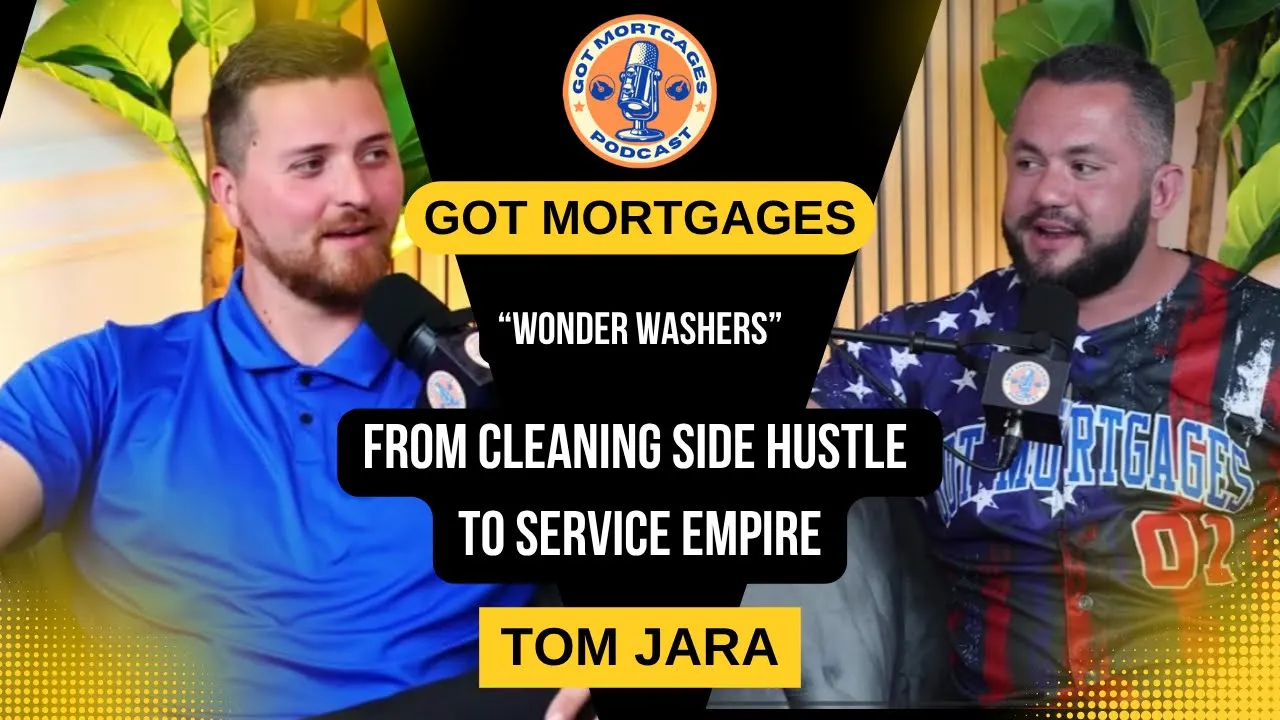
Breaking the “golden handcuffs” of a traditional job took more than a decision to work for himself. For Tom Jara, owner of Wonder Washers, it meant testing handyman services, recognizing customer demand for exterior cleaning, and building relationships that brought people back. On the Got Mortgages Podcast, Tom joins Abdel Khawatmi to explain how automotive work led to a home-service business offering cleaning and seasonal services. His experience offers a practical lesson: independence becomes more sustainable when an owner combines enjoyable work with repeatable standards, trusted relationships, and the ability to adapt.
Conversation originally published April 29, 2026. Recap added October 24, 2026.
Watch the original conversation on YouTube.
Key Takeaways: Growth Came From Several Connected Decisions
Wonder Washers did not begin as a fully formed exterior-cleaning company. Tom started with handyman work and added power washing before customer response helped identify a stronger specialty. Later, an existing customer’s lighting request opened another service opportunity. In both cases, actual work supplied information that a business plan alone could not.
Relationships became central to finding customers, while hiring required Tom to separate his personal working style from the standards a team could consistently meet. The episode also highlights a less comfortable part of independence: the owner remains responsible when equipment becomes unavailable or demand changes. Tom’s community initiative, The Business Playground, extends the relationship-building lesson to entrepreneurs who need practice starting conversations.
Leaving Employment Was About Fit, Not Just Being the Boss
Tom’s automotive career began with genuine interest. He enjoyed vehicles and wanted to build and modify them, but dealership work eventually felt repetitive rather than fulfilling. He also describes frustration with flat-rate compensation: busy and slow periods could affect what he earned. The appeal of a traditional job did not erase those concerns.
His transition was not a straight jump from technician to cleaning-company owner. He tried another line of employment before beginning handyman work on the side. That sequence matters because it shows experimentation rather than a single dramatic leap. His practical skills remained useful even as the setting changed from vehicles to homes.
For someone considering a similar move, the useful question is not simply whether entrepreneurship sounds more exciting. Identify what needs to change: control over scheduling, the kind of work performed, earning potential, or responsibility for decisions. Then test whether a proposed business actually addresses those issues. Leaving a job replaces one set of obligations with another; it does not eliminate obligations.
Customer Response Helped Turn an Add-On Into a Specialty
The early handyman business handled jobs such as storm-door installation and other general household tasks. Power washing entered as a summer add-on, partly inspired by Tom’s memory of cleaning an in-ground pool with his grandfather. He enjoyed the visible transformation, which gave the work an appeal beyond its place on a service list.
The stronger business signal came after he learned the soft-washing process. Tom says customers liked the way he cleaned their homes, and demand grew from there. Enjoyment helped him stay engaged, but customer response helped establish that exterior cleaning could become the main business rather than an occasional extra.
A practical application is to track add-on services separately instead of treating all revenue as interchangeable. Record which jobs generate repeat requests, positive feedback, referrals, and workable scheduling. Tom does not provide a formal profitability comparison, so his story should not be read as proof that cleaning always outperforms handyman work. It illustrates how a small service test can reveal where to focus.
Seasonal Expansion Started With Customers Already in Reach
Wonder Washers expanded into residential and commercial exterior services, including windows, gutters, roof cleaning, and power washing. Tom also describes snow removal, holiday lighting, and permanent lighting. These offerings respond to different customer needs across the year rather than relying entirely on the busiest cleaning season.
The lighting story is especially revealing. A recurring customer asked whether Tom could install lights. Initially reluctant to take on another responsibility, Tom quoted a price he expected might discourage the request. The customer accepted. After completing the installation with two team members, Tom found that both he and the crew enjoyed the work.
That is a discovery story, not a pricing method to copy. A more deliberate approach would evaluate labor, materials, access requirements, training, insurance, and follow-up responsibilities before quoting an unfamiliar service. Existing customers can reduce the difficulty of finding a first project, but they do not remove the need to understand delivery costs. Seasonal diversification works best when the added service fits the team’s capacity as well as the calendar.
Referrals Began With Conversations, Not Aggressive Pitches
Tom describes a business that does relatively little advertising and depends heavily on relationships and referrals. When Abdel asks how much business comes through networking, Tom gives a rough estimate of about 80%. That is his assessment of his own experience, not a measured benchmark for other companies.
His approach is deliberately personal. He asks what someone does, but does not make the entire conversation a sales presentation. He wants to understand the person, their interests, and their values. The goal is familiarity and trust rather than extracting an immediate lead from every introduction.
This distinction is useful for service professionals whose work requires customers to trust them around a home or business. A contact may not need cleaning today, but may later remember the owner when a neighbor asks for help. For an owner applying the lesson, useful follow-up could be a short personal message or a relevant introduction—not an automatic sales pitch. Track where inquiries originate so relationship-building efforts can be understood without turning every conversation into a transaction.
Community Participation Gave the Team a Role in Visibility
Networking was not limited to Tom attending formal meetings alone. He describes sponsoring a local community event, cleaning host properties beforehand, and bringing employees along. He gave team members business cards and encouraged them to make conversation while participating in the event.
That connects the company’s work with the people who perform it. Potential customers can meet more than the owner, and employees can see how local relationships support the business. The service itself also has context: the company helps prepare a place where people will gather, rather than appearing only as a name on promotional material.
For another business, the application is to choose community activities with a genuine connection to its work and people. Give participating employees a simple, accurate explanation of the services offered and a clear way to route inquiries. Keep commitments realistic. Community visibility is most useful when the team can deliver the same professionalism after the event that people experienced during it.
Delegation Required Standards Beyond the Owner’s Preferences
Tom is candid that moving from solo work to managing employees was difficult. He still feels particularly invested in how a home is cleaned, but recognizes that employees have their own lives and do not experience ownership in the same way. His practical response is to establish structure, attention to detail, and a consistent standard across jobs.
The important distinction is between requiring a reliable result and requiring every worker to operate exactly like the owner. Tom mentions employees who had stayed with him across multiple seasons, along with seasonal help and a newer hire. A growing team needs expectations that can be taught to people with different levels of experience.
A practical step is to translate “do a good job” into observable completion criteria: the agreed scope, a final inspection, clear handling of customer questions, and a process for reporting anything unfinished. Those are suggested management tools, not systems Tom claims to use. They address the tension he describes by making quality less dependent on the owner personally completing every task.
Resilience and Giving Back Address Different Growth Challenges
The conversation also covers an unexpected vehicle loss that left Tom needing to work out a replacement. He frames it as a major bump rather than the end of the business. For a mobile service company, the operational lesson is concrete: demand alone cannot keep jobs moving if transportation or equipment is unavailable. A backup plan should identify which work can continue and which customers may need updated scheduling.
Tom’s response to another challenge—learning to connect with people—was collaborative rather than operational. He introduces The Business Playground, a free initiative developed with other local professionals to help newer entrepreneurs practice networking, public speaking, and customer conversations. He wanted an interactive environment rather than another office-style meeting.
Tom recalls speaking to very few people at his first networking event and says confidence developed through practice. The initiative addresses that gap by giving beginners a place to participate. Its lesson is not that every owner must become naturally outgoing. Communication is a business skill that can be rehearsed, supported, and improved.
Final Checklist: Build a More Repeatable Service Business
Review your service mix. Identify the jobs customers request again, the work your team can deliver consistently, and the services that fit quieter periods. Before expanding, price the full delivery requirements rather than assuming an attractive customer request will be profitable.
Review your relationships and standards. Ask new customers how they found you, follow up personally with useful contacts, and choose community involvement you can sustain. Write down what a completed job must include so employees can meet a clear standard without guessing what the owner wants.
Review your weak points and learning needs. Decide how you would communicate and reschedule if a key vehicle or tool became unavailable. If introductions or customer conversations hold you back, seek a practice-oriented group. Tom points listeners to WonderWashersNJ.com for the business and to The Business Playground through its social channels; confirm current services and meeting details directly.
Frequently asked questions
How did Tom Jara start Wonder Washers?
Tom moved from automotive work through another job into a handyman side business. He added power washing during summer, then focused more heavily on exterior cleaning after learning soft washing and receiving strong customer response.
Why did soft washing become important to his business?
Tom identifies learning the soft-washing process as a turning point in how customers responded to his house-cleaning work. The episode discusses its business impact, not technical instructions or which method is appropriate for a particular surface.
What services did Wonder Washers expand into?
Tom describes residential and commercial exterior cleaning, including windows, gutters, roofs, and power washing, plus snow removal, holiday lighting, and permanent lighting. Contact the company directly to confirm current availability and the scope of a particular job.
How did Wonder Washers get its first lighting installation?
A recurring customer asked Tom to quote an installation. Although initially reluctant, he completed the job with two team members and found they enjoyed it. The experience encouraged him to pursue lighting as another service.
How much of Tom’s business came through networking?
Tom roughly estimates about 80% in the conversation and says the company does little advertising. Treat that as his personal estimate, not an audited referral statistic or an expected result for another business.
What does Tom do differently at networking events?
He focuses on getting to know people rather than immediately selling cleaning services. After asking about their work, he explores personal interests and values. His approach aims to build familiarity that can support later recommendations.
What was difficult about hiring a cleaning team?
Tom found it hard to accept that employees would not approach every task exactly as he would. He emphasizes structure, detail, and maintaining a standard across jobs rather than expecting employees to feel the same ownership he does.
What is The Business Playground, and who is it for?
Tom introduces it as a free, interactive community initiative for entrepreneurs seeking help with networking, public speaking, and customer conversations. He directs interested people to its Instagram presence or the organizers. Confirm current meeting arrangements before attending.
To talk with PRMG Got Mortgages, call 973-536-0276, visit GotMortgages.com, contact the team or build your mortgage plan.
Explore more Got Mortgages Insights and Abdel Khawatmi’s profile. Explore more conversations at the Got Mortgages Podcast website.
Author: Abdel Khawatmi with PRMG Got Mortgages | 973-536-0276
This article is general mortgage information only. It is not a commitment to lend, a rate quote, or legal or tax advice. Loan approval, terms and pricing depend on a full application, credit review and property details, and market conditions change. Talk with a licensed loan officer and your own legal or tax professional about your situation. NMLS #1712023 | PRMG NMLS #75243.