
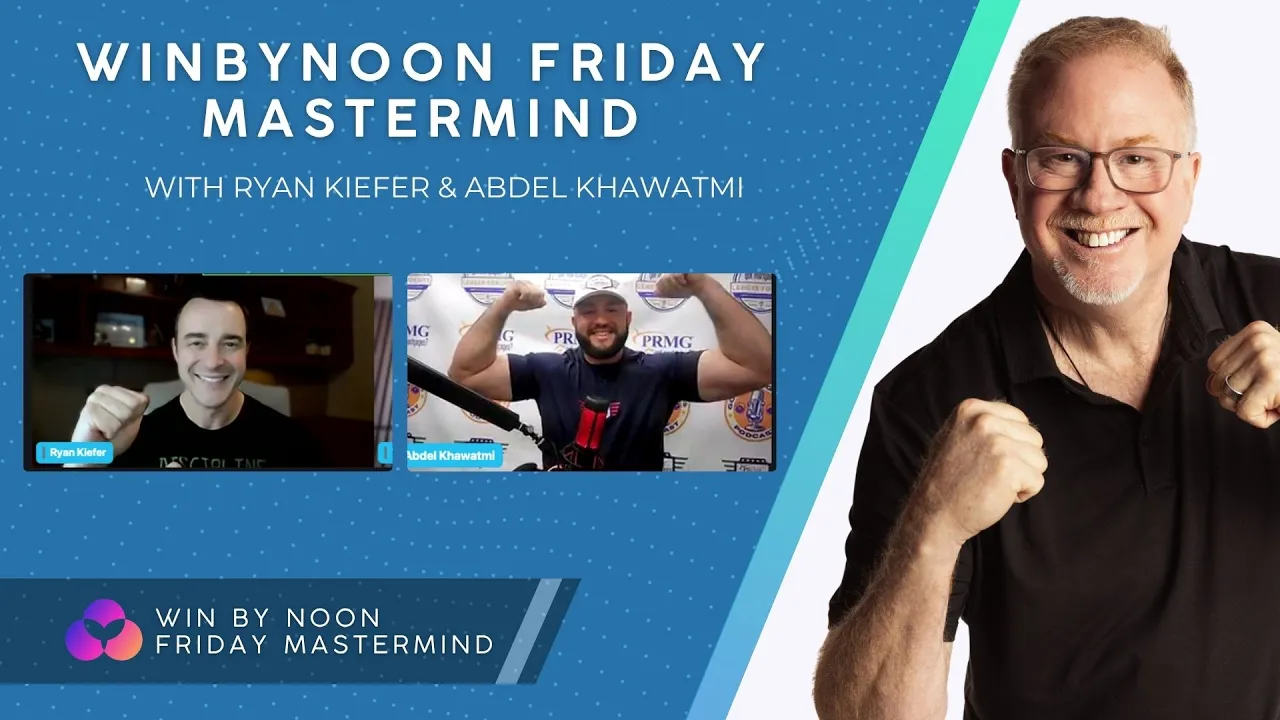
Winning by noon means completing the mortgage business activities most likely to create and advance relationships before reactive work takes over. In the WinByNoon Friday Mastermind, Ryan Kiefer and Abdel Khawatmi describe a daily success plan built around prepared call lists, protected prospecting, meaningful borrower conversations, and consistent follow-through. Their central lesson is not to work faster at everything. It is to identify what matters, make room for it early, and measure whether it actually happened.
Conversation originally published April 3, 2026. Recap added October 24, 2026.
Watch the original conversation on YouTube.
Key Takeaways: Define the Win Before the Morning Starts
The conversation marks the Friday community’s transition from the Mortgage Coach Mastermind to the Win by Noon Friday Mastermind. Hosts Dave and Todd frame that change as a sharper focus on execution: helping mortgage professionals finish important work rather than simply stay busy. Ryan contributes the perspective of a producing branch manager, while Abdel explains how he combines relationship-building, technology, and team support.
Their practical takeaways connect closely. Prepare tomorrow’s outreach before tomorrow arrives. Protect the time as seriously as a client meeting. Track quality conversations and pipeline movement, not just dial counts. Use proactive transaction updates to reduce avoidable interruptions. Give the team enough capability to keep service moving without making the producing leader the answer to every question.
The framework also leaves room for different ambitions. Todd emphasizes that not everyone wants the same production target. A useful daily system should support the business and personal life someone actually wants, rather than impose another producer’s schedule or goals.
Break the Sales Rollercoaster Without Neglecting Active Loans
Ryan describes a familiar origination cycle: a loan officer prospects, becomes busy with files, stops prospecting to get those files closed, and then discovers the next wave of business is missing. The immediate workload feels urgent, but attending only to that workload creates a future gap. Winning by noon is an attempt to keep relationship-building active through both busy and quieter periods.
His definition goes beyond making a few calls and declaring victory. He wants originators to understand their lead flow and conversion, then build their day around enough meaningful conversations to support their goals. That does not make closings certain. It gives the producer a more useful operating standard than judging the day by how full the inbox became.
For a working loan officer, the application is to separate pipeline service from pipeline creation on the calendar. Both deserve attention, but they should not compete without rules. When an active transaction genuinely requires intervention, address it; when a routine question can be handled by the team or a scheduled update, protect the outreach appointment.
Ryan’s closing advice offers a fallback for disrupted days: do something rather than abandon the routine completely. One purposeful call is not a replacement for the full plan, but it preserves the habit of taking action when the schedule becomes difficult.
Build Outreach Around Two Different Growth Levers
Ryan organizes growth around two levers: developing more referral sources and improving conversion among the opportunities already arriving. That distinction makes a weekly schedule easier to evaluate. A calendar filled entirely with new-agent outreach may neglect existing preapprovals. A calendar devoted only to current leads may leave the referral network underdeveloped.
His examples include agent conversations, transaction-status calls, annual mortgage reviews with past clients, and follow-up with actively preapproved buyers about their upcoming property search. Each has a different purpose. The first can open a relationship; the others can clarify needs, sustain engagement, or help an existing opportunity move forward.
Abdel describes a more explicitly segmented week: two days prospecting for real estate agent relationships, two for financial advisors, and one focused on past clients. He also uses sales, service, and support as organizing categories. These are examples of how to distribute attention, not a universal schedule every originator needs to copy.
A practical planning exercise is to label each outreach block by its intended outcome. Is it meant to arrange a partner meeting, understand a buyer’s timeline, resolve uncertainty, or schedule a mortgage review? Naming the outcome helps prevent a completed call list from becoming a substitute for business progress.
Make Conversations Count Before Adding More Automation
Ryan’s advice is to slow the process down in order to improve the outcome. He connects stronger conversations to curiosity and better questions, rather than rushing toward a sales pitch. Counting contacts remains useful, but a conversation should also reveal something that helps the loan officer understand the person and determine an appropriate next step.
Abdel reaches a similar conclusion from a technology-heavy operation. He describes returning to direct calls with listing agents and referral partners even while video messages and automated mortgage analyses continue running. His point is that recipients should hear his actual voice, not experience the relationship entirely through automated communication.
He also draws on the why, how, and what sequence from Start With Why. Applied to mortgage advice, that means understanding why someone wants to buy before explaining how the loan officer can help and which programs might fit. Leading with a program list can answer a question the borrower has not yet asked while leaving the underlying goal unexplored.
A practical step is to review conversations for three elements: a clearly understood goal, an unresolved concern, and an agreed next action. Those markers make quality observable without turning the call into a rigid script. They also give a manager something more useful to coach than whether an originator sounded enthusiastic.
Protect Prospecting With Clear Interruption Rules
The episode’s most concrete boundary is Abdel’s red light outside the office. During prospecting, it signals that the team should not interrupt. Ryan immediately recognizes its value because getting pulled off task remains a challenge even when time has already been blocked.
Ryan compares the outreach block to an appointment with a real estate agent. A loan officer would ordinarily avoid taking unrelated calls in the middle of that meeting; the same respect should apply to an appointment with their own business plan. He suggests closing email or moving away from the inbox and turning off notifications during the block.
Todd describes protecting an 8:30-to-11:30 morning window and, earlier in his process, hiding at restaurants and coffee shops to escape the noise. The transferable idea is not a particular location or exactly three hours. It is creating an environment where the planned activity is easier to finish than to postpone.
For a team, the boundary needs an operating agreement behind it. Decide who handles routine status questions, how urgent issues are escalated, and when deferred questions will be reviewed. Otherwise, a closed door can merely relocate confusion. Protected focus works best when service coverage remains clear.
Send Transaction Updates Before People Have to Ask
Abdel describes sending transaction updates on Monday, Wednesday, and Friday, with milestone communication in between. His reasoning combines service and productivity: participants receive information before they begin chasing it, and the producing team encounters fewer avoidable status requests during focused work.
He acknowledges that a scheduled update may repeat something communicated the previous evening. Repetition can still serve a purpose when it consolidates the current position and gives the relevant parties a shared understanding. The important distinction is between useful confirmation and an empty message that adds no clarity.
A practical version of this cadence would explain what changed, what remains outstanding, who owns the next step, and when another update should be expected. If nothing changed, the message can identify the pending item rather than imply progress that has not occurred. Information should be appropriate to each recipient’s role; a shared communication rhythm does not require distributing sensitive borrower details.
Ryan also includes calls to the buyer, selling agent, and listing agent in his themed workdays. Together, these examples show that service communication is not separate from relationship development. Reliable updates give partners a direct experience of how the loan officer and team work.
Track the Funnel, Then Batch Work That Shares a Workflow
Abdel describes tracking a progression from content to client, client to credit, credit to conversion, conversion to closing, and post-closing. Ryan emphasizes leads and lead conversion. Todd brings those ideas back to a simple discipline: establish an activity standard, record what happened, and review the results.
For a team applying this approach, stage definitions matter. A contact, a substantive conversation, a new lead, and a completed application are not interchangeable. Recording them separately helps distinguish an outreach shortage from a follow-up problem. It also makes a quarterly review more informative than a single production total.
Todd explains that he used a spreadsheet while coaching others to demonstrate that an elaborate system was not the prerequisite. A planner, spreadsheet, or CRM can support the process if it reliably connects intended activity with completed work. Buying another tool does not resolve unclear targets.
Ryan adds a workflow example: rather than preparing a Mortgage Coach total cost analysis immediately after every conversation, he batches that preparation into a later afternoon block. Dave, meanwhile, advocates meaningful borrower presentations early in the day. These approaches need not become competing rules. Schedule advice conversations and preparation around actual client commitments, while grouping similar preparation tasks when deadlines allow.
Use AI to Support the Relationship, Not Replace It
Abdel’s technology discussion includes an important restraint: he had paused new AI work to concentrate on scaling what the team had already implemented and returning to fundamentals. The lesson is not that technology has stopped being useful. It is that adoption should include time to make existing workflows dependable.
He describes using technology to support activity tracking, reminders, content repurposing, and reusable educational materials. A library of presentations for partner-led homebuyer education illustrates the operational opportunity: the team can adapt an existing resource instead of rebuilding every seminar from scratch.
The practical test is whether the tool returns attention to client and partner conversations. If a new automation produces more dashboards to inspect but does not improve preparation, follow-through, or service, it may add work rather than remove it.
For mortgage teams, implementation also needs clear information boundaries. Use approved systems, keep confidential borrower information out of unapproved AI tools, and review educational content before distribution. These are operating safeguards for applying the episode’s technology ideas, not a reason to postpone every useful improvement.
Design the Business So Personal Boundaries Are Possible
The speakers distinguish a personal morning win from a professional morning win. Their routines differ, but the shared idea is intentional preparation rather than beginning the day already reacting. They also discuss the evening before as part of that preparation, making the framework broader than an early alarm.
The more consequential business discussion concerns availability. Abdel describes leaving his laptop at the office and relying on his team. Ryan emphasizes being genuinely present outside work instead of continually checking partner messages. Neither point works well without expectations and coverage.
Abdel connects delegation to giving team members access to the same resources, technology, and conversational capability that support his own work. He specifically favors empathy over robotic scripts. A team cannot become more independent if the leader retains every important explanation and decision.
An actionable application is to identify which requests require the producing loan officer, which can be resolved by a trained teammate, and which can wait until the next business window. Then explain those expectations to partners. Personal boundaries become more credible when clients and agents know how their needs will still be handled.
Final Checklist: Put One Repeatable Morning Into Practice
Before the next workday, choose the morning’s primary outcome and prepare the call list. Include enough context to begin each conversation intelligently: the relationship, last interaction, unresolved question, and intended next step. Do not spend the protected block deciding whom to contact.
Reserve the time and assign service coverage. Turn off avoidable notifications, establish an interruption signal, and tell the team what qualifies for escalation. Place transaction updates and preparation work in deliberate windows rather than allowing them to occupy every opening.
Record completed calls, substantive conversations, next appointments, and relevant pipeline movement. At the end of the week, compare the activity with the intended outcome. Ask what to keep, start, or stop—the review approach Todd describes—before changing the entire system.
Finally, choose a fallback action for difficult days and a firm stopping point for routine work. The aim is a repeatable operating rhythm, not a perfect morning. Win by noon becomes useful when it helps the loan officer serve today’s clients, develop tomorrow’s relationships, and leave enough capacity for life beyond the pipeline.
Frequently asked questions
What does winning by noon mean for a mortgage loan officer?
It means completing a defined set of important business-building activities early, before reactive work consumes the schedule. In this episode, those activities include referral outreach, borrower conversations, follow-up, and deliberate service communication. It does not mean finishing every task or stopping work at noon.
How should a loan officer divide weekly prospecting?
Abdel describes consistent daily outreach to agents and partners, while Ryan emphasizes using the Win by Noon framework to ensure meaningful conversations across referral sources and past clients. Ryan also includes active preapprovals and annual mortgage reviews. Use those examples to balance new referral relationships with better follow-through on existing opportunities, rather than copying the allocation without considering your pipeline.
What should go on a Win by Noon activity tracker?
Track the planned activity, completed calls, meaningful conversations, appointments, leads, and relevant pipeline stage changes. Keep attempts separate from actual conversations. Review the information regularly to see whether the limiting factor is reach, conversation quality, or movement to the next step.
How can a producing branch manager protect prospecting time?
Combine a calendar block with explicit team coverage. Abdel uses a red light to signal focused work; Ryan recommends removing inbox notifications. Assign routine questions to an appropriate teammate and define which urgent issues justify interrupting the block.
Why does Abdel send mortgage transaction updates three times a week?
His Monday, Wednesday, and Friday cadence keeps relevant participants informed before they need to ask. Milestone updates happen between those scheduled messages. A useful update identifies the current status, outstanding items, ownership, and next expected communication, with information limited appropriately for each recipient.
Should mortgage analysis preparation happen immediately after every call?
Not necessarily. Ryan describes batching total cost analysis preparation later in the afternoon to reduce switching between workflows. That approach works when it meets the borrower’s agreed timeline. Time-sensitive advice should not be delayed merely to preserve a batch.
Do loan officers need the Win by Noon planner to use the method?
No. Todd describes using a spreadsheet to demonstrate that clear targets and consistent execution do not depend on a sophisticated system. A planner, CRM, or spreadsheet can work if it helps you prepare, record activity, and review results.
How can AI help without making mortgage outreach impersonal?
Use approved tools for preparation, reminders, content adaptation, and other support work, while retaining direct human conversations about goals and concerns. Abdel specifically describes returning to personal phone calls alongside automated communication. Review outputs and protect confidential borrower information.
To talk with PRMG Got Mortgages, call 973-536-0276, visit GotMortgages.com, contact the team or build your mortgage plan.
Explore more Got Mortgages Insights and Abdel Khawatmi’s profile. Explore more conversations at the Got Mortgages Podcast website.
Author: Abdel Khawatmi with PRMG Got Mortgages | 973-536-0276
This article is general mortgage information only. It is not a commitment to lend, a rate quote, or legal or tax advice. Loan approval, terms and pricing depend on a full application, credit review and property details, and market conditions change. Talk with a licensed loan officer and your own legal or tax professional about your situation. NMLS #1712023 | PRMG NMLS #75243.