
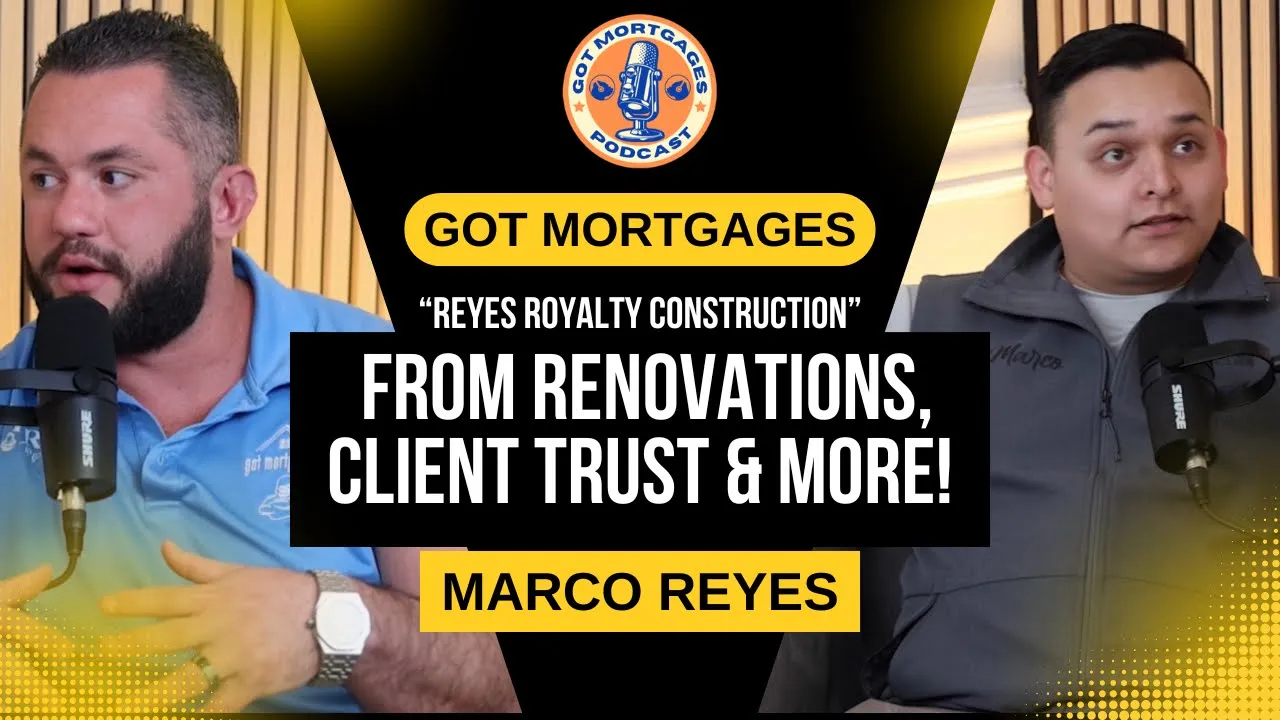
Growing a construction company requires more than adding jobs or workers. In this Got Mortgages Podcast episode, Marco Reyes, owner and operator of Reyes Royalty Construction, explains how he shares administrative responsibilities while keeping projects and client relationships moving. Speaking with Abdel Khawatmi, Marco connects business growth to practical decisions: giving homeowners a place to compare materials, matching crews to project size, coordinating investor renovations and letting an assistant handle work that otherwise waits for the owner. His central lesson is that timely, well-guided execution can be more valuable than insisting every task be completed exactly his way.
Conversation originally published February 4, 2026. Recap added October 24, 2026.
Watch the original conversation on YouTube.
Key Takeaways: Growth Depends on More Than Construction Capacity
Marco specializes in kitchens and bathrooms, while also taking on broader home repairs, remodels and larger projects. That range creates different demands on the same business. A homeowner choosing a vanity needs help making decisions; an investor renovating for resale needs coordinated scheduling; a client facing an inspection issue needs a clear explanation of what happens next.
Three lessons connect those demands. First, help clients make informed choices before work advances. Second, organize labor and project handoffs around the job rather than assuming every renovation follows the same pattern. Third, assign recurring communication and administrative work to someone who can give it consistent attention.
Delegation is the thread running through the conversation, but Marco does not describe stepping away from responsibility. He describes staying involved through direction, feedback and communication without personally performing every task. For a growing contractor, that distinction matters: sharing execution should make service more dependable, not make the owner harder to reach.
A Bayville Showroom Helps Turn Ideas Into Specific Decisions
Marco describes operating a kitchen showroom in Bayville, New Jersey, with a business partner. The space displays kitchen cabinets, bathroom vanities and related design possibilities. Its purpose is not simply to present products. He wants clients to feel comfortable, explore ideas and experience the visual impact of a finished arrangement.
His example is crown molding with lighting: a client may notice a feature in the showroom that they had not previously considered. Seeing and touching materials also allows people to compare them from different perspectives. Abdel connects that experience to choosing pavers for a personal project, where surface appearance and feel made the differences easier to understand.
For homeowners, the practical application is to arrive with room measurements, photos and priorities, then distinguish essential choices from attractive extras. A showroom can clarify preferences, but it can also introduce additional scope. Before approving a newly discovered feature, ask how it changes the proposed work, material order and budget. The goal is to turn inspiration into a decision the contractor can actually price and schedule.
Plan Exterior Work Before the Weather Opens the Schedule
In the conversation, Marco describes a winter workload concentrated on interiors, including kitchens and bar areas. Exterior demand is already emerging, however. He has booked railing and deck work that needs to be rescheduled because of snow and ice. His advice is to begin requesting quotes and arranging spring projects early.
This separates two activities homeowners sometimes treat as one: planning a project and physically starting it. Weather may prevent installation without preventing a discussion about scope, materials or scheduling. Waiting until conditions are ideal to make the first call can leave those decisions unresolved when the homeowner hopes construction will begin.
A useful early conversation should establish what can be decided now and what remains weather-dependent. Ask whether a proposed start is tentative, how rescheduling is communicated and which selections must be completed beforehand. Marco does not offer a universal booking window; the relevant lesson is to get ahead of the planning rather than interpret a preferred spring date as a confirmed construction commitment.
Match Crew Capacity to the Job, Not Just the Calendar
At the time of the discussion, Marco describes N/A. An addition, for example, may require a different crew arrangement from a smaller remodeling job. His approach is to maintain a core team while adjusting capacity to the work.
For a contractor, that flexibility creates a coordination responsibility. More people are useful only when the necessary work is ready for them and someone is directing the sequence. Expanding a crew does not by itself resolve unanswered client selections, missing materials or an unclear next step.
Homeowners can use this part of the conversation to ask better hiring questions. Instead of focusing only on total employee count, ask who will manage the project, how staffing changes across its stages and who communicates schedule updates. Those answers help explain how a contractor intends to deliver a particular job rather than simply how large the company appears.
Fix-and-Flip Renovations Need Coordinated Handoffs
Marco calls investor renovation work a different business model from other remodeling assignments. The investor wants a quick turnaround because the time required to renovate and sell affects project costs and potential profit. Marco emphasizes structure and scheduling, comparing the desired flow to a conveyor belt with each stage moving into the next.
He also acknowledges that disruptions happen. The objective is not to pretend a renovation can be made entirely predictable, but to address problems quickly enough to keep the project moving. This is a more useful operating principle than promising speed without explaining how the work will be coordinated.
For an investor, an actionable extension is to review dependencies with the contractor before work begins. Identify which decisions must be finalized, which materials are needed for the next stage and which inspections may affect subsequent work. If a delay occurs, ask what it prevents and what can still proceed. That discussion is more informative than repeatedly asking whether the original completion date still stands.
The episode does not provide a financing model or a calculation of daily delay costs. Investors should build their own project budget around their actual obligations and allow for uncertainty, rather than treating a fast renovation as an assured financial outcome.
Inspection Problems Require Clear Questions and Respectful Follow-Up
The conversation also covers permits and certificates of occupancy, often shortened to COs. Marco describes situations in which someone contacts him after struggling to understand why an inspection has failed or what needs correction. His response is to speak with inspectors, ask questions and work toward a clearer explanation.
Marco emphasizes courtesy and relationships in those exchanges. The useful lesson is about communication, not special access: a respectful conversation can help establish what an inspector is asking for. It does not replace required work or change the standards a project must meet.
For a homeowner or investor, the practical next step is to request a specific explanation of outstanding items and confirm who will address each one. Where possible, keep the correction list and follow-up instructions in writing. Requirements vary by location and project, so ask the relevant municipal office about the applicable process rather than assuming another property's experience will be identical.
Delegate Follow-Up Without Giving Up Standards
Marco says his assistant now handles scheduling, calls and follow-up, along with newsletters. Blogs are a planned next step, not an established result described in the interview. These are responsibilities he previously handled himself, and shifting them gives him more room to focus on other parts of the company.
Abdel points out a familiar problem: marketing and other recurring work can be postponed when the owner is occupied with immediate demands. They also discuss the customer-service value of dedicated support. A completed renovation is not the only thing a client experiences; scheduling clarity and returned calls are part of the relationship too.
The obstacle is often the owner's preferred way of doing things. Marco says that work completed at what he considers 70 percent of his personal ideal can be better than waiting an extra one to three weeks for him to do it himself. In context, this is about delegated administrative and communication work, not accepting incomplete construction, unsafe conditions or missed requirements.
His approach includes continued guidance, adjustments and room for his assistant's ideas. A practical way to apply it is to define what must be accurate, provide examples of the desired tone and explain which situations need escalation. Review the work without rewriting every harmless difference. Otherwise, delegation can become another queue waiting for the owner.
Final Checklist: Put the Next Decision in Someone's Hands
For homeowners: define the project before requesting a schedule. Bring photos and priorities to material discussions, separate necessary work from optional upgrades and confirm selections before they affect ordering. For exterior projects, ask what can be planned early and what depends on weather.
For investors: review the renovation sequence, not just the finish date. Confirm responsibility for material decisions, inspection follow-up and schedule updates. When something slips, identify the affected work and agree on the next action.
For construction business owners: choose one recurring responsibility to transfer with clear instructions. Scheduling follow-up or newsletter preparation may be a more manageable starting point than handing over an entire function. Set boundaries for independent decisions, establish a review routine and allow a capable employee to contribute a different approach. Marco's example points toward growth through clearer ownership of tasks, not simply more tasks on the owner's list.
Frequently asked questions
What remodeling work does Reyes Royalty Construction discuss in this episode?
Marco describes kitchens and bathrooms as specialties, alongside broader home repairs and remodeling. The conversation also covers bar areas, decks, railings, additions and fix-and-flip renovations. Ask the company directly about availability and the scope of a proposed project.
Why visit a showroom before choosing kitchen cabinets or bathroom vanities?
A showroom lets you see and touch materials and compare design details in context. Marco highlights how displays can introduce ideas such as illuminated crown molding. Bring photos and measurements, and ask how any added feature changes the scope and price.
When should homeowners start planning spring deck or railing work?
Marco recommends requesting quotes and beginning booking discussions before spring arrives. His example involves exterior jobs postponed by snow and ice. Start planning early, but confirm which dates remain weather-dependent rather than assuming an early booking eliminates weather delays.
What should I ask about a contractor's crew for a larger renovation?
Ask who manages the work, how staffing will change across project stages and who provides updates. Marco describes using a core team with additional help for larger jobs such as additions. The important question is how the proposed team will serve your project, not employee count alone.
Why does scheduling matter so much on a fix-and-flip renovation?
Marco explains that the time needed to renovate and sell affects an investor's costs and potential profit. Review the order of work, required decisions and inspection dependencies with the contractor. If a problem arises, identify what it blocks and what can proceed while it is resolved.
What can I do if a certificate-of-occupancy inspection fails without a clear explanation?
Contact the relevant municipal office or inspector and request a specific explanation of the outstanding items. Marco describes helping clients clarify those issues through direct, respectful conversations. Confirm the correction requirements, who will complete them and how follow-up inspection is arranged.
Which tasks did Marco delegate to his assistant?
He identifies scheduling, calls, follow-up and newsletter work. He also says blogs are planned. These are recurring responsibilities he previously handled himself, making them concrete examples of work an owner can transfer with clear instructions and ongoing feedback.
Does Marco's 70-percent example mean lowering construction quality?
No. He uses it while discussing an assistant's work and his own perfectionism about how tasks are completed. The point is that timely administrative execution can be better than waiting weeks for the owner's preferred version. It is not a benchmark for construction quality, safety or code compliance.
To talk with PRMG Got Mortgages, call 973-536-0276, visit GotMortgages.com, contact the team or build your mortgage plan.
Explore more Got Mortgages Insights and Abdel Khawatmi’s profile. Explore more conversations at the Got Mortgages Podcast website.
Author: Abdel Khawatmi with PRMG Got Mortgages | 973-536-0276
This article is general mortgage information only. It is not a commitment to lend, a rate quote, or legal or tax advice. Loan approval, terms and pricing depend on a full application, credit review and property details, and market conditions change. Talk with a licensed loan officer and your own legal or tax professional about your situation. NMLS #1712023 | PRMG NMLS #75243.