
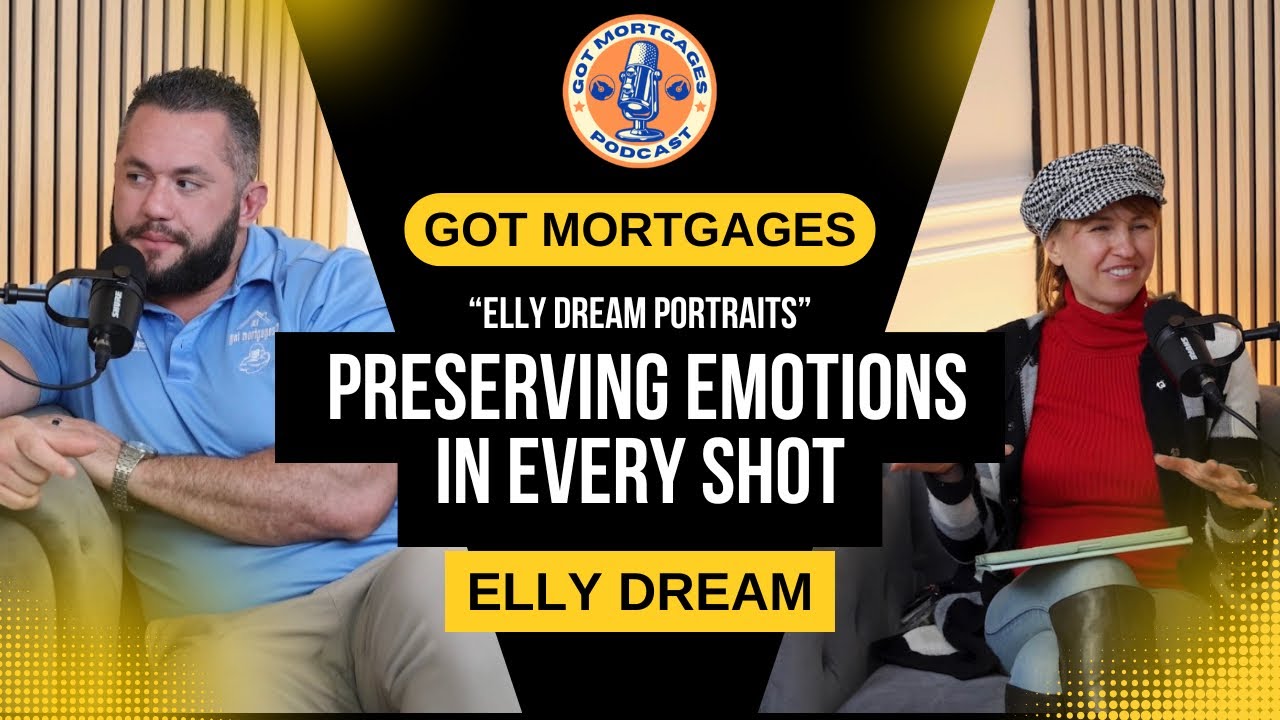
A memorable portrait photography business sells more than an image: it helps people recognize and preserve what matters to them. On the Got Mortgages Podcast, Abdel Khawatmi and Ellie of Ellie Dream Portraits explore how that purpose shapes everything from the finished artwork to networking, technology and customer experience. Ellie’s approach begins with authentic photographic expressions and adds painted artistry, creating portraits intended to belong in a family’s home. The broader business lesson is equally practical: use tools and systems to deliver consistently, but make the human relationship the reason people remember you.
Conversation originally published February 8, 2026. Recap added October 24, 2026.
Watch the original conversation on YouTube.
Key Takeaways: Make the Meaning Clear Before Marketing the Product
Ellie describes her work as preserving a family’s identity, not simply producing photographs. Ellie describes her work as preserving a family’s identity, not simply producing photographs. She considers what makes a family unique and how the finished portrait will fit the interior of its home. Her approach focuses on creating meaningful artwork designed for a particular family and place, rather than an interchangeable image.
Three connected ideas run through the conversation. First, branding is the feeling people retain after an interaction, not merely a logo. Second, AI and automation are useful when they strengthen a professional’s ability to serve, not when they substitute a script for attention. Third, networking becomes more meaningful when it starts with a genuine contribution rather than an immediate demand for business.
The episode also connects emotional experience with operational discipline. Ellie looks at Disney as a lesson in creating a memorable feeling; Abdel notices the systems supporting that feeling at Disney. For a relationship-led business, the discussion suggests the importance of building both a clear emotional connection and a dependable process that delivers on it.
Build a Portrait Business Around an Outcome Clients Can Recognize
Ellie traces her interest in photography to childhood, when she began using a camera at around ten. Developing images with her stepmother gave her an early appreciation for both capturing a moment and shaping the finished result. Her account emphasizes creative decisions: an image changes depending on how it is developed, enlarged and presented.
That combination continues in her contemporary mixed-media portraits. She photographs people in her studio or on location, then finishes the portraits with painting. Starting photographically allows her to retain authentic expressions without asking subjects to sit for the extended periods typically required for traditional portrait painting. The finished work aims for the presence of a painting while remaining connected to a real moment.
Her positioning is also unusually concrete. A portrait should reflect the family’s values and work within the home’s interior design. Those are two different requirements: emotional accuracy and physical suitability. A successful image must feel like the people in it, but the final piece must also make sense where they intend to display it.
Ellie’s process focuses on the final result for the client. For a portrait client, this means having an important relationship represented on the wall. While technical expertise is required, the primary goal is the emotional impact of the finished work in the home.
Physical Portraits Make Family Identity Part of Everyday Life
Ellie describes family portraits as a form of visual branding for the home. Just as branding serves business professionals, she believes a portrait preserves a family's story and values on their walls for generations. This perspective highlights the value of physical artwork compared to digital files.
A physical portrait is present and visible in the home. Ellie emphasizes that the physical display is a key part of the experience, as digital files can become corrupted or inaccessible over time.
She also raises concerns about digital files becoming inaccessible or corrupted. The useful distinction is not that digital preservation is impossible, but that possession of a file is different from a preservation plan. While the episode highlights the permanence of physical portraits, it also notes the challenges of digital preservation, including the risk of files becoming corrupted over time.
Ellie’s approach encourages families to think about what they want to preserve and where the artwork will be displayed. This moves the focus from simply taking a photograph to creating a lasting piece that reflects the family's identity within their home.
Use AI to Expand Capability Without Flattening the Relationship
Ellie welcomes new technology rather than treating it as an automatic threat to artistry. She compares the arrival of AI with the transition from film to digital photography: both expand access to capabilities that were once available to fewer people. Easier creation, however, makes judgment more important. If many people can generate polished material, the distinction becomes what they choose to create and whether it feels true to the person or business represented.
Abdel makes a related point about service. Technology should amplify the professional, not eliminate face-to-face conversation. He describes testing AI interactions that could acknowledge a sensitive situation—such as the loss of a spouse—but then immediately move to a transactional request like asking for a social security number. The discussion highlights that technology should amplify, not replace, empathetic human conversation.
In both portraiture and mortgage services, the speakers agree that technology should be used to amplify professional capabilities rather than replace face-to-face interaction. The artist or professional remains responsible for the emotional and authentic elements of the relationship.
The conversation emphasizes that a technologically efficient response can still be inappropriate if it lacks empathy during sensitive moments. Maintaining trust and authenticity remains a human responsibility.
Turn Branding Into a Discipline, Not Just a Visual Style
Abdel offers a framework for branding using the acronym BRAND: Belief, Relevance, Analytical (or Authenticity), Notice, and Discipline. The discussion emphasizes that branding is a lasting impression and a feeling, rather than just a logo or marketing materials.
His preference for analytical thinking adds an important counterweight to creative enthusiasm. A professional may enjoy making certain content or attending particular activities without knowing whether those efforts produce meaningful business conversations. Abdel encourages examining the numbers behind the work rather than assuming the most enjoyable or visible activity is the most effective.
Ellie adds that a brand evolves. She describes having older marketing materials that no longer represent where her business is going, without suggesting those materials were necessarily wrong when created. That is a useful distinction: updating a brand can reflect a clearer offer or a changed audience rather than a failure of the earlier identity.
Ellie notes that a brand evolves over time. She describes moving away from older materials that no longer represent her business's current direction. This transformation reflects changes in both the professional and the technology available to the industry.
Let Networking Begin With Service and Develop Through Follow-Through
Ellie’s networking story begins somewhere different from a conventional sales strategy. Originally from Ukraine, Ellie was organizing fundraisers and connecting families with resources after the war began. A photographer from Idaho encouraged her to visit BNI to share information about her work. This experience helped her realize the value of networking for her professional growth.
She describes having previously preferred being behind her camera or computer. Networking became more natural when she recognized a connection to what she already valued: understanding people and supporting what matters to them. Her account challenges the assumption that effective networking must begin with a highly outgoing personality or an expertly rehearsed pitch.
Both speakers emphasize the difference between helping and immediately calculating what someone owes in return. Abdel observes that some close friendships began through networking and that expecting a quick return can overlook how relationships develop. This does not mean a business should ignore results. It means the first interaction may be the wrong point at which to judge the full value of a relationship.
Abdel also distinguishes social gatherings from focused one-to-one business conversations. Group events can help people get to know one another; a separate meeting provides space to understand services, needs and possible introductions. Abdel emphasizes that social gatherings allow people to get to know one another, while separate one-to-one meetings provide space to understand business needs. Both speakers agree that genuine service and helping others are the foundations of effective networking.
Study Customer Experience as Both a Feeling and a System
Travel becomes a business topic when Ellie explains why she studies Disney. In her view, its appeal is not reducible to the newest ride or most advanced attraction. The distinctive achievement is the feeling surrounding the visit. Familiar experiences can remain powerful because they belong to a larger emotional story.
Abdel notices the operational side of that story: arrival, transportation, shops, scheduled entertainment and structured dining. His observations suggest that the feeling does not happen independently of organization. The experience has a sequence, and the sequence helps visitors understand what comes next.
For a small business, the lesson is not to imitate a theme park’s scale or encourage unnecessary purchases. It is to look at the whole customer journey instead of treating each touchpoint as unrelated. A portrait session may be excellent, yet the overall experience can still feel disjointed if preparation is unclear or clients do not know what happens afterward.
The speakers use Disney as a model for customer experience, noting the balance between structured systems and emotional magic. A business can learn to look at the entire customer journey, ensuring that every touchpoint contributes to a consistent and memorable feeling for the client.
Make Charitable Purpose Operationally Real
Near the end of the conversation, Ellie describes wanting 2026 to be a year of giving. She expresses an ambition to contribute her services toward organizations’ fundraising and invites collaboration. The goal is presented as an intention, not as an already completed result.
That ambition connects back to her route into networking. Service was not an unrelated addition to her business story; it helped create the relationships through which she discovered a wider professional community. Her portrait work and charitable interests share an emphasis on people, family meaning and experiences that may otherwise be out of reach.
Ellie also acknowledges that the business must grow in order to support a substantial contribution. The practical implication is that generosity needs capacity planning. Ellie notes that her goal to donate $250,000 in services requires her business to grow in capacity. By leading with service, she aims to collaborate with organizations that help people, such as breast cancer research or support for people with disabilities, to preserve their legacies.
Summary of Lessons: The conversation between Abdel and Ellie highlights that a successful business combines authentic human connection with disciplined systems. Whether through portrait photography or mortgage services, the goal is to create a lasting, meaningful impression. By using technology to amplify rather than replace personal interaction, and by leading with a spirit of service in networking, professionals can build brands that families recognize and trust for generations.
Clarify the outcome. Write one sentence explaining what clients gain beyond the immediate deliverable. For a portrait business, name the connection between the people, the artwork and the home rather than relying only on descriptions of image quality.
Audit the brand. Compare current materials with the work you want to be known for now. Keep recognizable elements that still serve the message, retire outdated ones and track whether inquiries reflect the intended offer.
Review automation at sensitive moments. Identify where technology saves useful time and where a person should take over. Test what happens when a customer is confused or not ready to proceed, not only when every answer follows the expected path.
Strengthen one relationship through a useful action. Follow up on a networking promise, schedule a focused conversation or connect an organization with a relevant resource. Avoid turning every introduction into an immediate sales request.
Map the experience and capacity. Make the next step clear at each stage of service, including delivery and follow-up. If charitable work is part of the plan, reserve the time and resources to fulfill it. The lasting impression should match the promise that attracted the client in the first place.
Frequently asked questions
What makes Ellie’s mixed-media portraits different from a standard photograph?
Ellie explains that her portraits begin photographically and are then finished with painting. The photographic foundation preserves authentic expressions, while the painted treatment creates the artistic character she wants in the finished piece. She also considers how the portrait will fit the family’s home.
What does it mean to call a family portrait visual branding?
Ellie uses the phrase to describe artwork that represents a family’s identity and values. Rather than promoting a business, the portrait makes belonging and connection visible within the home. Its meaning comes from who is represented and what the family wants to preserve.
Should families choose printed portraits instead of keeping digital files?
The episode emphasizes the emotional presence of physical artwork, but the two formats can serve different purposes. A displayed portrait is part of daily life; digital copies provide another way to retain and share images. A practical approach is to enjoy physical artwork while maintaining organized, checked backups of important files.
How does Ellie view AI’s effect on portrait photography?
She welcomes the expanded creative access technology provides and compares it with photography’s move from film to digital. Her concern is maintaining taste, authenticity and trust when polished content becomes easier to produce. The artist’s judgment still determines whether the result meaningfully represents the subject.
What is Abdel’s branding framework in this episode?
He connects branding with belief, relevance, analytical thinking, being noticed and discipline. He also discusses authenticity as another possible emphasis for the A. His analytical point is to examine which activities generate meaningful business results rather than relying on impressions alone.
How did Ellie begin using BNI for networking?
A photographer encouraged her to visit BNI while she was organizing fundraising and resource support connected to Ukraine. She initially attended to share that work, then recognized the potential for professional relationships and business connections. Service was the entry point, rather than a direct sales campaign.
What can a portrait or mortgage business learn from the Disney discussion?
Ellie emphasizes the memorable feeling of the experience, while Abdel emphasizes its structured sequence. A practical application is to map each customer stage and define both what the client needs to know and how the interaction should feel. Clear preparation and next steps help support a consistent experience.
How can a small business plan donated services without overcommitting?
Define the recipient’s needs, the specific services offered, the time commitment and responsibility for delivery before making the promise. Ellie acknowledges that a substantial giving ambition requires business capacity. Treating donated work as a real operational commitment helps make the contribution dependable.
To talk with PRMG Got Mortgages, call 973-536-0276, visit GotMortgages.com, contact the team or build your mortgage plan.
Explore more Got Mortgages Insights and Abdel Khawatmi’s profile. Explore more conversations at the Got Mortgages Podcast website.
Author: Abdel Khawatmi with PRMG Got Mortgages | 973-536-0276
This article is general mortgage information only. It is not a commitment to lend, a rate quote, or legal or tax advice. Loan approval, terms and pricing depend on a full application, credit review and property details, and market conditions change. Talk with a licensed loan officer and your own legal or tax professional about your situation. NMLS #1712023 | PRMG NMLS #75243.