
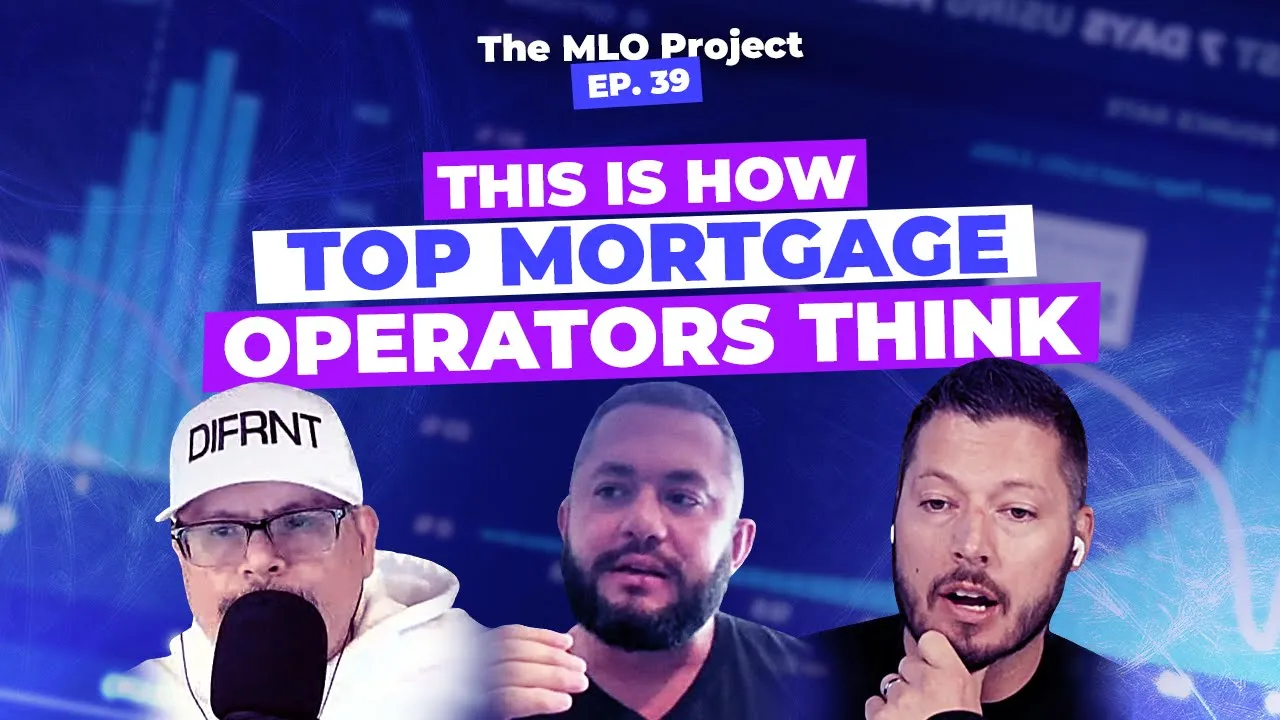
A scalable mortgage business needs more than leads: it needs a reliable way to turn attention into conversations, conversations into well-prepared files, and completed loans into lasting relationships. On The MLO Project Episode 39, Abdel Khawatmi joins Frazier and Michael McAllister to explain how he connects source attribution, hands-on communication, AI-assisted education and team accountability. His central operating principle is straightforward: establish the service infrastructure before accelerating demand, then measure whether each activity actually moves the business forward.
Conversation originally published October 28, 2025. Recap added October 24, 2026.
Watch the original conversation on YouTube.
Key Takeaways: Build the Operation Behind the Brand
Abdel’s visible Got Mortgages brand is only the entrance to the business he describes. Behind it are lead-source records, engagement checklists, loan officer support, recurring partner outreach and borrower explanations. The episode’s useful distinction is between being recognizable and being operationally ready when someone responds.
Three lessons connect the discussion. First, measure where business starts rather than assuming the most visible channel produces the most loans. Second, use technology to improve communication and execution, not to remove the originator from the relationship. Third, turn mistakes into specific process changes instead of relying on everyone to remember what went wrong.
For a mortgage team, the practical starting point is not another platform subscription. It is identifying the handoff, explanation or follow-up that currently depends on someone remembering to do it. That is where a documented workflow can create more dependable service.
Track the Borrower Journey, Not Just the Final Closing
Asked where his business comes from, Abdel describes a review of approximately three years of source information. In his reported breakdown, real estate agents initiated about 41% of business, past clients accounted for 16.7%, and social media directly generated 13.9%. Those are his historical business figures, not industry benchmarks or targets for another branch.
The more important detail is how far his tracking extends. He names contact established, no contact established, preapproval, accepted offers, shopping after offer acceptance and post-closing referrals. That approach makes a source more than a label attached to a closed loan. It becomes a way to examine what happens between initial interest and an actual outcome.
Frazier reinforces the point with a familiar management problem: a favorite referral partner may not be the partner producing the most business. Relationship familiarity and production are different things. Reviewing actual activity helps a manager notice productive partners who receive little attention and expensive relationships that contribute less than expected.
A practical application is to review source and stage together. A channel generating many inquiries but few completed conversations needs a different response from one generating prepared buyers who struggle to win offers. Without those intermediate stages, a team can mistake a follow-up problem for a lead-quality problem.
Separate Social Media Discovery From Social Media Influence
Michael asks an important follow-up: if social directly accounts for a relatively small share of business, why invest so much effort in it? Abdel explains that social also supports relationships formed elsewhere. A person meets him through networking, receives an introduction or notices the brand, then checks his online presence before deciding whether to engage.
That is a different function from generating a cold inquiry. The original source might be an agent, while videos and posts help the borrower become comfortable making contact. Giving social all the credit would distort the source record; giving it none would overlook its role in building familiarity.
Abdel describes a partner outreach sequence that begins with social connections, followed by a call, text and email. He also favors content that includes personality and ordinary life alongside mortgage education. His recurring market updates and experimentation with carousels illustrate a willingness to adjust format rather than treat one content style as permanent.
For teams applying this idea, preserve the initial source and separately ask what helped the person decide to respond. A simple field for supporting influences can be more useful than forcing every touchpoint into one attribution category. Content planning should then support actual borrower and partner questions, not merely pursue views.
Diversify Referral Relationships Without Abandoning Agents
Abdel wants real estate agents to represent a smaller proportion of his overall business, not because he dismisses those relationships, but because he wants less dependence on a single channel. His other sources include past clients, personal connections, networking and financial advisors. The strategic question is whether one change in partner behavior could materially weaken the pipeline.
Financial advisor relationships receive particular attention. Abdel describes approaching wealth management firm owners, understanding their clients and offering operational training to advisors. The subjects include time blocking, systems and sales organization. That creates a professional reason to collaborate beyond repeatedly asking for mortgage introductions.
Community participation is another distinct element. Through the Elevated Alliance and other networking relationships, he describes in-person meetings and charitable efforts such as food banks and coat drives. These activities place him among business owners in settings where the conversation is broader than mortgage pricing.
The practical step is to build a referral portfolio around genuine usefulness. An advisor may need clear financing explanations for a shared client; a local business owner may value consistent community involvement. Neither relationship should be treated as a purchased referral. Any co-marketing, sponsorship or referral arrangement needs an appropriate compliance review rather than an assumption that relationship-building alone makes it permissible.
Keep the Originator Accountable After the Handoff
Early in the conversation, Abdel identifies a service failure that can accompany growth: the originator introduces an assistant or processor and then effectively disappears. The borrower receives document requests without understanding their purpose, while the agent has to ask for an update. Adding staff has increased capacity but weakened continuity.
His response is to remain involved while making communication visible across the team. He describes shared text and email conversations and an expectation that parties should know what is happening. The objective is not for the originator to perform every processing task. It is to prevent delegation from becoming abandonment.
A useful implementation is to make every handoff answer three questions: who owns the next step, what the borrower needs to provide and when the next update will arrive. Internal ownership should be equally clear. A processor’s request for documentation should not leave the borrower guessing whether something has gone wrong.
Communication visibility also requires boundaries. Agents need relevant transaction updates, not unrestricted access to borrower financial information. Teams can preserve Abdel’s emphasis on continuity while using approved channels, appropriate permissions and audience-specific summaries.
Use AI to Explain Mortgage Choices, Not Make the Decision
The episode’s most concrete technology workflow begins with a real borrower conversation. Abdel asks about home preferences and goals, then uses Mortgage Coach or MBS Highway to illustrate financing choices. He describes selecting the presentation approach according to how the consumer processes information, rather than insisting that everyone absorb the same chart.
He then uses ChatGPT to help articulate the explanation and Gamma to create a presentation. The sequence matters: establish the borrower’s question, develop the comparison, simplify the language and present it in a usable format. The tools support an explanation that the originator still owns.
This also addresses a problem Abdel recognizes in his earlier approach: sending a pricing screenshot and asking the borrower to choose. Internal pricing displays can be confusing to consumers who do not understand points, pricing adjustments or how upfront costs relate to the payment. A technically complete image is not necessarily a useful explanation.
For a team adopting this workflow, the safeguard is a human review of every assumption, number and conclusion. AI-generated language should match the actual loan options and approved disclosures. Sensitive documents should stay within authorized systems. The goal is a clearer discussion of tradeoffs, not an AI recommendation presented as an underwriting or pricing decision.
Make Meeting Notes Useful for Follow-Through
Abdel uses AI note-taking tools, including Fireflies, and mentions Zoom AI as another option. He describes using summaries to keep participants informed after a financing conversation, including agents who may not have attended. This gives the meeting a practical output rather than leaving its value entirely in the memories of the participants.
The strongest application is an action record: the options discussed, questions still open, documents needed and the person responsible for each next step. A summary can also help an assistant follow up without making the borrower repeat the entire conversation.
The recording itself should not be treated as unquestionable evidence or a substitute for required disclosures. Obtain appropriate consent, follow company recording and retention policies, and review generated notes before sharing them. A mistaken summary of a rate-lock discussion could create the very confusion the tool was meant to prevent.
Create Repeatable Support Around Different Origination Models
When asked about his next chapter, Abdel focuses on branches and systems that an originator can join without rebuilding the operation from scratch. He organizes the work around sales, service and support. His example is a preapproval engagement checklist handled by administrative staff, virtual assistants or in-house loan officer assistants as an extension of the originator.
That infrastructure still has to fit the business model. Abdel distinguishes consumer-direct origination from partner-driven relationships and notes that their economics and client expectations can differ. The management question is not which model sounds better, but what support, acquisition spending and communication each originator needs to operate effectively.
He also describes monitoring weekly credit-report activity and rewarding engagement with opportunities to collaborate on partner business. Credit activity is an earlier signal than closings, but it is not a complete definition of productivity. An applied scorecard should pair authorized credit activity with progression, file quality and eventual outcomes so the metric does not become an end in itself.
His discussion of upfront soft-credit reviews further illustrates the importance of explaining why a step matters. Teams should distinguish credit review from approval: a soft inquiry does not make a preapproval indefinite, remove documentation requirements or promise improved pricing. Any charge, authorization and credit-back practice must follow the lender’s applicable policies and requirements.
Turn Process Failures Into Named Checkpoints
Abdel offers a specific example of learning from mistakes: buyer-agent compensation obligations were missed during contract review as practices were changing. His response was to add checks at initial disclosures, submission and before requesting clear-to-close. The useful lesson is the control design, not an assumption that experienced professionals will always catch a new requirement.
Each checkpoint represents another opportunity to reconcile the contract with the financing plan before the transaction reaches its final stage. For a team implementing a similar control, the checklist should identify the responsible role, the document being reviewed and what happens if the figures or obligations do not match.
His recurring listing-report workflow demonstrates the same preference for operational specificity. Rather than simply telling originators to support agents, he describes scheduled reviews and report preparation tied to new listings, followed by outreach about participation. The repeatable activity creates an opportunity; an originator still has to respond and build the relationship.
These examples show why systems are more than written intentions. A useful process specifies a trigger, owner and next action. When a mistake occurs, the improvement should change one of those elements instead of adding a vague instruction to be more careful.
Final Checklist: Put One Operational Improvement Into Practice
Audit attribution first. Review a defined period of closed and active business, record the original source, and separate that source from later social or marketing influences. Look for missing information before drawing conclusions about where to spend more.
Map one borrower handoff. Identify who introduces the next team member, explains the documentation request and sends the next update. Confirm that the borrower knows who remains accountable when responsibilities change.
Pilot one reviewed explanation workflow. Choose a recurring financing question, prepare the underlying comparison, use approved tools to simplify it and check the finished explanation before delivery. Add another platform only after the first workflow is dependable.
Close the loop on one recurring error. Assign an owner, place the check at the relevant transaction stage and review whether the change is actually being followed. Abdel’s operator mindset is ultimately about making execution observable: knowing what happened, understanding why and improving the next repetition.
Frequently asked questions
Which mortgage KPIs does Abdel recommend tracking beyond closings?
He describes tracking lead source, whether contact was established, preapproval status, accepted offers, shopping after offer acceptance and post-closing business. He also monitors credit-report activity. Together, these measures show where opportunities progress or stall rather than reporting only the final funded result.
How should a loan officer measure social media when referrals start elsewhere?
Keep the original referral source and record social media separately as a supporting influence. For example, an agent may introduce the borrower while videos help the borrower decide to call. Asking both how someone found you and what helped them choose you captures that distinction.
What does Abdel’s social-first partner outreach sequence look like?
He describes connecting on social platforms first, then calling, texting and emailing. The purpose is to establish familiarity before or alongside direct outreach. Teams applying the sequence should respect contact preferences, permissions and their company’s outreach policies.
How does the episode suggest developing financial advisor relationships?
Abdel describes engaging firm owners, understanding the needs of their clients and providing useful training on systems, time blocking and sales organization. The practical focus is becoming a reliable financing resource rather than simply requesting introductions.
How are Mortgage Coach, MBS Highway, ChatGPT and Gamma used together?
Abdel describes using Mortgage Coach or MBS Highway for financing comparisons, ChatGPT to help explain the choices and Gamma to build a presentation. A loan professional should verify the inputs and output, protect borrower information and ensure the presentation agrees with actual loan terms.
What should an AI-generated mortgage meeting summary include?
A useful summary identifies the choices discussed, unresolved questions, agreed next steps and responsible team members. Review it for accuracy before distribution, obtain appropriate recording consent and limit each recipient’s version to information they are authorized to receive.
Does using a soft credit inquiry mean a preapproval never expires?
No. The inquiry type does not determine the validity of a preapproval. Lender requirements, document freshness and changes in income, assets, credit or the proposed transaction can require an updated review. A soft inquiry is not a commitment to lend.
Where did Abdel add checks for buyer-agent compensation obligations?
He describes adding checkpoints at initial disclosures, submission and before requesting clear-to-close after his team missed contract obligations. Teams can apply that lesson by assigning ownership for reviewing compensation terms and reconciling any borrower obligation with the transaction’s financing and closing figures.
To talk with PRMG Got Mortgages, call 973-536-0276, visit GotMortgages.com, contact the team or build your mortgage plan.
Explore more Got Mortgages Insights and Abdel Khawatmi’s profile. Explore more conversations at the Got Mortgages Podcast website.
Author: Abdel Khawatmi with PRMG Got Mortgages | 973-536-0276
This article is general mortgage information only. It is not a commitment to lend, a rate quote, or legal or tax advice. Loan approval, terms and pricing depend on a full application, credit review and property details, and market conditions change. Talk with a licensed loan officer and your own legal or tax professional about your situation. NMLS #1712023 | PRMG NMLS #75243.