
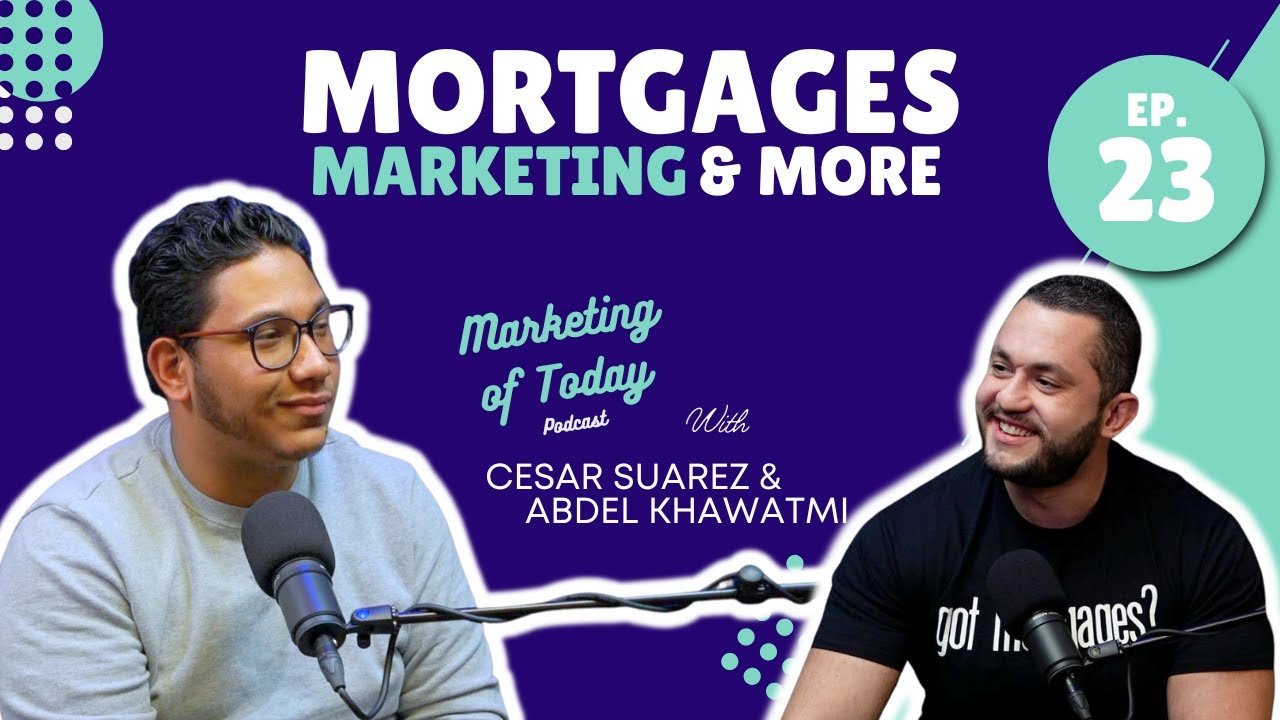
Effective mortgage marketing needs more than visibility: it needs a service experience that supports the message. On the Marketing of Today Podcast, host Cesar Suarez talks with Got Mortgages founder Abdel Khawatmi about connecting educational videos, referral relationships and brand awareness to practical borrower support. Their central point is that attracting an inquiry and helping someone through a purchase are different jobs. Clear explanations, organized follow-up and a team that answers when the loan officer cannot are what connect them.
Conversation originally published May 9, 2023. Recap added October 24, 2026.
Watch the original conversation on YouTube.
Key Takeaways: Make the Marketing Promise Operational
Abdel presents education as a meaningful way to differentiate a mortgage business when many lenders offer overlapping loan categories. His emphasis is not that every institution has identical products or pricing. It is that explaining a borrower’s choices can be more useful than claiming to have something nobody else offers.
The conversation also identifies an easily neglected part of the customer journey: the period between a first inquiry and preapproval. A person who is not ready to buy immediately still needs direction. Follow-up during that period is part of the service, not simply a reminder to submit an application.
Three practical lessons run throughout the episode. Teach in language the borrower understands, give each stage of the process a clear communication plan, and build coverage behind the individual professional. Marketing can create recognition, but these operating habits determine what happens when recognition becomes a phone call.
Educational Content Should Help People Ask Better Questions
Cesar first connected with Abdel through Instagram content and later saw him teach at an event. That progression matters: online exposure created familiarity, while an in-person educational experience showed how the information worked with actual homebuyer questions. The content and the event were different settings for the same service approach.
Abdel describes building a substantial YouTube library alongside shorter Instagram explanations for first-time buyers, investment-property buyers and people considering second homes. He also connects his teaching style to operating a mortgage licensing school. Repeatedly explaining the fundamentals to newcomers, he says, helps keep those fundamentals from disappearing beneath professional shorthand.
Cesar’s observation about the homebuyer event supplies a useful test of educational quality. Attendees were not merely asking what an acronym meant. They began describing their own situations and asking which next step made sense. Useful education moves an audience from confusion toward questions that reveal priorities, constraints and decisions.
A practical step is to organize content around those decisions rather than around a list of products. A video about cash needed at closing should help someone distinguish that amount from the down payment. A discussion of mortgage qualification should help a viewer identify what to prepare. Each piece can answer one question while making the next conversation more productive.
Start With the Borrower’s Priority, Then Explain the Four Cs
Abdel stresses that borrowers do not all arrive with the same concern. One may be focused on the monthly payment; another may be worried about cash to close. Starting with that difference prevents a loan discussion from becoming a product presentation disconnected from the household’s needs.
His teaching framework uses four Cs: capacity, collateral, credit and capital. In practical terms, capacity concerns the ability to repay, collateral concerns the property supporting the loan, credit concerns borrowing history, and capital concerns available funds and their sources. The framework gives unfamiliar requirements an understandable structure without pretending to replace a full review.
He pairs that structure with basic discovery questions: who is buying, why they want to buy, when they hope to move, where they are looking and how they expect to finance the purchase. These questions help connect qualification to the actual purchase plan. A borrower can have a preferred payment and still need to resolve timing, savings or documentation issues.
The discussion includes examples of reconsidering a large down payment or comparing FHA and conventional financing. The useful lesson is to examine alternatives, not to prescribe a particular percentage or loan type. Keeping more savings may matter to one household; reducing the loan balance may matter to another. A sound comparison should work on its present terms rather than depend on a hoped-for future refinance.
Use Automation to Reduce Friction, Not Remove Explanation
Cesar asks whether mortgage technology and automated systems can replace the personal side of lending. Abdel’s answer centers on the continued need for someone who can explain the choices. The distinction is between automating an administrative task and helping a borrower understand a consequential financial decision.
Abdel describes introducing document requests in stages and using account-linking technology to reduce repetitive collection work. Those examples illustrate a less overwhelming intake experience. They do not mean that every borrower needs the same initial documents or that a lender will never request updated information.
For a borrower, a well-designed process should explain what is needed now, why it matters and what may be needed later. For a lending team, the operational benefit is fewer ambiguous requests and a clearer handoff between the initial conversation and file preparation. Technology is most useful when it makes those responsibilities easier to follow.
Human access still matters when an automated result leaves someone uncertain. A portal can show an outstanding task, but the borrower may need help understanding which document satisfies it. A practical evaluation question is therefore not simply whether a lender has an online application. It is who will help when the application, document request or loan comparison raises a question.
Follow Up Across Three Distinct Mortgage Stages
Abdel divides the customer journey into three periods: first contact to preapproval, preapproval through the home search, and finding a home through closing. Treating these as separate stages reveals why a single generic follow-up message is inadequate. The borrower’s uncertainty changes as the purchase moves forward.
He considers the first period especially vulnerable to neglect because it may not produce immediate income. Someone could need time to gather records, understand affordability or prepare financially. The practical response is to agree on a next step and a suitable time to reconnect, rather than leaving the person with an open-ended instruction to call when ready.
During the home search, communication should remain connected to the financing plan. A practical step is to clarify whether changes in the intended property, available funds or financial circumstances require another review. A preapproval should begin an ongoing conversation, not end contact until an offer is accepted.
Once a property is under contract, Abdel describes email updates and a group text involving the borrower, agent and processor. The underlying value is shared awareness of milestones and outstanding tasks. A sensible implementation keeps sensitive financial records in approved secure channels while using coordinated messages to identify what needs attention, who owns it and what happens next.
Preparation and Team Coverage Make Responsiveness Credible
When Cesar asks about completing transactions rather than merely receiving inquiries, Abdel points to advance document collection, underwriting preparation and the people working behind the scenes. He discusses both automated underwriting and earlier underwriter involvement. The operational theme is to investigate the file before urgency exposes unanswered questions.
For borrowers, those processes warrant a concrete question: what has actually been reviewed? An initial conversation, an automated underwriting result and a file examined by an underwriter are not interchangeable descriptions. Ask which documents support the assessment, what conditions remain and what property-related review is still required.
The episode’s most tangible coverage example appears near the end. Abdel explains that when he cannot answer, calls route to his office so a team member can respond. That is a different model from relying entirely on one person’s availability. It gives the caller an acknowledgment and gives the business a way to record the request.
Cesar recognizes that responsiveness depends on staffing, not just enthusiasm. Abdel credits assistants, processors, underwriters and closers rather than presenting the loan officer as the sole source of execution. For another business applying this lesson, the first step is to define backup ownership: who receives an unanswered call, who documents it and who makes sure the promised follow-up occurs.
Build Referral Relationships Around Useful Work
Abdel’s account of moving into lending begins with dissatisfaction over referrals that did not receive adequate communication. While managing a law firm, he says, he saw clients struggle to get responses from mortgage contacts. The broader business lesson is that a referral puts the referring professional’s reputation into someone else’s hands.
His preferred partnership model includes business planning, goal discussions and short educational sessions for real estate teams. Rather than defining a relationship only by the number of introductions exchanged, he asks what a professional contributes to the other person’s ability to serve clients. Training and reliable transaction updates are concrete examples.
He also describes communicating with listing agents to explain the financing position behind an offer. That can help address questions, but it should not be confused with making an offer certain to succeed. The practical step is to communicate accurately about completed review, remaining conditions and realistic next steps, with appropriate borrower authorization.
Borrowers can apply the same standard when evaluating a family or professional referral. Familiarity is a reason to begin a conversation, not a substitute for checking fit. Ask whether the lender can explain suitable options, provide a clear cost comparison and identify the team supporting the transaction. A strong relationship should make those questions easier to answer.
Connect Brand Awareness to Service and Measurable Learning
The marketing discussion moves beyond social media into billboards and branded delivery trucks. Abdel explains that the trucks are associated with businesses making local deliveries, giving the branding exposure beyond highways. Cesar connects these appearances with podcast interviews, online content and personal recommendations as different ways someone may encounter a business.
This is a useful distinction between familiarity and attribution. Repeated exposure may make a name recognizable, but recognition does not reveal which channel produced a qualified inquiry. When Cesar asks about tracking the truck campaign, the conversation does not establish a measured return. The brand-awareness idea is therefore more developed than the performance evidence.
A practical extension is to ask new contacts where they first heard the name and what prompted them to reach out now. Those may be different answers. Someone might remember a vehicle, later watch an educational video and finally call after an agent’s recommendation. Recording that sequence is more informative than assuming the final contact explains the entire decision.
Abdel also describes continuing to help clients beyond a purchase, including guidance for people who are not yet ready to qualify. That approach connects marketing to a longer relationship. For a team, it suggests measuring more than inquiry volume: whether questions were answered, agreed follow-ups occurred and borrowers understood their next step also matters.
Final Checklist: Turn the Episode Into a Better Borrower Experience
Before choosing a lender, write down your main constraint: monthly payment, available cash, purchase timing or readiness to qualify. Ask the professional to explain how that priority affects the options. Request a comparison you can understand without relying on unexplained abbreviations or a prediction that refinancing will solve a future problem.
Before relying on a preapproval, ask what documents have been reviewed, whether an underwriter has examined the file and which conditions remain. Confirm how to get updated guidance while shopping. Once under contract, identify your primary contact, backup contact and the secure method for submitting financial documents.
For a mortgage team, map each of the three stages Abdel describes. Assign an owner, define the next action and agree on how the borrower will receive updates. Test what happens when the main loan officer is unavailable. A communication promise is only useful if the handoff works.
For marketing and referral planning, choose educational topics from real borrower questions, connect events and videos to a clear next step, and record how inquiries find you. Review whether the resulting service matches the public message. The episode’s most practical conclusion is that visibility should introduce a dependable process, not compensate for the absence of one.
Frequently asked questions
How can mortgage education distinguish a lender when programs overlap?
Education helps borrowers understand which choices address their actual needs. Abdel emphasizes explaining payment, cash requirements and qualification rather than relying only on product claims. Ask a lender to describe the trade-offs between suitable options in plain language.
What are the four Cs of mortgage qualification discussed in the episode?
They are capacity, collateral, credit and capital. Capacity concerns repayment ability, collateral concerns the property, credit concerns borrowing history, and capital concerns funds and their sources. They organize the discussion but do not replace a lender’s complete eligibility review.
What should happen between the first mortgage inquiry and preapproval?
The borrower and lender should identify the purchase goal, determine what information is needed and agree on a next step. If the borrower needs preparation time, establish when to reconnect and what to complete beforehand. Abdel identifies this early period as a common follow-up gap.
Does an automated underwriting result mean a mortgage is fully approved?
No. An automated underwriting result is not the same as completed document review or final approval. Ask what information supports the result, which conditions remain and whether an underwriter has reviewed the file. Property-related requirements may also remain outstanding.
How should borrowers use a group text during a mortgage transaction?
A group text can coordinate milestones, scheduling and outstanding tasks among authorized participants. It should not replace secure document submission. Send financial records and sensitive identifying information through the lender’s approved secure channels.
Does buying in a rural area mean no down payment and no property taxes?
Not automatically. The episode mentions USDA Section 502 financing, which can allow eligible borrowers to purchase eligible properties without a down payment. Eligibility still matters, other costs may apply, and rural location does not itself eliminate property taxes. Check the specific property’s tax obligations separately.
How can a mortgage business evaluate branded trucks or billboards?
Separate recognition from demonstrated results. Ask inquiries where they first encountered the brand and what prompted contact, then record those answers consistently. Appropriate campaign-specific tracking can add detail. The episode discusses truck branding but does not establish its return on investment.
What should a borrower ask about a lender’s availability?
Ask who answers when the loan officer is unavailable, how requests are recorded and who handles urgent transaction questions. Abdel describes routing unanswered calls to his office. The transferable lesson is to evaluate the coverage system rather than assume one person will always be reachable.
To talk with PRMG Got Mortgages, call 973-536-0276, visit GotMortgages.com, contact the team or build your mortgage plan.
Explore more Got Mortgages Insights and Abdel Khawatmi’s profile. Explore more conversations at the Got Mortgages Podcast website.
Author: Abdel Khawatmi with PRMG Got Mortgages | 973-536-0276
This article is general mortgage information only. It is not a commitment to lend, a rate quote, or legal or tax advice. Loan approval, terms and pricing depend on a full application, credit review and property details, and market conditions change. Talk with a licensed loan officer and your own legal or tax professional about your situation. NMLS #1712023 | PRMG NMLS #75243.