
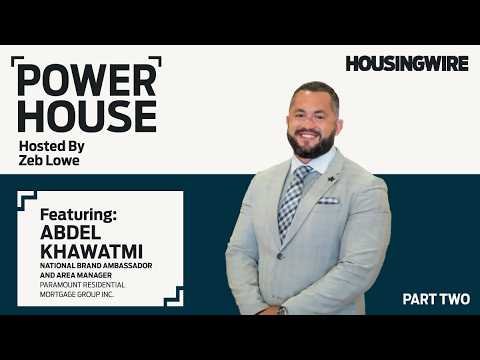
Scaling a mortgage business does not have to mean distancing the loan officer from the people who trust them. In Part 2 of his HousingWire Power House conversation with Zeb Lowe, Abdel Khawatmi describes a different goal: use systems, staff and AI-assisted production to protect time for client and referral-partner relationships. His model separates relationship ownership from task ownership. The originator remains accessible and accountable, while specialists handle document collection, content production and operational execution. The practical lesson is not to automate everything. It is to decide which work needs your judgment, which work needs your voice and which work needs a reliable process.
Conversation originally published August 27, 2026. Recap added October 24, 2026.
Watch the original conversation on YouTube.
Key Takeaways: Build Capacity Around the Relationship
Khawatmi’s central distinction is between delegating a task and delegating trust. He wants clients and agents to hear directly from him, but he does not want to become the bottleneck for every document request, presentation or technology decision. A useful operating model makes both commitments possible rather than forcing a choice between personal service and capacity.
Several connected practices support that model: give operational specialists clear ownership, turn a single market update into multiple educational formats, research referral partners before contacting them, and develop producers inside a shared system. His PROOF framework connects these activities to prospecting, resilience, operational efficiency, omnipresence and fundings. Visibility matters, but it is only one part of a functioning mortgage business.
Keep Relationship Accountability Personal, Not Every Task
Asked what he refuses to delegate, Khawatmi identifies client and referral-partner communication. He ties that decision to a complaint he hears from agents: they cannot reach the loan officer or do not know what is happening. In his model, the agent’s relationship with the originator should not disappear once the transaction moves into processing.
That does not mean the originator answers every operational question. When a borrower asks which documents are missing, Khawatmi directs that conversation to the team member responsible for collecting them. The distinction is important. Relationship ownership means remaining accountable for the experience; task ownership means letting the person responsible for completing a requirement explain it clearly and follow through.
His team also uses live video help when a document submission goes wrong instead of allowing repeated email exchanges to drag on. A practical application is to define escalation rules: who explains missing paperwork, who handles a concern about the transaction, and when the originator personally reconnects. A warm handoff should tell the borrower why the specialist is involved, not simply send them elsewhere.
Delegate Technology Evaluation Before It Becomes a Distraction
Khawatmi describes encountering Notion and resisting the temptation to explore every possibility himself. Instead, he sends the idea to his growth strategy team to evaluate its advantages, disadvantages and fit with existing systems. The question is not whether a tool is interesting. It is whether adding it makes the current operation better.
That is a useful discipline for producing managers, whose curiosity can easily compete with prospecting and leadership. Every new application brings more than a subscription decision: someone must configure it, maintain it, train users and determine where information belongs. A tool that duplicates an existing function may add work even when its individual features look attractive.
A practical evaluation brief would identify the problem, the current workflow, the proposed improvement and the person who would own implementation. Khawatmi’s example supports delegating the research, not abandoning leadership judgment. The team brings back a recommendation; the leader decides whether the change deserves space in the business.
Translate Market Information Into Local Buyer Education
Lowe raises the gap between national housing coverage and the expectations buyers bring to a local transaction. Khawatmi says his emphasis on data developed over time and changed his conversations and relationships. The useful distinction is between repeating a headline and explaining what information means for someone considering a particular market.
More detail is not always more helpful. Khawatmi also acknowledges that some consumers need foundational guidance before a detailed market discussion. He describes Got Mortgages University as a resource his team built with explanations of closing costs, appraisals, title and mortgage programs. The educational approach changes according to the consumer’s starting point.
For an originator, the application is to connect each update to a decision. Does a buyer need help understanding transaction costs, comparing payment scenarios or interpreting local conditions? Start there. A national trend can supply context, but it should not stand in for local evidence or a household’s budget. Effective education gives the borrower a clearer next question, not merely more charts.
Build a Content Workflow Around One Useful Explanation
Khawatmi describes a repeatable market-content process using information from MBS Highway, a short market-update recording and team-produced supporting assets. His staff uses NotebookLM to develop a slide deck, an infographic and a video overview. His main contribution is a brief explanation on camera rather than responsibility for every production step.
When he cannot record, the team can use an AI-generated summary in place of his segment. That keeps the production workflow moving, but the larger lesson is the separation of roles: the originator contributes perspective, while the team packages and distributes the material. Lowe contrasts this with older marketing templates whose personalization often amounted to a headshot and a few fields.
The practical step is to make repurposing serve comprehension. A video can explain the issue conversationally, a graphic can isolate a comparison, and a written answer can address a specific question. Before distribution, someone should review accuracy, context and required approvals, including permissions for third-party material. Khawatmi also discusses SEO and AI-oriented discovery, but discoverability is most useful when the underlying explanation is genuinely helpful.
Use PROOF to Evaluate More Than Marketing Activity
Khawatmi spells out PROOF as prospecting, resilience, operational efficiency, omnipresence and fundings. The framework broadens the definition of a strong originator. A producer needs a way to create opportunities, respond constructively to setbacks, execute transactions, remain discoverable and bring business through to closing.
Each component asks a different question. Prospecting asks where the next conversation will come from. Resilience asks whether difficulty produces withdrawal or a proactive response. Operational efficiency asks whether the process supports reliable execution. Omnipresence asks whether people can find the originator across relevant channels. Fundings bring the discussion back to completed business rather than attention alone.
A practical coaching session can use these categories without inventing a complicated scoring system. Ask for evidence in each area: a prospecting plan, a response to a stalled opportunity, a recurring processing problem, an example of useful content and a review of completed transactions. The value is diagnostic. More posting will not fix an operational bottleneck, and smoother operations will not create a prospecting habit by themselves.
Make Agent Outreach Relevant Before Asking for Business
Despite his investment in systems and content, Khawatmi still describes direct agent prospecting and attending open houses. He also distinguishes between an agent participating in a purchase transaction and an agent originating the relationship. That distinction matters when evaluating lead sources: working with an agent does not necessarily mean the agent brought the borrower.
Before contacting a listing agent, he researches their local activity and whether they may lead a team. His example connects a specific listing conversation with a professional introduction and an invitation to ask financing questions. The outreach has an immediate reason to exist; it is not simply a request to become the agent’s preferred lender.
For other originators, the transferable practice is preparation. Understand the agent’s market, recognize relevant activity and explain your role without delivering a generic sales pitch. Share borrower information only within appropriate authorization and privacy boundaries. Direct lender contact can make communication clearer, but it does not determine whether a seller accepts an offer. A useful introduction should remain courteous whether or not the transaction moves forward.
Support Partners While Reducing Friction for Borrowers
Khawatmi identifies three groups he commits to supporting: loan officers, real estate agents and consumers, in that order. He explains the sequence through infrastructure. Producers need a working system, agents need dependable collaboration, and borrowers need the resulting service to be accessible and useful. It is an operating philosophy, not a reason to subordinate the borrower’s interests.
On the consumer side, he describes a digital buyer pass that makes a preapproval accessible through a phone wallet. He also discusses personalized videos and organized transaction materials. The common purpose is reducing friction: helping people find the document, understand the next step or connect the information to their own purchase.
He uses local report cards and cost-of-waiting analyses as discussion tools as well. The responsible application is scenario comparison, not a prediction that postponing a purchase must cost a fixed amount. Explain the assumptions behind prices, payments and timing, then consider affordability and readiness. Convenience and compelling presentations should make the borrower’s decision clearer, not create pressure to buy before they are prepared.
Create Community Without Letting Producers Lose Their Focus
The conversation presents relationship building as something broader than transaction updates. Khawatmi describes recurring masterminds, shared office activity and a relationship-event concept called Glow, Glam, and Got Mortgages. These examples show his preference for regular, personal contact rather than relying entirely on digital outreach to maintain connections.
The event format itself is not a universal template. Mortgage businesses considering sponsored gatherings, hospitality or services for referral partners should obtain compliance review, particularly around RESPA, referral-linked benefits and applicable company policies. The broader lesson is to create appropriate opportunities for people to learn and build familiarity without treating referrals as something purchased through benefits.
Inside the team, Khawatmi values producers helping one another but also sets boundaries. An originator who is particularly good at social media should not automatically become everyone’s unpaid marketing department. His growth discussion similarly emphasizes shared systems, coaching and regular sales huddles. Developing others requires support that can be repeated without pulling every capable producer away from originating.
Final Checklist: Put the Relationship Model Into Practice
Start with communication ownership. Name the person responsible for borrower document questions, agent updates, urgent concerns and transaction explanations. Make handoffs explicit, and identify the moments when the originator should personally reconnect.
Choose one recurring content workflow. Define the market question, the source material, the originator’s contribution, the supporting formats and the review owner. Build a process the team can maintain before adding more channels or applications.
Review the business through PROOF. Identify whether the immediate constraint is prospecting, resilience, operations, visibility or completed business. Choose one specific improvement rather than treating every weakness as a marketing problem.
Finally, protect producer time. Assign technology research, training support and event responsibilities deliberately. Check that the resulting capacity creates more useful client and partner conversations. That is the test at the center of this episode: systems should make personal accountability easier to sustain, not easier to avoid.
Frequently asked questions
What mortgage work does Abdel Khawatmi refuse to delegate?
He identifies client and referral-partner communication as responsibilities he wants to retain. He still delegates operational conversations, such as explaining missing documents, to the specialist responsible for that task. The distinction is personal relationship accountability versus personally performing every step.
How can a processor handle document requests without weakening the client relationship?
Use a clear handoff that explains the processor’s role and why that person is best positioned to help. Khawatmi describes directing document questions to his operational specialist and using live video assistance when a submission needs correction. The originator remains available for broader transaction concerns.
What does the PROOF framework mean for loan officers?
PROOF stands for prospecting, resilience, operational efficiency, omnipresence and fundings. It gives managers and producers five distinct areas to review, from generating conversations and handling setbacks to executing transactions and closing business.
How does Khawatmi turn a market update into multiple content pieces?
He describes combining market information from MBS Highway with a short recording, then having his team use NotebookLM to produce supporting assets such as slides, an infographic and a video overview. His contribution centers on explanation; the team owns much of the production.
When should a loan officer use basic mortgage education instead of detailed market data?
Use foundational education when the borrower first needs to understand costs, appraisals, title or financing options. Khawatmi acknowledges that extensive data can overwhelm some consumers and describes directing them to educational resources. Market detail becomes more useful once the borrower understands the decision it informs.
What should an originator research before calling a listing agent?
Khawatmi looks at the agent’s activity in the area and whether they lead a team. A practical introduction connects that research to the current transaction, explains the lender’s role and offers a direct contact for appropriate financing questions without promising offer acceptance.
How should a cost-of-waiting mortgage analysis be explained?
Present it as a scenario based on stated assumptions, not a guaranteed future cost. Explain what the comparison assumes about prices, financing costs and timing, and consider alternatives. The borrower’s affordability and readiness remain essential even when a scenario favors purchasing sooner.
How can a producing branch manager develop other loan officers without doing all their work?
Build shared workflows, assign support responsibilities and use recurring training sessions. Khawatmi describes sales huddles and a common operating system, while cautioning that producers who help colleagues still need time to originate. A useful boundary separates occasional peer help from an ongoing support role.
To talk with PRMG Got Mortgages, call 973-536-0276, visit GotMortgages.com, contact the team or build your mortgage plan.
Explore more Got Mortgages Insights and Abdel Khawatmi’s profile. Explore more conversations at the Got Mortgages Podcast website.
Author: Abdel Khawatmi with PRMG Got Mortgages | 973-536-0276
This article is general mortgage information only. It is not a commitment to lend, a rate quote, or legal or tax advice. Loan approval, terms and pricing depend on a full application, credit review and property details, and market conditions change. Talk with a licensed loan officer and your own legal or tax professional about your situation. NMLS #1712023 | PRMG NMLS #75243.