
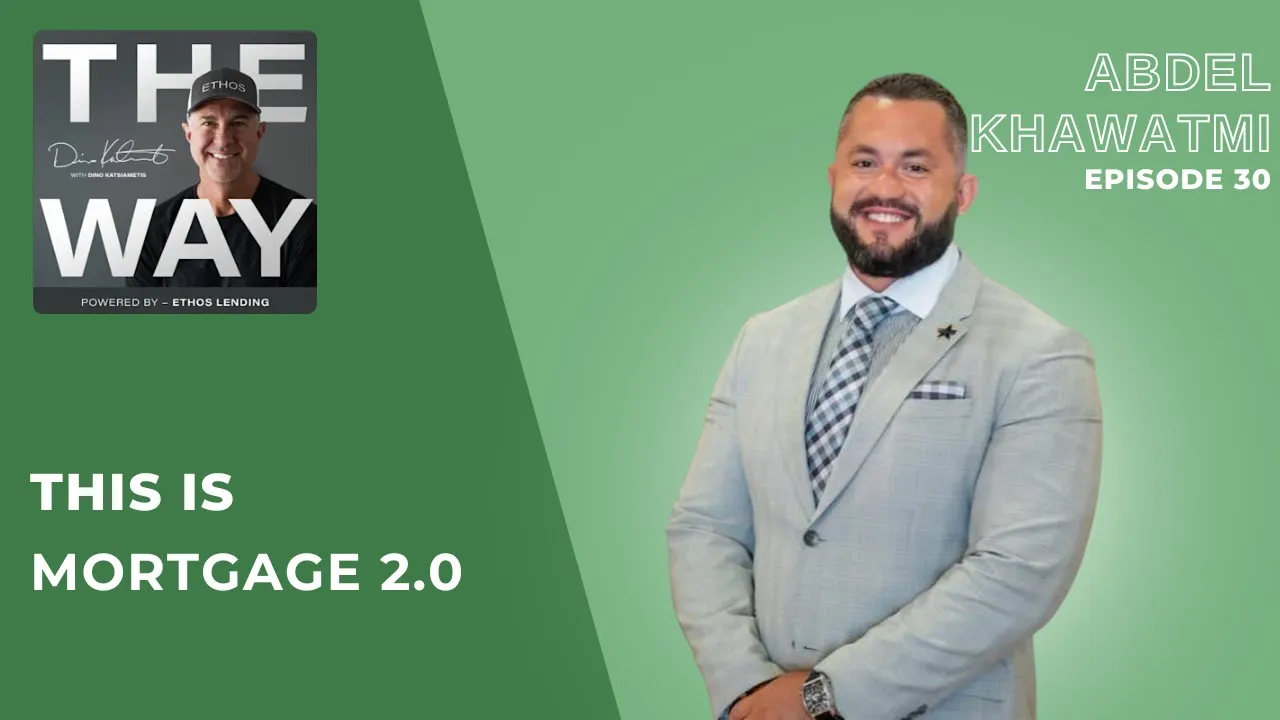
AI helps a mortgage business when it makes promised work happen: the follow-up gets sent, the meeting becomes usable notes, and the client understands the next step. That is the central lesson of Abdel Khawatmi’s guest appearance on The Way with Dino Katsiametis. Rather than describing a fully autonomous lending operation, Abdel explains a working combination of custom GPTs, virtual assistants, connected software and personal conversations. His guiding principle is the three Fs: follow up, follow through and follow back.
Conversation originally published November 18, 2025. Recap added October 24, 2026.
Watch the original conversation on YouTube.
Key Takeaways: Execution Comes Before Automation
Abdel’s strongest examples start with a defined responsibility, not a new tool. A teammate follows up after an event. A meeting recording becomes a recruiting record. A milestone triggers an explanatory video. Technology supports an action that already has a purpose and an owner.
The conversation also draws important boundaries. Calendar reporting depends on accurate calendar entries. Uploaded mortgage guidelines require maintenance. Meeting summaries still involve manual handling in parts of Abdel’s operation. AI voice and expanded text outreach are areas he is exploring, not a finished system he demonstrates.
For a mortgage team, the immediate takeaway is to choose one recurring communication failure and fix it end to end. Adding another application without deciding who reviews its output, where the record belongs and what happens next can simply relocate the problem.
Faith, Service and the Reason to Build a Better Business
Abdel frames his priorities as faith, family, fitness and finance, with freedom as the broader goal. His discussion of service includes employees, clients, referral partners and community involvement. That context matters: efficiency is not presented only as a way to generate more transactions, but as a way to support a purposeful business.
His entry into mortgages also began with a service problem. While working in a personal-injury law firm, he referred people who wanted to purchase homes and repeatedly heard complaints about unanswered calls. Protecting those relationships helped motivate him to become licensed.
Dino and Abdel discuss net revenue rather than treating volume as the only measure of success. The practical application is to evaluate automation against business quality: time spent per task, communication reliability and operating expense. A busy pipeline alone does not reveal whether the organization is becoming easier to run.
Track Business Sources Before Choosing What to Automate
Abdel describes a referral mix that includes real estate agents, financial advisors, personal networking, social media and everyday community relationships. His point is not that agents are unimportant. It is that understanding the actual sources of business reveals opportunities that a realtor-only growth strategy might miss.
He also distinguishes three groups his operation serves: consumers, loan officers and referral partners. Each needs a different process. Consumers, loan officers, and referral partners each have distinct needs. Originators may seek sales, service, or support (such as lead generation or branding), while partners may benefit from coaching and business planning conversations.
A useful application is to label inquiry sources consistently and follow them through consultation, application and closing. Then identify where time disappears. Automating a low-response activity may make it faster without making it valuable. Strengthening a productive referral channel may be the better first investment.
Calendar Discipline Makes AI Reporting Useful
One of Abdel’s simpler examples is an AI-assisted calendar routine: advance reminders, meeting-format details and a weekly tally of activity. Knowing whether an appointment is a phone call or Zoom meeting eliminates a small but recurring preparation problem.
Dino immediately identifies the limitation: an activity absent from the calendar cannot appear in a calendar-based report. Abdel agrees and emphasizes protecting personal commitments as well as business appointments so teammates do not book over them.
For implementation, standardize event titles, meeting types and completion status before relying on automated summaries. Separate scheduled activity from completed activity, and distinguish appointments from outcomes. A weekly count can help assess consistency, but it cannot by itself establish whether meetings produced useful relationships or whether calls actually took place.
Recruiting Workflows Combine Recordings With Human Judgment
Dino describes organizing recruiting interviews in a project and using accumulated conversations to prepare candidate summaries and coaching road maps. His goal is continuity: later interviews should build on earlier discussions rather than restart the discovery process.
Abdel’s workflow uses scheduled Zoom meetings, Fireflies recordings, Google Drive, a virtual assistant, Zapier and Trello. A teammate moves material into the candidate’s folder, and an automation helps update the recruiting pipeline. This is a hybrid process, not a claim that every handoff happens automatically.
The resulting information helps distinguish needs across sales, service and support. Does the candidate need lead generation, operational capacity or help with branding and technology? A practical recruiting summary should preserve those stated needs, agreed next steps and coaching commitments. Review it before using it to shape an offer or development plan.
Custom GPTs Need Narrow Instructions and Maintained References
Abdel uses custom GPTs for recurring mortgage questions, drafting and internal assistance. He describes supplying reference documents and refining instructions repeatedly rather than expecting a general chatbot to understand his operation without preparation.
Dino raises a critical objection to guideline tools: shared reference folders often become outdated. Abdel says a teammate is responsible for updates, particularly for changing non-QM materials. The maintenance assignment is as important as the initial upload.
The discussion also touches on income worksheets, letters of explanation and property-payment estimates. These are useful places to reduce repetitive preparation, but they do not remove professional review. Qualifying income depends on documentation and applicable rules; a payment estimate must distinguish assumptions from verified taxes, insurance and other costs.
For a controlled rollout, start with one narrow internal task, require the answer to identify its supporting reference, and test it against known scenarios. Use approved systems for sensitive information. Qualifying income involves extracting figures from document 'snips' (such as Schedule E or pay stubs) to perform calculations. Users should be aware of the data they share with AI tools.
Design Communication Around the Borrower’s Four Stages
Abdel divides the consumer experience into initial contact through preapproval, preapproval through finding a property, contract through closing, and postclosing. His virtual assistants are especially active in the first two stages, helping maintain contact while the borrower prepares and searches.
Once a contract arrives and qualification milestones are complete, his support structure takes over much of the transaction coordination. Originators return when their relationship or explanation is needed. That division aims to protect business-development time without leaving clients unsupported.
Abdel describes scheduled Monday, Wednesday and Friday updates alongside BombBomb videos connected to Encompass milestones. The videos explain what an approval means, what conditions may follow and why further documentation might be requested.
The editorial lesson is to assign each stage an owner, an update rhythm and an escalation path. Templates should explain the process without asserting a file-specific fact that has not been checked. A milestone message is useful only when its timing and content match the actual file.
Turn Networking Into Specific, Prepared Follow-Up
At networking events, Abdel photographs business cards and sends the information to his team with the meeting location. A teammate (VA) follows up using a specific script and the loan officer's Calendly link. The value comes from closing the gap between a promising introduction and the next conversation.
For prospective agent partners, his team uses business information from Model Match to prepare an AI-assisted outreach message. The emphasis is on the agent’s market, business mix and possible support needs, rather than a generic request for referrals.
The useful adaptation is to prepare questions, not manufacture certainty. An agent with substantial listing activity might welcome a conversation about buyer engagement, listing promotion or team support. Confirm that the underlying information is accurate and relevant before sending a business assessment. Research should make the meeting more thoughtful, not make an automated message sound intrusive.
Keep the CRM and Be Honest About Unfinished Automation
Dino asks whether conversational AI could eventually replace a conventional CRM. Abdel’s answer remains grounded in his current operation: Big Purple Dot holds records, Trello supports pipeline organization, and integrations help move notes between systems. He does not describe ChatGPT as his primary client-record interface.
Some summaries are still copied manually. Abdel also acknowledges that he has not solved the entire email problem. Those admissions are useful: a dependable partial workflow can be more valuable than an ambitious integration nobody maintains.
Recording and sharing conversations also require deliberate controls. Obtain appropriate consent, restrict access and share only what each recipient needs. A referral partner may need a progress update without needing a borrower’s complete financial conversation. Future AI calling or texting should receive its own compliance and escalation review before deployment.
Final Checklist: Build One Accountable Workflow
Choose one use case: event follow-up, recruiting summaries, calendar reporting or milestone education. Write down its trigger, responsible person, approved information source, destination and completion deadline.
Separate the draft from the decision. Identify what AI may prepare, what a teammate must verify and which exceptions require a licensed professional. Assign ownership for reference updates and failed integrations.
Test the process on a small set of approved examples. Check accuracy, consent, access permissions and whether the next action actually happens. Measure time saved alongside corrections and missed handoffs.
Finally, review the result against the three Fs. Did the team follow up, deliver what it promised and return to confirm the outcome? That is the operating discipline this conversation places ahead of the technology.
Frequently asked questions
What are Abdel’s three Fs for mortgage business growth?
They are follow up, follow through and follow back. In practice, that means initiating the next contact, completing the promised work and checking back on the result. Automation helps only if those actions reliably happen.
What is a practical first AI workflow for a loan officer?
Start with a narrow administrative task such as preparing a daily appointment briefing or drafting follow-up from approved meeting notes. Define the required inputs, review the output and assign the next action before expanding into more sensitive mortgage tasks.
How does Abdel organize recruiting meeting information?
He describes Fireflies recording scheduled Zoom meetings, files moving into Google Drive, a virtual assistant organizing candidate material, and Zapier connecting part of that process to Trello. The workflow helps track candidates and their sales, service or support needs.
Do uploaded mortgage guidelines update themselves in a custom GPT?
Not in the workflow discussed. Abdel assigns a teammate to update reference materials. A team using this approach should track document versions and effective dates, verify the applicable source and test responses after changes.
Can AI calculate qualifying income from tax returns or pay stubs?
It can assist with extracting figures and preparing calculations, but qualifying income requires review of documentation, income history and applicable program rules. Abdel specifically notes situations such as changing employment status and declining income that complicate a simple calculation.
How does Abdel use video during the mortgage process?
He describes BombBomb videos integrated into Encompass milestones to explain progress and set expectations. The videos use scripted explanations for specific stages like approval or submission for clear to close. The videos explain progress and set expectations about conditions or additional documents. File-specific details still need verification so the message accurately reflects the borrower’s transaction.
How can a team make networking follow-up more consistent?
Capture the contact information, where the introduction happened and the agreed next step. Assign a teammate to send a contextual follow-up with a scheduling option, then record completion. Abdel uses business-card photos and team chat to initiate that handoff.
Should referral partners receive full borrower call recordings?
Not automatically. Although the conversation describes sharing recording links and summaries, a safer operational approach is to obtain appropriate consent, limit access and provide only the information needed for coordination. A brief status summary may be sufficient.
To talk with PRMG Got Mortgages, call 973-536-0276, visit GotMortgages.com, contact the team or build your mortgage plan.
Explore more Got Mortgages Insights and Abdel Khawatmi’s profile. Explore more conversations at the Got Mortgages Podcast website.
Author: Abdel Khawatmi with PRMG Got Mortgages | 973-536-0276
This article is general mortgage information only. It is not a commitment to lend, a rate quote, or legal or tax advice. Loan approval, terms and pricing depend on a full application, credit review and property details, and market conditions change. Talk with a licensed loan officer and your own legal or tax professional about your situation. NMLS #1712023 | PRMG NMLS #75243.