
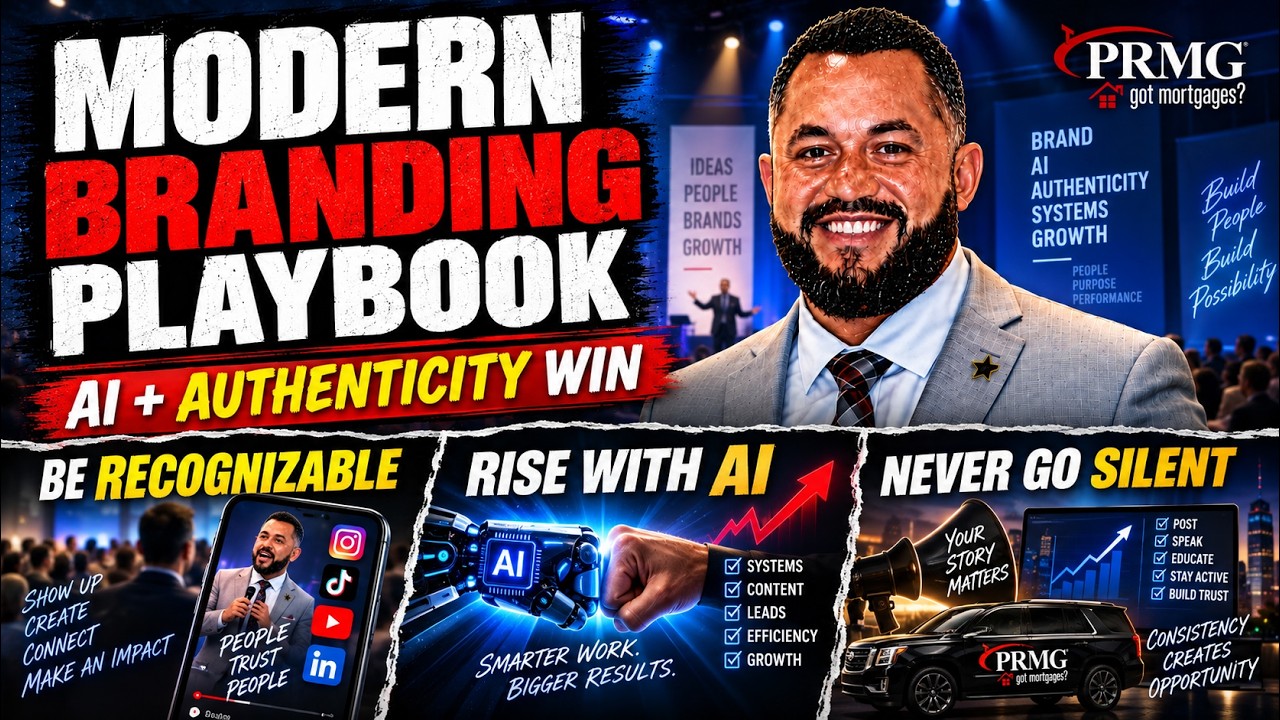
A recognizable mortgage brand is built through consistent behavior, not just a memorable logo. That was the central message of my Modern Mortgage Summit keynote: connect a clear identity with useful education, dependable communication and repeatable content distribution. For loan officers and branch leaders, the opportunity is to make every interaction reinforce the same standard. This Got Mortgages Insights recap explains how we approach that work, why partner education matters and which practical habits a mortgage team can start building without copying an entire technology stack.
Original video publication 2026-08-25. Archive recap added October 24, 2026.
Watch the original conversation.
1. The keynote’s central idea: recognition must be earned
Mortgage marketing often starts with appearance: a logo, a color palette, a headshot and a polished announcement. Those elements can help people recognize a business, but they cannot establish its service standard. The keynote argued for something deeper: an identity that people recognize because the experience consistently matches the message.
That distinction matters in a crowded digital environment. If your content promises personal attention but your communication feels generic, the brand loses credibility. Recognition becomes valuable when consumers and referral partners know what working with you will actually feel like.
2. Key takeaways from the BRAND framework
I organized the presentation around BRAND, connecting five recurring themes: being recognizable, rising with AI, building authentic relationships, never going silent, and documenting and distributing useful information. The practical value lies in how those themes reinforce one another, rather than in treating them as separate marketing projects.
The key takeaways are straightforward. Make your identity recognizable without making it artificial. Use technology to support useful work rather than replace personal attention. Teach partners, not just prospects. Establish a communication rhythm that people can depend on. Finally, document the work so a team can deliver it consistently.
Together, these ideas turn branding from an occasional campaign into an everyday operating discipline.
3. A recognizable identity can evolve without disappearing
The gorilla identity was a visible example throughout the keynote, including the shirt I wore onstage. But I also explained that our earlier logo contained the gorilla while the newer team logo did not. As the business expanded beyond its original New Jersey footprint, the visual identity evolved.
The lesson is not that every mortgage professional needs a mascot. It is that recognition should survive a redesign, team expansion or change in market. People should still recognize your voice, your standards and your approach to explaining decisions.
Practical suggestion: identify three characteristics you want people to associate with your business. Then examine whether your website, videos, consultations and follow-up actually demonstrate those characteristics.
4. Authenticity means being approachable and audience-aware
I described using video conversations to make consultations more personal and help consumers connect a face with the advice they receive. I also discussed moving away from a uniformly formal presentation toward a more recognizable, approachable style.
That is not a recommendation to abandon professionalism or require every consumer to communicate the same way. The underlying point is to reduce distance while remaining attentive to the person in front of you. Authenticity should make information easier to understand, not make the interaction revolve around the loan officer.
Practical suggestion: establish a consistent introduction that explains your role, what the conversation will cover and how questions will be handled. Offer an accessible communication format rather than assuming one channel fits everyone.
5. Measure whether technology is weakening personal contact
One of the keynote’s most useful examples began with uncomfortable feedback. A longtime referral partner observed that our communication had shifted toward texts and emails and away from phone conversations. I reviewed the records and found that the criticism was correct.
That experience led to ongoing tracking of communication activity alongside other business measures. The important lesson is not to maximize calls indiscriminately. It is to notice when efficient communication starts replacing the personal attention that helped establish a relationship.
Practical suggestion: review your communication mix regularly. Ask partners whether they feel informed and supported, then compare that feedback with your habits. A high message count is not the same as a strong relationship.
6. Build mortgage content around questions and recurring themes
The keynote described a recurring publishing rhythm: Monday market updates, Wednesday wins and Friday scenarios or strategies relevant to referral partners. We also discussed FAQ-style website articles that address what people actually want to know, rather than repeatedly announcing how good the business is.
AnswerThePublic was mentioned as a question-discovery resource. The broader editorial principle does not depend on that particular tool: start with a real question and deliver a useful answer. Search-optimized mortgage content should help readers understand a decision, not merely repeat a keyword.
Practical suggestion: create a small question library covering documentation, cash needed, financing comparisons and transaction milestones. Use hypothetical or fully anonymized teaching examples, and review mortgage explanations before publishing.
7. Capture once, then distribute with a purpose
Our content operation developed from educational videos and market updates into virtual podcasts and, later, a dedicated podcast room. The keynote described a space where loan officers and referral partners could participate with production support.
The more transferable idea is to make useful conversations easier to capture. A substantive educational recording can support several formats, but distribution should be intentional. A short clip can introduce a question; an article can explain the qualifications; a longer discussion can explore trade-offs.
Practical suggestion: record one public-facing educational conversation, then create a short video, a question-led article and a concise partner email. Preserve the original meaning in every version. More output is not helpful if editing removes the conditions that make an explanation accurate.
8. Use AI selectively, without making the software the strategy
The presentation discussed AI for content ideation, repurposing and organizing work, along with meeting tools, NotebookLM and workflow automation. These were examples of tools and workflows discussed at the session, not guarantees of present-day functionality, availability or suitability for another business.
My broader advice was to avoid getting distracted by every new platform. A manageable workflow that people understand is more useful than a collection of subscriptions nobody consistently uses.
Practical suggestion: begin with a low-risk editorial task, such as outlining an article from approved public educational material. Keep borrower information and private transaction details out of general-purpose AI tools. Review accuracy, tone and mortgage-specific qualifications before anything reaches an audience.
9. Partner education is more valuable than constant self-promotion
The keynote described the Elevated Alliance mastermind as a setting for sharing strategies with referral partners, including AI and individual brand development. It also discussed helping partners become more visible rather than remaining a well-kept secret.
This changes the focus of the relationship. Instead of repeatedly asking for business, a mortgage professional can help an agent understand financing conversations, communicate more clearly and produce stronger educational content. That support should stand on its own value, without promises or expectations of referrals.
Practical suggestion: offer a focused educational session on one recurring problem, such as explaining financing milestones or planning a useful buyer FAQ video. Keep participation voluntary and avoid tying education or marketing support to referral commitments.
10. Organize advice so consumers can use it
I emphasized preparing a TCA as part of the application workflow and organizing educational resources rather than overwhelming consumers with disconnected information. HousingLink was discussed as a presentation destination, with a personalized video and supporting resources. Its wallet-pass example reflected functionality described in the session, not a current feature guarantee.
The evergreen lesson is that delivery affects comprehension. A consumer may receive plenty of information and still be uncertain about the next step.
Practical suggestion: give each consultation a short, organized conclusion: what was compared, which assumptions matter, what remains unresolved and what happens next. Separate educational comparisons from formal lending decisions, and do not present future refinancing or other uncertain outcomes as assured.
11. Communication standards need documented ownership
For transactions under contract, the keynote described Monday, Wednesday and Friday updates to relevant parties. The schedule made communication a defined responsibility rather than something left to memory. Any team adapting that idea should limit updates to appropriate recipients and information they are authorized to receive.
Documentation supports the same discipline internally. I discussed checklists, standard operating procedures and Scribe as an example of a tool used to document screen-based tasks. The objective was to make execution repeatable for administrative staff and loan officer assistants.
Practical suggestion: document who prepares each update, who reviews it, when it is sent and what triggers escalation. Pair activity tracking with questions about clarity and unresolved issues, not just volume.
12. Practical action checklist: start with one repeatable improvement
The closing discussion recognized that a mature system can feel overwhelming. The right response is not to copy everything at once. Choose the first improvement that addresses a real weakness in your current experience.
Practical checklist: define your recognizable service standard; select one audience question; assign an owner to one recurring content format; plan where that content will be distributed; establish a dependable transaction-update rhythm; document the process; and review whether people understand and value it.
Then add a partner-education activity only when the first routine is sustainable. A clearer brand is built through repeated evidence: helpful explanations, dependable follow-through and organized support. Technology can assist those habits, but it cannot substitute for them.
Frequently asked questions
How can a loan officer become recognizable without using a mascot?
Choose a consistent voice, visual presentation and service promise that you can demonstrate. For example, become known for clear comparisons and dependable milestone updates. Use those qualities across videos, articles and consultations. A mascot can attract attention, but recognizable behavior gives people a reason to remember and trust you.
What should a small mortgage team implement first from this keynote?
Start with the most visible service gap. If partners regularly ask for status, establish an update schedule and assign ownership. If prospects cannot understand your approach, publish one useful FAQ each week. Document that routine before adding tools or channels. Consistency at a manageable scale is the first objective.
How should we adapt the Monday, Wednesday and Friday content schedule?
Treat it as an example, not a publishing requirement. Assign different purposes to your available slots: education, a hypothetical problem-solving example and partner guidance. Reduce frequency if necessary to preserve quality. Market-related posts need timely review, while evergreen explanations can remain useful longer with periodic updates.
How can one podcast recording support multiple useful pieces of content?
Choose a focused educational topic before recording. Extract a short clip answering one question, develop an article explaining the surrounding conditions and write a partner email linking to the deeper resource. Each version should offer a complete useful thought rather than merely tease the recording or repeat promotional language.
What is an appropriate first AI use case for mortgage content?
Use AI to organize approved public information into an outline or suggest reader questions for a general educational article. Do not supply borrower records or private transaction details. A knowledgeable person should review the finished work for accuracy, unsupported claims and missing qualifications before publication.
What should a referral-partner education session actually teach?
Address a concrete communication challenge, such as explaining financing milestones, preparing buyers for a mortgage conversation or structuring an educational video. Give participants something they can apply independently. Keep education separate from referral expectations, and avoid making participation contingent on using particular providers or sending business.
Do three weekly transaction updates need to include every detail?
No. A useful update identifies the current milestone, outstanding actions and the next expected communication. Tailor it to each recipient’s role and authorization, without exposing sensitive borrower information. When nothing material has changed, a concise confirmation can still reduce uncertainty and prevent unnecessary follow-up.
How can a team evaluate branding beyond followers and views?
Review whether people recognize your approach, understand next steps and receive communication when promised. Combine partner feedback with completion of service routines and relevant business measures. The keynote’s communication audit illustrates why activity data needs interpretation: more texts did not necessarily mean the personal relationship was receiving enough attention.
To talk with PRMG Got Mortgages, call 973-536-0276, visit GotMortgages.com, contact the team or build your mortgage plan.
Explore more Got Mortgages Insights and Abdel Khawatmi’s profile.
Author: Abdel Khawatmi with PRMG Got Mortgages | 201-679-0422
This article is general mortgage information only. It is not a commitment to lend, a rate quote, or legal or tax advice. Loan approval, terms and pricing depend on a full application, credit review and property details, and market conditions change. Talk with a licensed loan officer and your own legal or tax professional about your situation. NMLS #1712023 | PRMG NMLS #75243.