
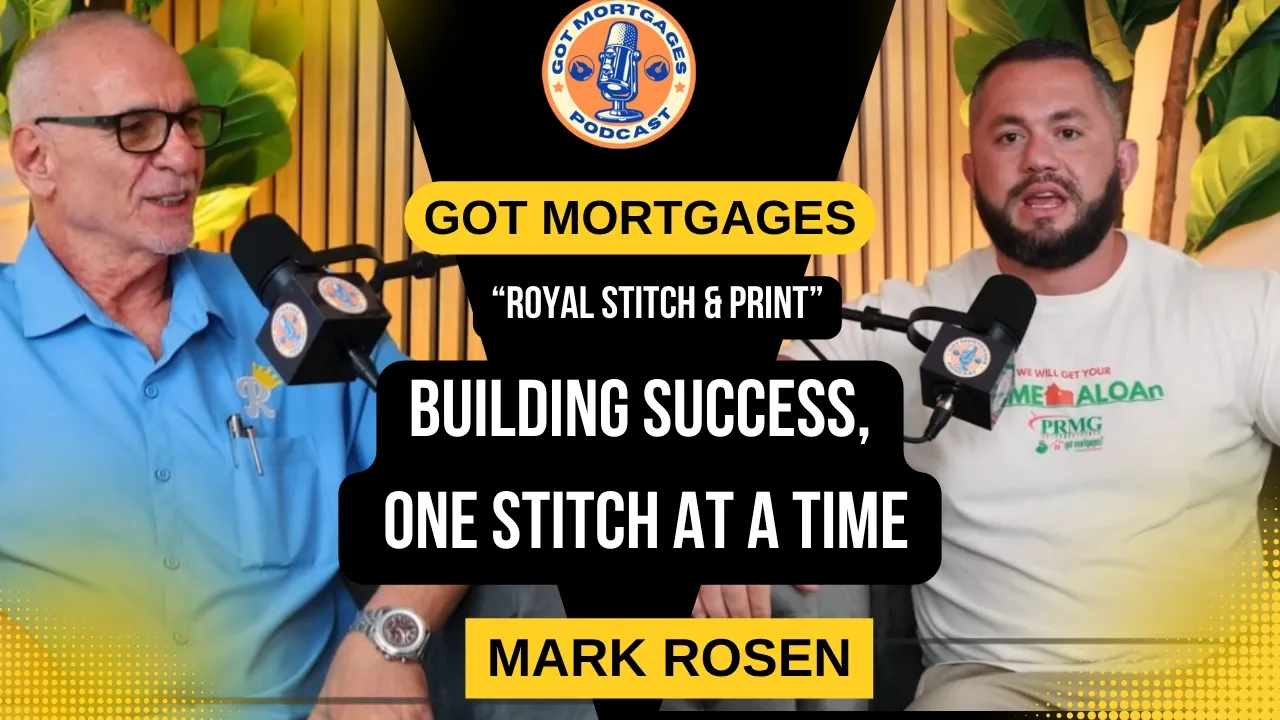
A side hustle becomes a stronger business when its owners learn what customers need and build the ability to deliver it. On the Got Mortgages Podcast, Abdel Khawatmi speaks with Mark Rosen, founder of Royal Stitch & Print, about that progression: an embroidery machine purchased for a small venture became the starting point for a family-run apparel and promotional products business. Mark credits hands-on service, lessons from earlier sales roles, genuine networking and a willingness to try unfamiliar work. His experience offers a practical perspective for business owners, including mortgage professionals: growth is not only about finding more customers. It is also about becoming more useful to the people already trusting you.
Conversation originally published May 13, 2026. Recap added October 24, 2026.
Watch the original conversation on YouTube.
Key Takeaways: Grow Through Usefulness, Not Just More Products
Royal Stitch & Print did not begin with a fully developed promotional products strategy. Mark describes buying an embroidery machine, learning the work and then responding to customer requests beyond the original offering. A request for pens helped change his understanding of what the company could become.
Three lessons connect the conversation. First, service gives customers a reason to choose a business beyond a product comparison. Second, networking has value when it starts with understanding and helping people, rather than calculating an immediate sale. Third, growth depends on being willing to learn, whether that means unfamiliar production work, outreach or improving the ordering experience.
Family is not a separate footnote to that story. Mark works alongside his wife and daughter-in-law, and he describes showing up for family as an ongoing responsibility. His definition of success includes the relationships and obligations the business is supposed to support.
An Embroidery Machine Was the Starting Point, Not the Whole Vision
Before Royal Stitch & Print, Mark worked in real estate and insurance sales and owned several businesses with mixed results. He describes those experiences as opportunities to learn rather than presenting his current company as the product of an uninterrupted winning streak. That distinction matters: previous experience can be useful without every earlier venture having succeeded.
The embroidery business began almost accidentally. After a conversation about a side hustle, Mark bought a machine the next morning. He says the initial knowledge was basic and the early work needed improvement. Within roughly three months, he decided to stop his other work and concentrate on the new venture, even as his wife raised the question of retirement.
The useful lesson is not that every new business deserves an immediate full-time commitment. It is that the direction became clearer through doing the work. For someone testing a side business, a practical step is to track customer requests, production quality, repeat orders and delivery demands before making a major commitment. Enthusiasm starts the experiment; evidence should help determine its next stage.
Customer Requests Revealed a Bigger Business
A customer asking for pens became a turning point. Mark initially wanted to stay with embroidery and considered having someone else handle the request. A friend encouraged him to offer pens and other products himself. Once he accepted that broader role, he began seeing the company as a promotional products business rather than simply an embroidery operation.
That shift changed the question from what the equipment could make to what customers needed. Mark describes expanding embroidery capacity, adding on-premises heat-press printing and offering items such as cups and pens. The broader offering grew out of a relationship with customers, not merely a desire to assemble a larger catalog.
For another business owner, the practical step is to record requests that fall just outside the current service. Repeated requests may reveal a sensible adjacent offering. Before adding it, establish how it will be produced or sourced, who will check the finished work and whether the delivery commitment is realistic. Responding to demand is valuable only when the business can support the promise.
Hands-On Service Makes the Product More Useful
Abdel identifies customer service as a reason he works with Mark for promotional materials. His comparison is between selecting an item from a large online platform and working with someone who helps translate a business objective into a suitable product. A shirt, cup or pen is only part of the purchase; customers also need help making the right decision.
Mark says he wants customers to call knowing the team will look out for them and do its best work. He emphasizes willingness to help with both small and large needs. That approach places the relationship ahead of an assumption about how valuable a particular order might be.
The conversation connects service with perceived value, but that does not make price irrelevant. Mark also says the company tries to do well on pricing for customers. The more useful reading is that informed help can make a purchase worth more than the item alone. For a mortgage business ordering branded materials, that means explaining the audience and purpose first: staff apparel, an event giveaway and a client-facing item may require different choices.
Rush Requests Test the Meaning of Customer Service
Abdel raises a familiar promotional products problem: customers often call needing items almost immediately. Mark acknowledges that urgency is common. He says expedited work can sometimes be arranged when the customer is willing to pay for it, while also recognizing that some requests cannot be fulfilled.
That qualification is important. Helpful service is not the same as agreeing to every deadline. A credible supplier investigates what can be done and explains the available choices. A customer who hears the limits early can adjust an order or event plan; a customer who receives an unrealistic promise loses that opportunity.
A practical application for event organizers is to supply the event date, required arrival date, quantity, artwork and acceptable alternatives at the first conversation. Ask which options fit the deadline before becoming attached to a particular item. This makes the supplier's assistance more effective and separates a genuinely necessary rush from delays caused by incomplete decisions.
Sales Experience Taught Mark to Work Through Discomfort
Mark's earlier insurance work required door knocking, which he initially disliked. His attitude changed as the activity produced sales. He describes learning that tasks he would prefer to avoid can be the very tasks that help him develop. The transferable skill was not simply knowing a sales script; it was becoming more willing to act despite discomfort.
That lesson appears again when he discusses learning unfamiliar production work and accepting broader product requests. His account does not suggest that confidence must come first. In several parts of the business, experience and confidence developed after he began.
For a business owner, the application is to identify one avoided task with a clear business purpose. It might be contacting a past customer, asking for feedback or learning an ordering tool. Define a manageable next step and evaluate the result. Discomfort alone is neither a reason to abandon a task nor proof that it is worthwhile; the purpose and the learning matter.
Networking Works Differently When the First Goal Is to Help
Mark and Abdel met through networking, and their conversation reflects a relationship that developed beyond an introduction. Mark says he enjoys meeting people, learning about them and seeing what he can do for them. He does not describe an event as worthwhile only when it produces an immediate sale.
His involvement extends into community service through Rotary and chambers of commerce. These activities fit his broader interest in being useful, rather than appearing solely as places to find prospects. Abdel connects that outlook with the idea of sharing what is working in a business and remaining willing to learn from someone else's experience.
The practical difference is in the questions and follow-through. Instead of opening with a product pitch, ask what someone is working on and where they need help. Follow up with the resource, introduction or answer you offered. For mortgage and real estate professionals, this is a relationship-building lesson, not a suggestion to treat assistance as something another person must repay with referrals.
Final Checklist: Improve the Business Without Losing Its Purpose
Review the customer experience. Mark discusses plans to update the website and ordering process, while Abdel emphasizes acting on useful advice rather than merely collecting it. Identify one point where customers struggle to order, provide information or understand the next step. Improve that point without removing access to the personal help that makes the business distinctive.
Review expansion decisions. List recent requests outside your core offering and choose only those you can deliver responsibly. For each proposed addition, clarify production or sourcing, quality review, timing and customer communication. A broader offering should make the business more useful, not simply more complicated.
Review relationship commitments. Choose a networking follow-up that helps someone without demanding a sale in return. Then review family responsibilities with the same seriousness. Mark's advice about work and family is to show up and do his part, not to offer a perfect scheduling formula. Agree on what presence and help mean in practice, especially when relatives also work in the business.
Finally, choose one unfamiliar but necessary action for the coming week. Mark's story combines learning, service and execution. The next useful move may be modest: resolve an ordering problem, respond to a neglected request or make time for a responsibility that growth has pushed aside.
Frequently asked questions
How did Royal Stitch & Print start?
Mark describes buying an embroidery machine after discussing a side hustle. The family learned the work as the business developed, and he decided within roughly three months to concentrate on it rather than continue his other work.
What prompted Mark to expand beyond embroidery?
A customer requested pens. Mark initially preferred to stay with embroidery, but a friend encouraged him to handle pens and other promotional products. Taking that request helped him see a broader business serving customers' branding needs.
What should I tell a promotional products supplier before choosing items?
Start with the purpose, intended audience, quantity, budget and required arrival date. Share the available artwork and any flexibility on products. This practical approach helps a service-focused supplier recommend an appropriate option instead of guessing from an item name alone.
Can a promotional products supplier always accommodate a rush order?
No. Mark says some urgent requests can be fulfilled at additional cost, but others cannot. Ask which products and production options fit the actual deadline, and establish what must be approved before work can proceed.
Why choose personal service instead of ordering promotional items online?
The advantage discussed is help interpreting the request and making the desired result achievable. A hands-on supplier can discuss the intended use and available choices. Price and convenience still matter; the question is whether you need guidance as well as an item.
What did insurance sales teach Mark about running a business?
Door knocking taught him to work through an activity he initially disliked. As he gained experience and made sales, he became more comfortable. He applies that lesson to necessary business challenges instead of waiting to feel fully confident before starting.
How does Mark approach networking without focusing on an immediate sale?
He focuses on meeting people, understanding them and finding ways to help. He says an event can be worthwhile even without a sale. A concrete application is to follow through on one useful resource or introduction rather than sending every new contact the same sales pitch.
What is Mark's advice for entrepreneurs managing family responsibilities?
His emphasis is on showing up and doing his part as a spouse, parent, grandparent and business owner. He does not offer a rigid work-life formula. The practical takeaway is to clarify what family members need and treat those commitments as real responsibilities, not leftover time.
To talk with PRMG Got Mortgages, call 973-536-0276, visit GotMortgages.com, contact the team or build your mortgage plan.
Explore more Got Mortgages Insights and Abdel Khawatmi’s profile. Explore more conversations at the Got Mortgages Podcast website.
Author: Abdel Khawatmi with PRMG Got Mortgages | 973-536-0276
This article is general mortgage information only. It is not a commitment to lend, a rate quote, or legal or tax advice. Loan approval, terms and pricing depend on a full application, credit review and property details, and market conditions change. Talk with a licensed loan officer and your own legal or tax professional about your situation. NMLS #1712023 | PRMG NMLS #75243.