
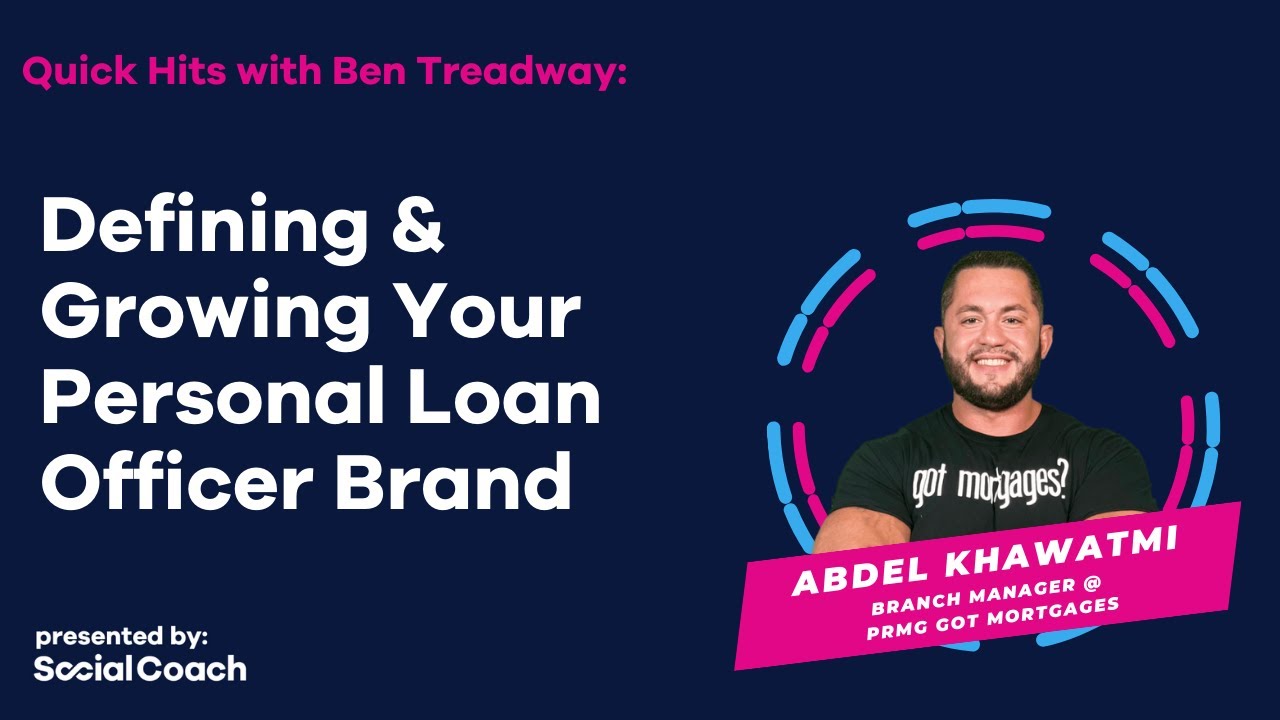
A recognizable loan officer brand grows when people can connect a name with a person, a useful explanation, and a consistent experience. In SocialCoach’s Quick Hits with Ben Treadway, Abdel Khawatmi of PRMG explains how he developed Got Mortgages around that combination. His approach connects visible branding with educational videos, personal interests, community involvement, and ongoing adjustments based on audience response. The practical lesson is not simply to post more: it is to make your expertise easier to discover and your working style easier to understand before someone contacts you.
Conversation originally published October 24, 2023. Recap added October 24, 2026.
Watch the original conversation on YouTube.
Key Takeaways: Recognition Needs Substance Behind It
Abdel’s central argument is that a loan officer needs a recognizable identity beyond the lender’s name or a list of available programs. Many professionals discuss familiar mortgage categories; the opportunity is to show how you explain decisions, communicate expectations, and make yourself accessible.
Three habits support that identity throughout the conversation: mix useful education with appropriate personal content, maintain a publishing routine that survives the initial burst of enthusiasm, and adjust based on actual audience behavior. A polished backdrop or a large follower count is not a substitute for those habits.
The strongest practical connection is between marketing and service. A video answering a common borrower question can introduce your expertise publicly and help an existing client understand the next step. That gives content a purpose beyond collecting reactions.
Define the Experience Your Brand Should Represent
Ben opens the interview by asking about branding rather than treating social media as the whole subject. Abdel describes Got Mortgages as an identity he carries into everyday interactions, including branded clothing. The visible name gives people an immediate clue about his work and can create an opening for conversation.
Recognition alone is not his full proposition. He emphasizes education, availability, advice, and setting expectations. His discussion of common mortgage programs is a differentiation argument, not evidence that every lender offers identical products or terms. The useful question for an individual originator is what a prospective client can learn about working with them that a program list cannot communicate.
A practical step is to define your brand promise in observable terms. Instead of relying on a broad claim such as excellent service, identify behaviors a client could notice: explaining the sequence after an accepted offer, answering questions clearly, and providing a resource they can revisit. Those behaviors give your public message something concrete to stand on.
Let Personal Content Create Familiarity Without Replacing Expertise
Ben notes that, although he and Abdel had only recently met in person, social media had already made Abdel familiar to him. He recognized interests such as salsa dancing, as well as community involvement and educational content. That familiarity illustrates a different function of social media from direct lead generation: people can arrive at an introduction with some sense of who you are.
Abdel explains that maintaining separate personal and business Instagram accounts created extra work and kept parts of his identity disconnected. Combining those elements helped him present a more complete picture. He also accepts that he will not connect with everyone, which is an important distinction between a personal brand and an attempt to appeal universally.
The practical lesson is not that every loan officer must combine every account or share private life publicly. It is to choose a few appropriate interests or community activities that genuinely belong alongside professional education. A profile should help someone understand both your competence and your manner, without making disclosure a requirement for authenticity.
Build Educational Videos Around Questions Borrowers Actually Ask
One of the interview’s most useful examples starts with a predictable borrower question: the offer was accepted, so what happens next? Abdel describes creating both a simple Canva graphic and a video to explain the upcoming process. Rather than waiting to repeat the same explanation individually, he prepares a resource that anticipates the question.
He mentions milestones such as inspection, appraisal, submission, and approval, with a reference to the local context in New Jersey. The broader lesson is the format, not a universal transaction sequence. A useful milestone resource should reflect the borrower’s location and transaction rather than implying every purchase follows the same order.
For an originator building a content library, this suggests starting with recurring moments of uncertainty instead of an abstract list of trending topics. Record the question in the words clients use, explain the immediate next step, and identify what they should ask their loan officer about their own situation.
Keep those resources organized so they can be retrieved when needed. A video that works as a public introduction can also support a direct client conversation. Its value then includes clarity and reuse, not just reach on the day it appears.
Make Useful Content Easier to Produce and Less Repetitive
Abdel describes having access to a dedicated media room and green screen, yet notes that a straightforward everyday setting can offer more authenticity. His point is not that production quality is irrelevant. It is that an elaborate setup should not become a condition that prevents an otherwise useful explanation from being recorded.
He also describes changing how he shares transaction milestones. Repeated individual posts about accepted offers drew less response, so he began grouping them rather than filling the feed with near-identical announcements. That is a specific example of changing presentation while keeping a category of content.
Together, these observations suggest two production tests: does the setup help the audience understand the message, and does this post add something beyond the last one? Clear audio, an understandable explanation, and a comfortable delivery can matter more than visual novelty. Similarly, consolidating routine updates can create space for education and community content without abandoning evidence of active work.
Turn Consistency Into a Calendar Commitment
When Ben asks about mistakes, Abdel returns to inconsistency. He describes the familiar pattern of leaving a motivational event excited, recording several videos, and then letting the effort fade. His alternative is time blocking: making content a recurring commitment rather than something left for a quiet day.
Abdel’s own high posting frequency is not presented here as a required schedule. The more transferable example is reserving a specific publishing time, maintaining it long enough to observe a pattern, and then reviewing engagement. A schedule has to fit the person responsible for creating the material.
A practical workflow separates choosing topics, recording, preparing captions, and reviewing results. Those tasks do not all need to happen immediately before publication. This also makes outside help more useful: an editor can work with a dependable supply of recordings instead of waiting for occasional bursts of inspiration.
Test Timing Against the Audience’s Actual Availability
The interview moves beyond posting frequency to the timing of participation. Abdel recounts holding homebuying seminars on summer Saturdays and finding attendance disappointing. He then moved them to Thursday evenings and describes a better response. That is a concrete example of changing the invitation’s timing rather than assuming the educational topic had no appeal.
He applies similar reasoning to social posts: a publishing time that suits the creator may not match when the audience is available. His suggested comparisons are hypotheses to test, not universal best times. The same principle applies to live sessions, where attendance requires more commitment than watching a short recording.
For a useful test, change one major element at a time when practical and define the outcome beforehand. A seminar should be evaluated through registration and attendance, while a short educational video might be assessed through viewing behavior or relevant questions. Otherwise, it becomes difficult to know whether a change solved the actual problem.
Measure Familiarity and Useful Engagement, Not Just Audience Size
Abdel questions the value of paying for followers and expresses more interest in genuine audience response. He also describes meeting someone at a local event who recognized him from his videos. That encounter matters because it shows how content can support an offline relationship even when visible reactions are modest.
A practical measurement approach should therefore distinguish attention from business relevance. Views indicate exposure; questions can reveal whether a topic connects with a real concern; recognition at a meeting can show that repeated appearances are making the brand memorable. None of those signals alone proves that a post generated a loan.
Both speakers frame weak engagement as a reason to adjust rather than automatically stop. Abdel mentions reviewing viewing behavior and reconsidering the targeted area or demographic after a disappointing boosted post. The disciplined application is to identify what underperformed before spending again: the topic, opening, audience, timing, or invitation to act.
Low engagement relative to follower count does not establish that an account bought its audience. The more useful lesson is to avoid making follower totals the primary objective and to track the responses that relate to your actual service and relationship goals.
Final Checklist: Keep the Voice Yours, Even When You Get Help
Define the promise. Write one sentence describing the experience you want people to associate with your name, then identify the client-facing behaviors that support it. Check whether your profile and recent posts make that promise understandable.
Choose the first useful resource. Start with a recurring question, such as what happens after an offer is accepted. Prepare an explanation suited to your market and a simple way to share it with clients when the question arises.
Set a sustainable routine. Reserve time to record and publish, choose appropriate personal or community content, and consolidate repetitive announcements. Use a recording setup you can maintain rather than one that makes every video a production obstacle.
Assign the right work. The interview closes with a clear boundary around outsourcing: third parties can help edit and distribute content, but the professional still needs to provide the substance and appear in the material. Support should reduce friction without inventing a personality for you.
Review and adjust. Track useful questions, audience response, event participation, and recognition in real conversations. Change weak elements deliberately while keeping the public voice consistent with the person clients and partners will meet.
Frequently asked questions
How can a loan officer stand out when competitors discuss similar programs?
Show how you work, not only what you offer. Abdel emphasizes education, accessibility, and setting expectations. A clear explanation of an upcoming mortgage milestone demonstrates those qualities more concretely than a list of loan categories.
Should loan officers combine personal and business social media accounts?
Abdel found that separate accounts created extra work and limited personal connection, so he favors mixing appropriate personal and professional content. That does not require sharing everything or eliminating private accounts. Choose a public content mix that supports familiarity while respecting your boundaries.
What is a useful first educational video for a loan officer brand?
Answer a question clients repeatedly ask. The episode’s specific example is what happens after an offer is accepted. Explain the likely next steps for the relevant transaction and market, and give viewers a reason to discuss their own timeline with their loan officer.
Does mortgage video content need a studio or green screen?
No. Abdel describes moving from a more elaborate setup toward natural recordings in an everyday setting. Prioritize clear sound, an understandable message, and a setting without distracting or sensitive information in view.
How should loan officers handle repetitive closing or accepted-offer posts?
Abdel began grouping milestone updates after noticing weaker response to repeated individual announcements. Consolidating similar posts can preserve those updates while leaving room for educational explanations and content that shows your personality.
What should a loan officer test when a homebuyer seminar draws few attendees?
Test whether the schedule fits the audience before abandoning the topic. Abdel describes moving summer seminars from Saturdays to Thursday evenings and seeing a better response. Compare registrations and attendance across your own events rather than assuming that timing will work everywhere.
Which signals matter besides follower count?
Look at viewing behavior, relevant questions, participation in events, and people mentioning your content in real conversations. These signals serve different purposes. Track them separately, and do not assume that a view or a like is evidence of a resulting mortgage transaction.
What can a loan officer delegate without losing an authentic brand?
Editing and distribution can be supported by outside professionals. Abdel and Ben emphasize that the loan officer still supplies the recordings and expertise. Delegate production tasks while retaining responsibility for the explanation, voice, and accuracy of the message.
To talk with PRMG Got Mortgages, call 973-536-0276, visit GotMortgages.com, contact the team or build your mortgage plan.
Explore more Got Mortgages Insights and Abdel Khawatmi’s profile. Explore more conversations at the Got Mortgages Podcast website.
Author: Abdel Khawatmi with PRMG Got Mortgages | 973-536-0276
This article is general mortgage information only. It is not a commitment to lend, a rate quote, or legal or tax advice. Loan approval, terms and pricing depend on a full application, credit review and property details, and market conditions change. Talk with a licensed loan officer and your own legal or tax professional about your situation. NMLS #1712023 | PRMG NMLS #75243.