
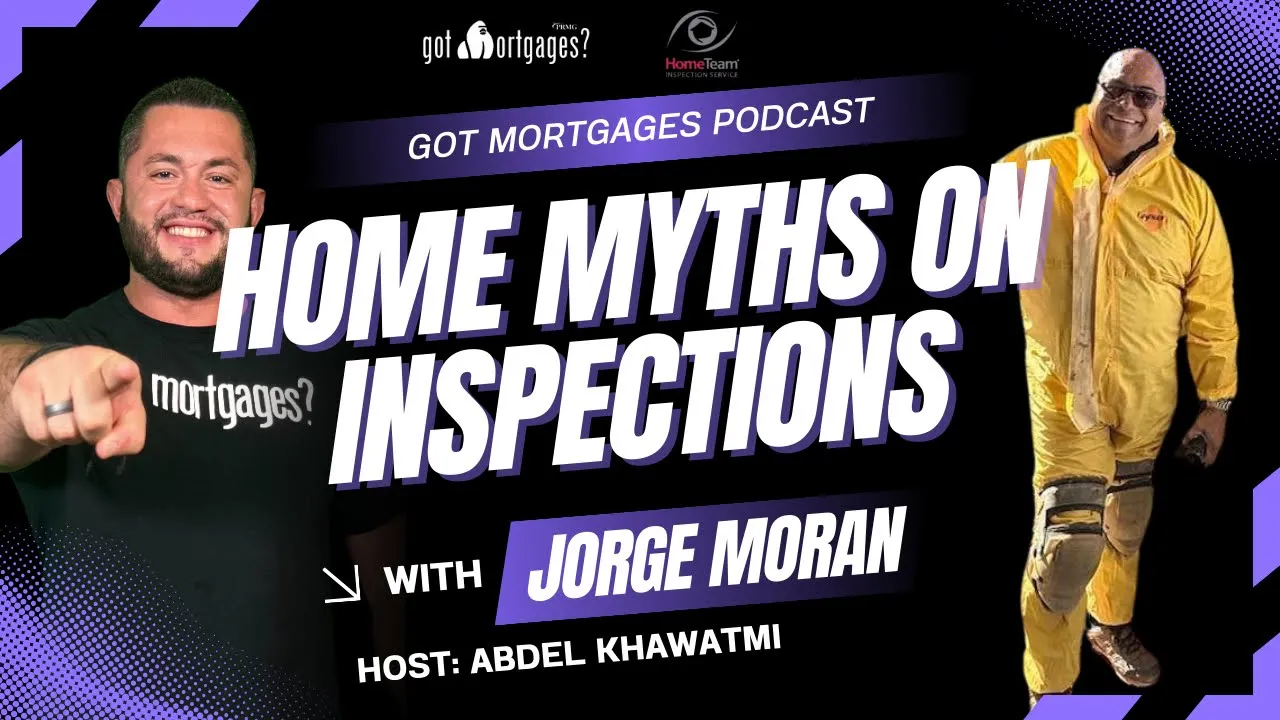
A home inspection should help you understand a property's condition, separate routine maintenance from serious defects, and decide what needs attention before closing. On the Got Mortgages Podcast, Jorge Moran, owner of HomeTeam Inspection Service of Monmouth County, joins Abdel Khawatmi to explain why that work goes well beyond a quick walkthrough. Their discussion connects structural clues, unfinished work in new homes, underground risks, and inspection timing to the decisions buyers actually face. The central lesson: get informed early, attend when possible, and understand that an inspection, an appraisal, and municipal approvals serve different purposes.
Conversation originally published March 5, 2025. Recap added October 24, 2026.
Watch the original conversation on YouTube.
Key Takeaways: Inspect for Decisions, Not Just Defects
Moran frames an inspection as an education in how a house works. A useful inspection identifies concerns, explains their significance, and helps a buyer distinguish a maintenance task from something requiring further evaluation. His approach is to communicate calmly without minimizing the condition. A house does not need to be flawless, but buyers need to understand what they are taking on.
Several practical lessons run through the conversation: new construction still needs scrutiny; a standard inspection does not answer every underground or environmental question; sellers can investigate problems before listing; and buyers should schedule early enough to act on findings. A fast report matters most when it leaves time for specialist visits, repair estimates, and informed discussions with the transaction team.
What Inspectors Notice Before the Walkthrough Begins
Moran describes inspection work as a process of connecting clues. In one example, an apparent lean visible from outside led him to pay closer attention to the interior floor levels. Looking beneath the house then revealed a main beam that was turned out of its intended position. The important point is not that every uneven floor indicates the same problem. It is that visible symptoms can direct an inspector toward a more consequential underlying condition.
For buyers, this changes how to think about a walkthrough. Fresh paint, an appealing floor plan, and updated finishes do not establish the condition of the supporting structure. An inspector looks beyond those features and considers whether observations across different parts of the property fit together. A floor irregularity deserves context, not an instant diagnosis or an automatic dismissal as an older home's character.
The same reasoning applies to moisture and foundation concerns. Moran discusses explaining how water pressure against a foundation can relate to cracking or water entry. The practical next step is to ask what was observed, what remains uncertain, and whether a qualified specialist should evaluate it. A general inspection can identify a concern without determining its full repair scope or cost.
Why New Construction Still Needs an Inspection
One of Moran's clearest warnings concerns the assumption that a new home has nothing to inspect. He recalls a furnace that would not operate because part of its gas supply piping had not been installed. In another new-home inspection, a garage door opened but then dropped when operated in the opposite direction. Both examples involve basic function and potential safety concerns, not cosmetic preferences.
These examples make a useful distinction between equipment being present and equipment working properly. A finished-looking house can contain incomplete connections or installation problems that are not apparent during a showing. An independent inspection gives the buyer another opportunity to identify those issues before taking responsibility for the property.
For a new-home purchase, coordinate inspection access with the builder and your agent, and ask how findings will be documented and addressed. Keep a written record of outstanding work rather than relying on an informal promise. Where a defect involves a potentially dangerous system, request appropriate professional correction and confirmation instead of attempting to test or repair it yourself.
An Inspection, an Appraisal, and a CO Are Different Checks
Abdel emphasizes a distinction mortgage buyers often miss: a home inspection examines condition, while an appraisal primarily supports the lender's assessment of value and may identify property-condition requirements. An appraisal is not a substitute for a buyer's inspection. Likewise, a mortgage approval does not mean that every physical or municipal issue affecting the property has been resolved.
The conversation highlights missing handrails and deteriorated paint as examples of conditions that may receive attention during appraisal review. Abdel also notes that an underwriter may require an issue to be addressed even when the appraisal was initially presented without that repair condition. The practical lesson is to ask the lender about the actual requirements on the file rather than assuming that one person's initial assessment settles everything.
Municipal approvals add a separate layer. A certificate of occupancy, where required for the transaction, can involve questions about alterations or permitted use that are not resolved by an inspection report. Buyers should ask their agent or attorney who is checking permits and local transfer requirements. Exact repair and approval requirements depend on the property, jurisdiction, loan program, and lender; the episode's examples are not universal rules.
Choose Additional Inspections Around the Property's Risks
Moran begins gathering information before arriving at the house. He asks about its age, location, surroundings, and the buyer's concerns. Those questions help determine whether additional services should be arranged. His team-based approach includes bringing in other professionals when necessary, rather than treating every question as something a single general inspector can answer.
For underground drainage, the discussion points to mature trees and older properties as reasons to consider a closer look. A sewer scope uses a camera to investigate the accessible sewer line; it is not an inspection of the public drinking-water supply. A property served by a septic system needs an appropriate septic evaluation instead. Buyers should establish which system serves the house before selecting services.
Underground oil tanks present a different concern. Moran stresses that underground oil tanks can lead to soil contamination, which is expensive to remediate. He notes that a leak might even require demolishing neighboring structures to reach the affected soil, and finding the tank is only part of the concern. A tank sweep and an environmental investigation answer different questions. If evidence of a tank or contamination emerges, involve qualified professionals and your attorney before assuming that removal alone resolves the issue or that responsibility is already clear.
Termite inspection and radon testing also feature prominently. Moran strongly encourages attention to both, particularly where the property's circumstances raise concern. Ask whether these services are included, separately priced, or coordinated through another provider, and when their results will be available. A quick general inspection report should not be mistaken for completion of every separately ordered test.
Use the Inspection Visit to Learn How to Own the House
Moran's background includes corporate work and hands-on exposure through his father's construction business. What he says he enjoys about inspections is taking clients through the house and helping them understand what they are seeing. That educational approach makes attendance valuable: the buyer can ask questions while the relevant equipment or condition is directly in front of them.
Useful questions go beyond whether something is defective. Ask which systems need regular maintenance, what signs would justify calling a professional, and which observations require prompt attention. If a finding sounds alarming, request a plain-language explanation of its significance and the recommended next step. Calm communication should make the issue clearer, not make a material defect sound harmless.
Turn the visit into an ownership plan. Separate items that need investigation before closing from work to budget for after purchase and recurring maintenance to schedule later. Take notes, then reconcile them with the written report. An inspection has limits, including areas that are concealed or inaccessible, so ask about those limits rather than assuming that an unmentioned area has been fully examined.
Schedule Early Enough to Act on the Findings
Moran's closing advice is to book promptly instead of using the entire inspection period simply to arrange the visit. The available contractual window may need to accommodate much more than the initial inspection: receiving results, consulting specialists, obtaining estimates, and deciding how to respond. Waiting until the deadline approaches can compress all of those decisions into a period when buyers are least equipped to make them.
He describes aiming to deliver reports the same day or the following morning and coordinating additional professionals to reduce repeated visits. Those are descriptions of his service approach, not a promise that every inspection or test will be completed on that schedule. When booking, ask about actual availability, access requirements, separate test timelines, and how follow-up questions are handled.
Abdel also discusses how inspection and appraisal scheduling can interact. Waiting for inspection findings may avoid committing to another expense on a property a buyer will not pursue, while a tight closing schedule may require parallel work. Discuss that tradeoff with the lender and agent. Let the attorney explain contractual deadlines and protections rather than assuming that a financing milestone extends an inspection deadline.
Why Sellers Should Consider a Pre-Listing Inspection
Moran recommends pre-listing inspections because they give sellers time to discover and address issues before a buyer's inspection turns them into an urgent negotiation. He recalls finding exposed energized wiring near an electrical panel that the owner had not recognized as a problem. Familiarity with a home is not the same as having evaluated its condition professionally.
The benefit is preparation, not a guaranteed higher sale price or a defect-free transaction. Sellers can investigate a finding, arrange qualified repairs, collect documentation, and make more informed decisions about pricing and presentation. Even modest problems become harder to manage when they surface shortly before an anticipated closing.
A pre-listing inspection does not replace the buyer's independent due diligence. It also creates information that may affect disclosure obligations, so sellers should discuss those obligations with their agent or attorney. Address the cause of an issue rather than merely covering its visible evidence; for example, replacing a stained ceiling material without investigating moisture leaves the central question unanswered.
Translate Findings Into Repair or Credit Decisions
The episode recognizes that most existing homes will have imperfections. The practical challenge is sorting ordinary wear from safety concerns, structural questions, and conditions whose costs are not yet understood. A long report is not automatically a reason to abandon a purchase, but neither should a buyer accept a serious finding simply because other items in the report are minor.
Moran and Abdel discuss seller credits as an alternative to having sellers perform work. A credit can give buyers more control over later repairs, while seller-completed work may address an immediate problem before ownership transfers. Neither approach is automatically preferable. The buyer needs a credible understanding of the repair scope, the available cash, and whether the lender or municipality requires correction before closing.
Abdel distinguishes a price reduction from a closing-cost concession. A lower price changes the purchase economics; an allowable concession can reduce eligible cash costs at closing. They are not interchangeable, and a credit is not unrestricted repair money paid to the buyer. Before negotiating a specific structure, ask the lender about applicable limits, eligible costs, and any property conditions that cannot simply be credited away.
Final Checklist: What to Do Before and After Booking
Before booking, confirm your contract deadlines and inspection access. Give the inspector the property's age, known alterations, heating history, and sewer or septic information. Ask about experience with similar homes and the local area, the scope of the inspection, additional services, report delivery, and availability for questions.
During the visit, attend if possible and ask for explanations of significant findings. Note inaccessible areas and recommendations for further evaluation. Do not confuse a calm presentation with a low-priority issue: ask explicitly what needs prompt attention and what can reasonably become part of a maintenance plan.
Afterward, organize the report into immediate concerns, further investigations, and future ownership tasks. Obtain appropriate estimates before negotiating, and coordinate any repair or credit request with your agent, attorney, and lender. Even if your contract limits inspection-based negotiations, seek permitted inspection access to understand the property. Information remains valuable even when it does not create a right to demand repairs.
Frequently asked questions
Does a home appraisal replace a home inspection?
No. An appraisal primarily supports the lender's assessment of value and may identify property-condition requirements. A home inspection examines the property's condition within its agreed scope. Neither replaces municipal permit or occupancy checks.
Why inspect a newly built home before closing?
New construction can contain incomplete or improperly installed systems. Jorge Moran describes finding unfinished furnace gas piping and a malfunctioning garage door in new homes. An inspection can identify functional concerns that a finished appearance does not reveal.
When should a buyer ask about a sewer scope?
Ask when arranging the general inspection, especially if the house is older, mature trees surround it, or the sewer line's condition is unknown. Confirm that the property uses a sewer connection. A septic property needs an appropriate septic evaluation rather than assuming a sewer scope covers the system.
Does an oil tank sweep show whether soil is contaminated?
Not by itself. A tank sweep looks for evidence of an underground tank. Determining whether a leak affected soil requires appropriate environmental evaluation. If a tank is identified, clarify investigation, remediation, and responsibility with qualified professionals and your attorney.
What should I ask a home inspector before hiring them?
Ask about experience with similar homes and the local area, what the inspection includes, which additional tests may be appropriate, and when each report will arrive. Also ask whether you can attend and how the inspector handles follow-up questions.
Is an inspection useful if I limited my inspection contingency?
Yes, if inspection access is permitted under your agreement. It can help you understand safety concerns, future expenses, and maintenance even when you cannot request certain repairs. Have your attorney explain your actual access and contractual rights before proceeding.
Should I request seller repairs or a closing-cost credit?
First determine the repair scope and whether correction is required before closing. A permitted credit may preserve cash for later work, but it is limited to eligible costs and is not unrestricted repair cash. Ask your lender to review the proposed credit before negotiating it.
What does a pre-listing inspection accomplish for a seller?
It gives the seller time to investigate problems, arrange qualified repairs, and prepare documentation before buyer negotiations begin. It does not eliminate the buyer's inspection or guarantee a sale outcome. Discuss disclosure obligations for newly discovered conditions with your agent or attorney.
To talk with PRMG Got Mortgages, call 973-536-0276, visit GotMortgages.com, contact the team or build your mortgage plan.
Explore more Got Mortgages Insights and Abdel Khawatmi’s profile. Explore more conversations at the Got Mortgages Podcast website.
Author: Abdel Khawatmi with PRMG Got Mortgages | 973-536-0276
This article is general mortgage information only. It is not a commitment to lend, a rate quote, or legal or tax advice. Loan approval, terms and pricing depend on a full application, credit review and property details, and market conditions change. Talk with a licensed loan officer and your own legal or tax professional about your situation. NMLS #1712023 | PRMG NMLS #75243.