
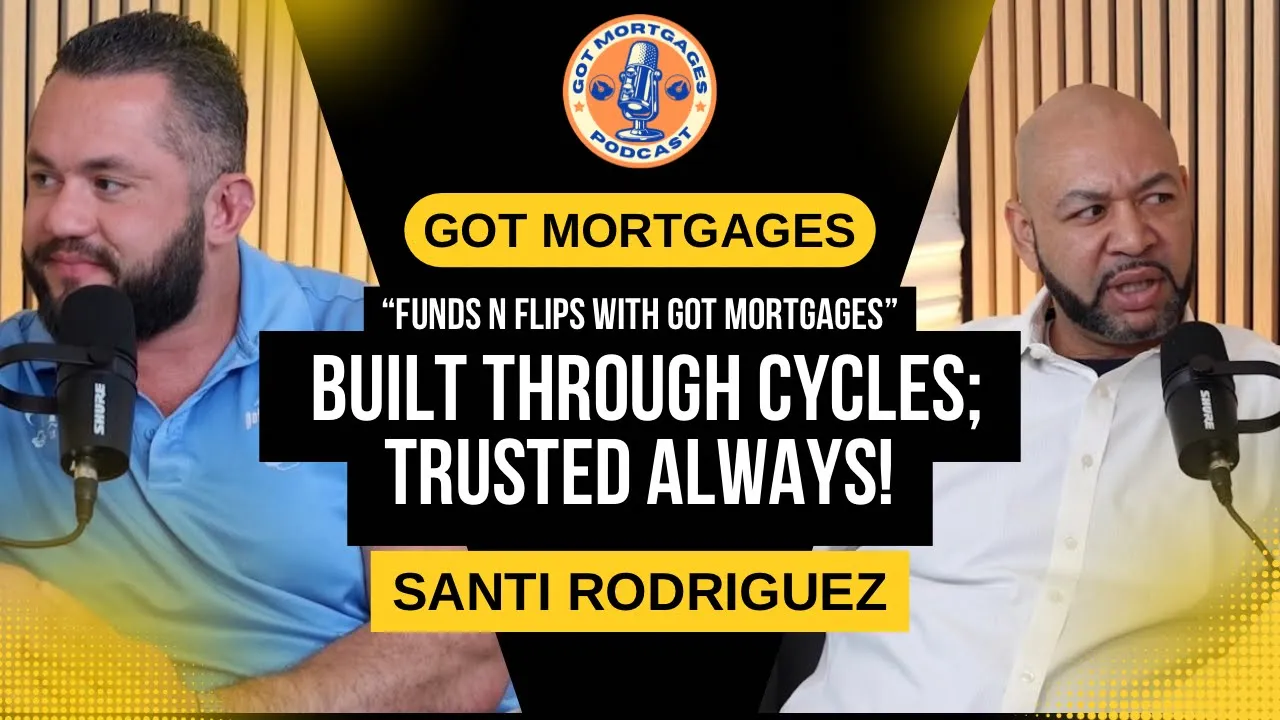
Fix-and-flip financing starts with matching the loan to the property’s intended outcome, not simply finding the smallest down payment. In this Got Mortgages Podcast conversation, Abdel Khawatmi and senior loan officer and real estate investor Santi Rodriguez discuss financing renovations, keeping properties as rentals, resolving lending obstacles and building reliable closing systems. Known as Mr. Funds and Flips, Santi brings over 20 years of lending and investing experience to the discussion. The practical lesson: define the exit, disclose complications early and evaluate the entire funding plan before committing to a deal.
Conversation originally published February 10, 2026. Recap added October 24, 2026.
Watch the original conversation on YouTube.
Key Takeaways: Finance the Project, Not Just the Purchase
Santi describes Funds and Flips as more than financing properties for resale. His work includes helping people purchase homes, fund investment projects and pursue rentals, while also seeking funding for his own investments. That dual perspective anchors the episode: financing should support what the buyer intends to do with the property, rather than force every transaction into the same structure.
Three lessons stand out. Higher leverage is conditional, not a substitute for financial preparation. Closing speed depends on coordinated execution, not just a lender’s willingness to move quickly. And difficult files need an accurate explanation of the obstacle before anyone can identify a workable alternative.
The discussion also connects growth with repeatable systems. For a first-time investor, that means establishing a reliable process for reviewing a property, arranging funding and tracking responsibilities before trying to manage several projects.
Choose Between Fix-and-Flip and Fix-to-Rent Before Shopping for Funding
Santi repeatedly distinguishes between fixing a property to sell and fixing one to keep as a rental. Both involve renovation, but they lead to different financial outcomes. A flip aims to recover capital through a sale. A rental strategy retains the property and depends on an ownership and financing arrangement that can work after the repairs are complete.
The practical application is to tell the lender which outcome you are underwriting from the beginning. For a flip, prepare a purchase budget, repair scope, expected completion schedule and realistic sale assumptions. For a rental, add an operating budget and discuss how the property will be financed once it is ready for tenants. These are planning steps prompted by the conversation, not a specific loan formula offered in the episode.
A rental should not become an automatic fallback merely because a flip takes longer to sell. Holding the property changes the cash demands and may require a different financing structure. Before treating renting as a backup, ask whether the existing loan permits the intended hold and what any replacement financing would require.
Higher Leverage Still Requires a Complete Cash Plan
Abdel and Santi discuss investor financing becoming more flexible in the circumstances they were seeing. Experience and credit are explicit factors in that conversation. Santi also mentions full financing, but the discussion does not establish a particular product, eligibility standard or definition of which project costs would be covered.
The useful takeaway is to investigate the structure behind a leverage claim. Ask whether financing applies to the purchase price, renovation costs or a combination of the two. Then establish how value is measured, what limits apply and whether any funds are withheld until work has been completed. A headline financing percentage cannot answer those questions by itself.
Build a separate cash schedule for closing costs, repairs paid before reimbursement, carrying expenses and contingencies. Even when a lender finances a substantial portion of a project, the investor may still need accessible cash at several points. Comparing the timing of expenses with the timing of loan proceeds is more useful than comparing down payments alone.
More leverage also leaves less investor equity to absorb disappointing results. Test the project against a longer hold, higher repair costs or a weaker sale outcome before deciding that a smaller initial contribution makes it a better investment.
Match the Loan Category to Occupancy and Property Condition
The conversation spans conventional mortgages, FHA, FHA 203(k) renovation financing, non-QM lending and investor funding. Santi presents these as different ways to serve different scenarios. They should not be read as interchangeable choices for an investment property simply because they appear in the same discussion.
Start with the intended occupancy and the property’s condition. FHA financing generally serves eligible owner-occupants, rather than purchases intended solely as investment flips. Conventional financing can address different occupancy categories, subject to the applicable requirements. Non-QM describes lending outside Qualified Mortgage criteria; it does not mean that documentation or underwriting disappears.
Santi also separates 203(k) work from his broader comments about fast closings, acknowledging its added complexity. The editorial lesson is to ask how repairs affect both eligibility and scheduling. A property needing substantial work may require more coordination than one ready for occupancy, and that distinction should shape the financing conversation before a purchase deadline is set.
Make Closing Speed a Plan With Named Dependencies
Santi emphasizes quick closings as a reason he values the team’s systems, and Abdel highlights the contribution of operations staff, underwriters and closers. Their discussion frames speed as the output of coordinated work. It is not simply an attribute of a loan product or an individual loan officer.
For an investor, a useful closing discussion identifies what must happen and who controls each step. Ask when the file can be submitted for underwriting, what property review is required and which documents remain outstanding. Distinguish a target date from a date supported by completed milestones.
Abdel specifically raises appraisal flags and reinspections as examples of transaction complications. If a property needs additional review, determine how that affects the schedule and who will arrange the next step. Building a purchase plan around the fastest possible outcome leaves little room for a condition discovered later.
Communication is part of this execution plan. Abdel describes a regimented Monday-and-Wednesday update approach and emphasizes bringing possible solutions when a snag arises. A practical status update should identify the issue, the responsible person, the next action and the effect on the expected closing.
Disclose the Obstacle Before Asking a Lender to Rescue the Deal
Santi asks clients to explain every potential issue early. He describes receiving transactions that another company could not close and examining whether a different program, structure or documentation approach could address the obstacle. His point is that problem-solving begins with knowing what went wrong, not with starting the application over blindly.
For someone seeking a second review, prepare a concise account of the prior outcome. Identify the reason given, the documents already supplied, the current contract deadline and any unresolved property concerns. A denial, an unfinished review and a missed deadline are different problems; the next lender needs to know which one occurred.
Changing documentation means accurately supporting the facts in a form the applicable program accepts. It does not mean changing the underlying facts or concealing a complication. A second review may uncover a viable route, but it may also confirm that the budget, timing or proposed financing needs to change. Early disclosure creates time to assess those choices.
Use Systems to Scale Without Losing Loan-Level Accountability
Santi traces his mortgage experience back to 2004 and contrasts manual processes with virtual documents and newer technology. Both speakers mention AI, but they do not demonstrate a tool or explain an automated underwriting workflow. Their substantive focus is broader: systems should help professionals execute consistently and support clients and referral partners.
Abdel draws an important distinction between knowing a file and personally performing every administrative task. A loan officer should understand the documentation, the requirements and the unresolved issues without becoming the sole person responsible for every collection and follow-up task. Delegation should preserve accountability rather than obscure it.
Investors can apply the same principle to their own operations. Maintain one current project budget, a shared milestone schedule and clear responsibility for financing and renovation decisions. Before adding another property, check whether the existing process can reveal delays and cash needs promptly. Technology is useful when it improves that visibility; it cannot repair unrealistic assumptions about the deal.
Before the Next Offer: An Investor Financing Checklist
Define the intended exit in writing. State whether the property will be sold or retained, how long the work is expected to take and what financing must accomplish at each stage. If a rental is the backup plan, evaluate it separately rather than assuming it will work.
Prepare a complete budget and cash schedule. Include acquisition, renovation, transaction expenses, carrying costs and a contingency. Ask the lender which costs are financed, when proceeds become available and what you must fund independently.
Present the entire scenario early. Explain your experience, intended occupancy, property condition and known financing obstacles. If another lender reviewed the deal, bring the stated issue and relevant documents so the new review can address the actual problem.
Confirm the execution process before relying on a closing date. Identify outstanding conditions, the person responsible for each one and the update schedule. Finally, stress-test the investment against delay and cost overruns. Santi’s lender-investor perspective points toward disciplined preparation: funding is one part of the project, not proof that the project makes financial sense.
Frequently asked questions
What is the difference between fix-and-flip and fix-to-rent financing?
A fix-and-flip plan anticipates selling after renovation, while a fix-to-rent plan anticipates keeping the property. Tell the lender which exit you intend so you can assess the loan term, repayment plan and any financing needed after renovation. A rental hold should be evaluated separately from a resale.
Does full financing mean an investor needs no cash?
Not necessarily. Ask exactly what the financing covers and when funds are released. Closing costs, carrying expenses, contingencies or repairs paid before reimbursement may still require cash. Santi mentions full financing but does not provide a product definition or eligibility terms.
What should a first-time flipper prepare before speaking with a lender?
Prepare the purchase details, intended exit, repair scope, estimated budget, available cash and expected timeline. Explain your investment experience honestly. Ask what additional borrower and property documentation is needed before treating an initial financing discussion as a basis for an offer.
Can FHA or FHA 203(k) finance a property bought solely to flip?
FHA programs generally require eligible owner-occupancy and are not designed for purchases intended solely as investment flips. The episode discusses FHA and renovation lending alongside investor financing because Santi serves different borrower situations, not because every program fits every property strategy.
What should I ask before relying on a fast closing estimate?
Ask which documents, underwriting decisions and property reviews remain outstanding, whether a reinspection could be needed and who owns each next step. Request a timeline tied to those dependencies. The closing experience described in the episode is not a commitment for another transaction.
What information helps a new lender review a deal another lender could not close?
Provide the reason the prior lender could not proceed, relevant documents, unresolved conditions and the contract deadline. Explain whether the problem involved eligibility, documentation, property condition or timing. That lets the next lender assess an alternative instead of repeating the same unsuccessful approach.
What should a useful mortgage status update include?
It should identify completed milestones, outstanding conditions, the person responsible for the next action and any effect on closing. If a problem has appeared, ask what options are being evaluated. Abdel highlights scheduled updates and solution-oriented communication rather than vague reassurance.
How can an investor use systems before expanding to multiple projects?
Start with a current budget, milestone tracker, document checklist and clear assignment of responsibilities. Use them to monitor cash needs and delays on the first project before adding another. The episode mentions AI as part of evolving business systems but does not recommend a specific tool or automated investment method.
To talk with PRMG Got Mortgages, call 973-536-0276, visit GotMortgages.com, contact the team or build your mortgage plan.
Explore more Got Mortgages Insights and Abdel Khawatmi’s profile. Explore more conversations at the Got Mortgages Podcast website.
Author: Abdel Khawatmi with PRMG Got Mortgages | 973-536-0276
This article is general mortgage information only. It is not a commitment to lend, a rate quote, or legal or tax advice. Loan approval, terms and pricing depend on a full application, credit review and property details, and market conditions change. Talk with a licensed loan officer and your own legal or tax professional about your situation. NMLS #1712023 | PRMG NMLS #75243.