
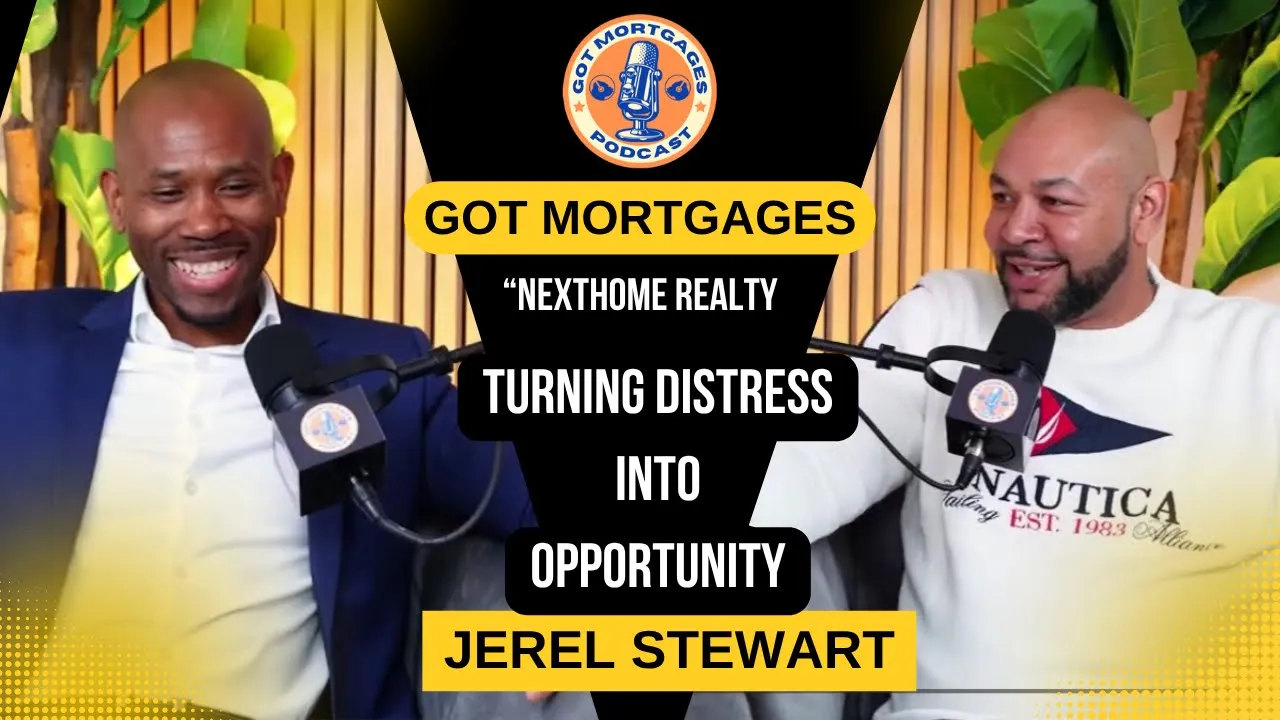
A first rental property needs more than an attractive purchase price: it needs workable cash flow, suitable financing, and a team that can address the property’s risks. In this Got Mortgages Podcast conversation, Santi Rodriguez, also known as Funds N Flips, speaks with Jerel Stewart of NextHome Realty about sourcing investor deals and helping distressed owners evaluate their options. Their discussion connects two often-separated priorities: making an investment work financially and treating the seller’s remaining equity as something worth protecting.
Conversation originally published April 29, 2026. Recap added October 24, 2026.
Watch the original conversation on YouTube.
Key Takeaways: Define the Investment Before Chasing the Deal
Jerel describes an investor-focused real estate business built around sourcing properties, analyzing opportunities, and helping connect buyers with funding. Yet he is still preparing for his own first investment. That distinction makes this conversation useful for beginners: exposure to experienced investors can help someone prepare, but it does not replace choosing a strategy and assembling the resources to execute it.
Three practical lessons stand out. First, decide whether the objective is resale profit or recurring rental income before screening properties. Second, an off-market lead still needs financial and property due diligence. Third, foreclosure-related opportunities require attention to the owner’s legal position and net proceeds, not simply the investor’s acquisition price. A workable transaction must account for more than one side of the closing table.
Why Jerel Prefers Buy-and-Hold to a Fix-and-Flip Business
Jerel’s preferred first investment is a rental. He explains that many of his clients flip properties, but he is more interested in building cash flow over time. His observation is straightforward: a flipping business continually needs another acquisition, renovation, and sale. He wants to build an ownership base that can eventually support other activities.
That is a strategic preference, not a claim that rentals are effortless or always more profitable. A flip relies heavily on the relationship between acquisition cost, renovation spending, carrying expenses, and resale proceeds. A rental must also work after the initial transaction, when rent collections, operating costs, repairs, and financing payments become the recurring reality.
For a first-time buyer, the practical application is to write a brief investment mandate before viewing properties. Specify the intended holding strategy, acceptable property condition, available cash, and capacity to manage repairs or tenants. A house that looks attractive as a resale project may be a poor rental at the same price. Calling it an investment does not resolve that difference.
What It Means for a Rental Property to Pencil Out
Jerel says his investor clients concentrate on numbers rather than the emotional appeal common in a personal home purchase. He also describes difficulty finding deals that meet their requirements when sellers’ expectations and buyers’ financing costs do not align. The useful lesson is his response: tighten the analysis instead of stretching assumptions to justify a purchase.
For a rental, that means starting with supportable rent and then estimating vacancy, property taxes, insurance, maintenance, management, and owner-paid expenses. Compare the resulting operating income with the proposed debt payments. Separately identify the cash needed for closing, initial repairs, and reserves. A property can show positive monthly cash flow while still requiring more upfront money than the buyer can safely commit.
Test the weak points before making an offer. What happens if a repair is more expensive than expected, the property takes longer to lease, or achievable rent is below the seller’s projection? The objective is to find the assumptions that could turn a promising acquisition into a cash drain.
Build the Financing and Contractor Team Before the First Purchase
Jerel’s preparation includes building relationships, finding contractors, and learning more about construction. Santi connects that preparation with the financing conversation: what would Jerel’s first deal look like, and how could the funding be structured around it? Their exchange treats the first purchase as a coordinated project rather than an isolated loan application.
A practical sequence is to discuss the intended strategy with a lender, establish how much cash is available, and then narrow the property search. Bring a contractor into the evaluation when repairs materially affect the budget or timeline. Financing capacity and renovation capacity need to be understood together; an affordable acquisition can become unworkable if the buyer cannot fund the necessary improvements.
The speakers also want to educate new investors about funding options. They do not walk through a particular program’s eligibility rules or pricing. Before relying on any proposed financing, ask what property conditions are acceptable, what cash and reserves are needed, when funds become available, and whether the loan fits the intended holding period. Education should precede an obligation to close.
Off-Market Prospecting Creates Leads, Not Automatic Bargains
Jerel uses several channels to find opportunities: direct outreach, cold calling, direct mail, wholesalers, and professional networking. This is not a single-source acquisition model. He is combining established prospecting methods with relationships that can bring properties to his attention outside ordinary listing searches.
He sees off-market sourcing as an important route to attractive deals. Buyers should still separate how they found the property from what it is worth. An unlisted property can be overpriced, need substantial work, or carry title complications. A wholesaler’s projected resale value or repair estimate should be treated as a starting point for investigation rather than the buyer’s final underwriting.
For a beginner, create a consistent intake process for every lead. Record the asking price, occupancy, condition, expected repairs, ownership information, and proposed closing timetable. Then apply the same financial standards used for a listed property. When sourcing involves direct outreach, lawful and respectful communication matters, especially if the owner is already under financial pressure.
Foreclosure and Remaining Equity Need Separate Analysis
A central theme is that homeowners facing foreclosure may not understand their available options. Jerel emphasizes professional involvement, including legal help, while Santi highlights the importance of connecting an owner with someone who actually works in this area. The conversation’s strongest practical message is to investigate promptly rather than assume the situation is either hopeless or easily reversible.
The legal distinctions matter. Reinstatement generally concerns bringing a defaulted loan current under applicable terms and law. Redemption can involve recovering an interest in property by paying a legally required amount within an applicable period. These are not interchangeable remedies, and a post-sale redemption right is not available in every foreclosure. The relevant law, type of proceeding, case status, and deadlines control what may be possible.
Equity also needs its own calculation. Estimated property value is not the same as money an owner can receive. Loan payoffs, liens, legal expenses, transaction costs, and any financing needed to complete a resolution can reduce the available proceeds. Foreclosure does not universally mean that every dollar of equity disappears; rights to surplus proceeds may also need review. An owner should have a qualified local attorney assess the actual case and any approaching deadlines.
Helping a Seller Requires More Than Offering a Fast Closing
Jerel challenges the idea that an investor’s profit necessarily comes at a distressed owner’s expense. His stated approach is to solve a problem while making the investment work. That is an important aspiration, but the practical test is whether the owner understands the transaction, the costs, the alternatives, and the amount expected at closing.
A useful seller-facing comparison looks at net proceeds and feasibility, not just price. Depending on the circumstances, an owner may need to compare an investor offer with a conventional listing or ask about available retention options. Timing, repair requirements, and legal deadlines may affect those choices. Independent legal advice is particularly valuable when the proposed solution involves foreclosure proceedings or additional financing.
Protecting equity can mean helping someone sell and move forward rather than helping them keep the property. Those are different outcomes and should be described honestly. The owner’s next housing step also belongs in the planning conversation: when possession changes, whether relocation is practical, and whether expected proceeds are sufficient for the intended transition.
Why Experienced Investors Explore Parks and Multifamily Properties
Jerel says some experienced clients have been exploring RV parks and mobile-home parks when single-family acquisitions do not meet their investment requirements. Santi also brings multifamily properties into the discussion. This reflects those clients’ search for workable opportunities, not a recommendation that every beginner should switch property types.
The practical lesson is to reassess the business model without assuming that a different asset class solves every problem. Multifamily properties require attention to leases, collections, expenses, and building systems. Parks introduce additional questions about infrastructure, land use, utility responsibilities, and the ownership of individual homes or units. More potential income sources can also mean more operational complexity.
For a new investor, learning why an experienced buyer rejected a single-family deal may be more useful than copying that buyer’s next acquisition. Their team, financing access, and operating experience may be very different. Expand the search only when the underwriting and management plan expand with it.
Final Checklist: Turn the Conversation Into a Buying Plan
Define the objective. Choose rental income or a resale strategy, identify the cash available, and decide how much renovation and ongoing management you can handle. Keep the search aligned with those limits.
Confirm the numbers and execution plan. Validate rent or resale assumptions, obtain realistic repair input, review financing requirements, and retain reserves. Apply the same standards to direct-mail leads, wholesaler opportunities, and listed properties.
If foreclosure is involved, establish the legal status before promising a solution. Have the owner obtain qualified local legal advice, identify deadlines and payoff requirements, and compare realistic options. Review the owner’s estimated net proceeds and housing transition as carefully as the investor’s expected return.
Frequently asked questions
Should a first-time investor choose a rental or a fix-and-flip?
Choose based on the intended income model and your ability to execute it. Jerel prefers rentals because he wants recurring cash flow rather than continually finding the next resale project. A flip needs a credible renovation and sale plan; a rental needs sustainable operating income, reserves, and a management plan.
What costs should I include when analyzing my first rental?
Include vacancy, taxes, insurance, maintenance, management, owner-paid expenses, and financing payments. Track acquisition costs, initial repairs, and reserves separately so you can see both the monthly economics and the total cash required to get the property operating.
How does Jerel find off-market investment properties?
He describes direct outreach, cold calling, direct mail, wholesaler leads, and networking. His approach combines multiple sources rather than relying on one channel. Regardless of the source, a buyer still needs to investigate price, condition, title, occupancy, and closing requirements.
What should I ask a lender before making an investment-property offer?
Explain the intended property type, condition, renovation plan, and holding strategy. Ask about required cash, reserves, documentation, acceptable property condition, funding timing, and loan terms. The interview encourages financing education but does not provide a specific product’s qualification rules.
Can a homeowner recover a property after a foreclosure sale?
Sometimes, but there is no universal post-sale recovery right or deadline. Any redemption right depends on applicable law, the proceeding, and the case’s status. A qualified local attorney should review the documents immediately rather than the homeowner relying on a general timeline.
Does foreclosure always eliminate a homeowner’s remaining equity?
No. The financial outcome depends on sale proceeds, secured debts, costs, and applicable law. An owner may have rights concerning surplus proceeds. Before assuming that equity is lost or available to withdraw, obtain a case-specific review and an accounting of obligations.
How can a distressed homeowner evaluate an investor offer?
Compare expected net proceeds after payoffs, liens, fees, and closing expenses, not just the headline price. Review timing, repair obligations, possession terms, and feasible alternatives. Independent advice helps the owner assess whether the proposed transaction addresses the actual problem.
Are RV parks or mobile-home parks an easier first investment?
Not necessarily. Jerel discusses experienced clients exploring these properties, not a beginner shortcut. Buyers need to understand infrastructure, utilities, land use, operating responsibilities, and financing. A different property type requires different due diligence rather than simply a larger income projection.
To talk with PRMG Got Mortgages, call 973-536-0276, visit GotMortgages.com, contact the team or build your mortgage plan.
Explore more Got Mortgages Insights and Abdel Khawatmi’s profile. Explore more conversations at the Got Mortgages Podcast website.
Author: Abdel Khawatmi with PRMG Got Mortgages | 973-536-0276
This article is general mortgage information only. It is not a commitment to lend, a rate quote, or legal or tax advice. Loan approval, terms and pricing depend on a full application, credit review and property details, and market conditions change. Talk with a licensed loan officer and your own legal or tax professional about your situation. NMLS #1712023 | PRMG NMLS #75243.