
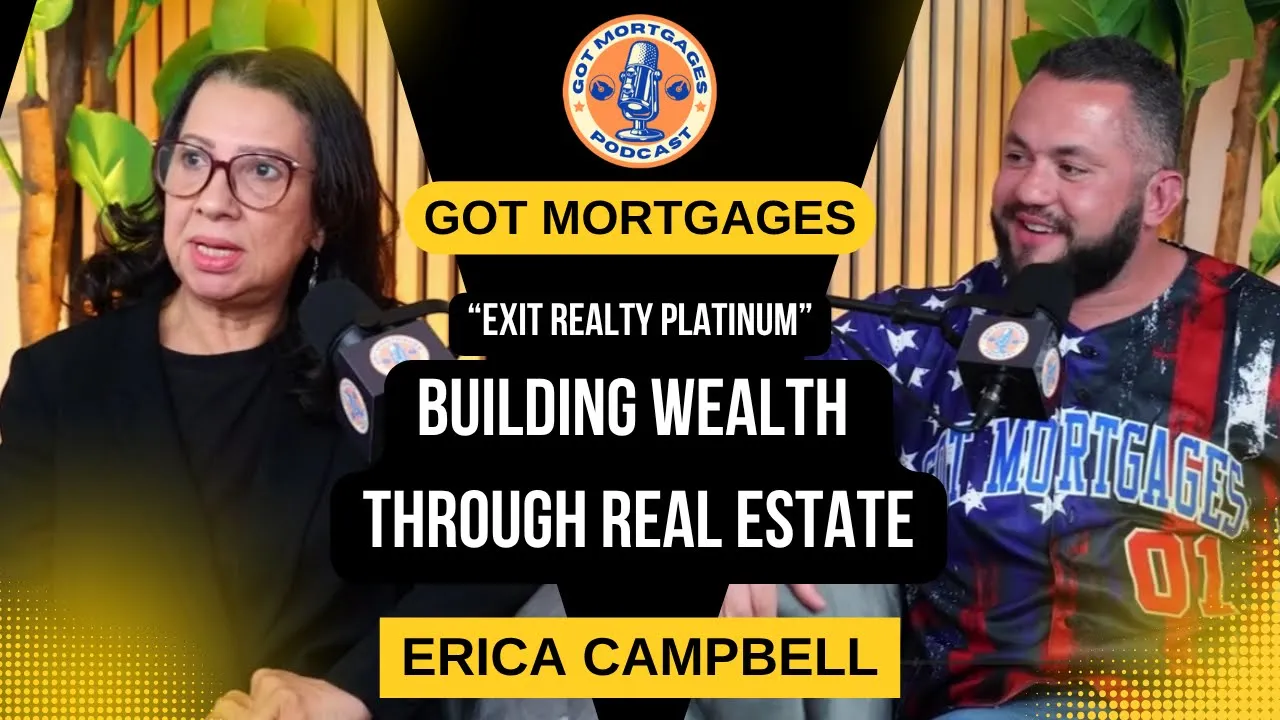
Building a brokerage takes more than recruiting agents: it takes a repeatable way to help them learn, solve problems and serve clients. On the Got Mortgages Podcast, Erica Lindy Campbell explains how she brings that approach to Exit Realty Platinum in Montclair, New Jersey, and to her work as a loan officer with the Got Mortgages team. Speaking with Abdel Khawatmi, she connects her background in IT and property investing to a leadership philosophy built around education, accessible support and personal attention. Her central lesson is practical: technology can organize the work, but people still need someone who will help them move through it.
Conversation originally published April 29, 2026. Recap added October 24, 2026.
Watch the original conversation on YouTube.
Key Takeaways: Build Support Around the People You Recruit
Erica’s career developed through connected stages: IT work, real estate investing, licensed real estate practice, brokerage ownership and mortgage lending. Her account shows how experience in one field can supply useful habits for another, especially an analytical approach to understanding problems before proposing solutions. Instead, her account shows how experience in one field can supply useful habits for another, especially an analytical approach to understanding problems before proposing solutions.
The brokerage’s support structure is specific: Wednesday evening training, a monthly Saturday boot camp and individual appointments with leadership. These are different forms of help for different obstacles. A class can introduce a process, a work session can turn it into action, and a private appointment can address the point where an individual agent gets stuck.
Three other ideas run through the conversation. Recruitment should account for team fit, not just head count. Technology adoption requires patient instruction rather than merely providing access. Community events create introductions, but follow-up determines whether those introductions develop into useful relationships. Together, these ideas describe growth as an ongoing service responsibility rather than a recruiting campaign.
From IT and Investing to Brokerage Ownership
Erica describes about 20 years in IT and over 20 years as a licensed real estate professional, with investing preceding her license. These experiences overlapped rather than forming a simple sequence of separate careers. She completed a short technical-school program, worked for several companies and invested while still employed in technology before moving fully into real estate.
Abdel connects that background to the way she approaches business: identify the issue, consider a solution and understand how to reach it. This is different from treating every client conversation as a sales presentation. Analytical thinking encourages a professional to ask what is actually preventing progress before deciding what service or next step will help.
For someone considering a similar career change, the useful application is to inventory transferable skills rather than assume a new industry requires starting from zero. Technical troubleshooting, explaining unfamiliar systems and organizing complex tasks can all support real estate work. Investing can add a property-owner perspective, although it does not replace learning the responsibilities of representing clients.
Erica’s story also distinguishes doing transactions from leading people. Brokerage ownership brings a second layer of work: helping other professionals become capable and consistent. Her experience matters not simply because she has accumulated it, but because she makes time to translate it into instruction.
Recruiting, Retention and Revenue Must Work Together
Abdel frames brokerage growth around three Rs: recruiting, retaining agents and generating revenue. His concern is what happens after someone joins. A brokerage that keeps adding people without developing them can build a roster without building a functioning business. Erica’s response centers on leadership taking responsibility for education rather than assuming new agents will find their own way.
The two discuss complementary leadership styles within Erica’s office. She describes herself as someone agents approach for patient guidance, while John offers more direct, task-oriented instruction. The point is not that every brokerage needs the same personalities. It is that agents may need different types of support, and leadership works better when those needs have somewhere to go.
Erica also describes EXIT’s recruitment-related residual compensation structure, including provisions connected to retirement and family benefits. In the discussion, those features help explain why someone might value a long-term relationship with the brand. They should be understood as her account of the model, not as an unconditional income promise; anyone evaluating it should review the applicable written terms and eligibility requirements.
Importantly, she says the recruiting agent is not left to manage a new colleague’s entire development. She and John take over that educational responsibility. A practical lesson for brokerage owners is to separate the incentive to introduce someone from the obligation to onboard and support that person. Clear ownership of the latter prevents new recruits from falling between roles.
Turn Agent Education Into Scheduled Practice
Erica’s office holds training on Wednesday evenings, generally through Zoom, and brings in outside educators when appropriate. She also describes a monthly Saturday boot camp lasting four hours. Unlike a presentation-only session, that block is intended for doing the work, including activities such as cold calling. Individual meetings provide another route for agents who need closer guidance.
These formats address a common gap between understanding and execution. An agent may follow a demonstration and still struggle when attempting the task alone. Erica acknowledges that homework does not always come back completed. That observation matters: attendance and exposure do not prove someone can independently use a process.
The office also brings education to a familiar environment rather than always sending agents elsewhere. Erica sees value in learning somewhere people already feel comfortable. For a brokerage, this makes training more than a calendar of outside classes. It becomes an integrated part of the working environment, with leaders available to connect instruction to actual responsibilities.
A practical step is to give each training format a distinct job. Use the group session to explain a workflow, the boot camp to practice it and the individual appointment to resolve a specific barrier. Before adding another course, ask what agents should be able to do afterward and how leadership will know they can do it.
Technology Adoption Is a Teaching Problem, Not Just a Software Decision
Both speakers acknowledge that implementing technology is difficult even when leadership believes in it. Erica says her office has tried to introduce systems, while Abdel describes adjusting his own instruction after colleagues encouraged him to return to the basics. Erica responds positively to a more participatory session because people in the room were more involved.
That exchange exposes a useful distinction: an available tool is not necessarily an adopted tool. Franchise programs and office systems may already exist, but agents still need to understand where to begin and how those tools fit into daily work. Erica favors using established resources rather than rebuilding something that is already available.
For leaders, the practical next step is to reduce the distance between explanation and use. Demonstrate one relevant task, let the agent complete it and identify the exact point of confusion. Repeating an overview may be less useful than watching someone attempt the workflow. This approach also gives technically hesitant agents a manageable starting point without suggesting they can ignore technology altogether.
Keep Human Service at the Center of the Digital Workflow
Erica is willing to adapt the setting of a meeting when that helps someone make progress. She describes an open-door approach that can include meeting at the office, in another convenient location or wherever appropriate assistance is needed. The larger principle is that a client’s difficulty using a system should prompt a service decision, not an automatic judgment about their willingness to cooperate.
The conversation uses this hands-on attitude to examine AI’s limits. Abdel and Erica emphasize the human work of recognizing frustration, showing empathy and staying engaged when a process becomes difficult. Their argument is not a technical evaluation of every AI capability. It is a reminder that efficiency does not remove the need for accountable, responsive professionals.
A useful business application is to distinguish routine organization from moments requiring judgment. Technology can support communication and task management, while a professional remains responsible for noticing confusion, explaining choices and arranging appropriate help. Assistance should also preserve the client’s privacy rather than treating access to personal documents as an informal convenience.
Abdel connects trust with understanding what matters to a borrower, including monthly payment and cash to close. Those priorities can make a financing conversation more useful than a discussion focused only on a quoted rate. That does not make rates, fees or compensation irrelevant. Good service helps clients understand both the costs and the practical consequences of their choices.
Make Collaboration Available When Questions Actually Arise
Erica values being able to ask another team member for help when a particular leader is unavailable. She sees a similar culture in her brokerage and the Got Mortgages office: colleagues can turn to one another rather than wait for a single person to solve everything. Abdel describes teamwork as an expectation, not an optional extra.
He also notes that mortgage professionals develop different areas of familiarity, mentioning HELOCs, VA lending, DSCR and non-QM scenarios. The useful point is not that every option fits every borrower. It is that a team can identify knowledgeable colleagues and seek appropriate input instead of expecting one person to hold every answer.
The conversation extends this idea to a shared virtual office that offers access to colleagues across the day. Erica appreciates being able to join when she encounters a question. For distributed teams, the application is to create a recognizable place for help, with clear expectations about availability and escalation.
Erica also values learning through time spent around experienced colleagues. A responsible version of that approach uses appropriate training discussions and anonymized examples, while keeping confidential client conversations restricted. Shared learning should broaden professional judgment without broadening unnecessary access to personal information.
Community Events Need a Follow-Up Plan
Erica describes participating in Montclair-area community activities, including an African American heritage festival, a Caribbean festival and flag-raising events recognizing different countries’ independence. These are settings where the team can talk with residents and hear their questions. She also notes that her mortgage role allows her to contribute financing knowledge alongside real estate guidance.
Her most important distinction is between showing up and following up. Setting up a table or distributing materials creates an opportunity, but it does not complete the relationship-building process. The conversation presents community participation as a starting point for continued service rather than an automatic source of business.
A practical follow-up plan should begin with the person’s actual question. Someone wondering whether to buy needs a different next conversation from an owner considering a sale or an investor exploring financing. With permission, record the relevant topic and preferred contact method, then offer a specific next step. This is more useful than sending every attendee the same broad sales message.
Combining real estate and mortgage knowledge can make those early conversations more connected, but clarity still matters. Explain which role you are performing and what further review is needed. An introduction at a community event is an opportunity to educate, not a substitute for a full assessment of a transaction or loan.
Action Checklist: Put the Support System Into Practice
Review the path from recruitment to independent work. Identify who welcomes a new agent, who explains existing resources and who follows up after the first training sessions. Do not leave those responsibilities implicit or assume the person who recruited the agent will handle everything.
Give education a practical output. Choose one recurring task for the next group session, schedule time to practice it and make individual support available for unresolved questions. Evaluate whether people can complete the task, not simply whether they attended.
Define how colleagues request help and how clients receive alternatives when digital steps become difficult. Keep confidential information within appropriate channels, and make human assistance part of the service design rather than a last-minute rescue.
Before the next community event, decide how interested attendees can request contact and who will respond. Follow up on the question they actually asked. Erica’s example points to a consistent operating principle: growth depends on what the team does after the introduction, after the training and after the first obstacle.
Frequently asked questions
How did Erica Campbell transition from IT into real estate?
Erica invested in real estate while working in IT, then moved into licensed real estate practice and eventually brokerage ownership. She describes approximately 20 years in IT and more than 20 years with a real estate license, with investing beginning before licensure.
What are the three Rs of brokerage growth discussed in the episode?
Abdel identifies recruiting, retention and revenue. The discussion emphasizes that recruiting alone is insufficient: leadership must help agents learn, perform their work and become productive members of the business.
What training schedule does Erica describe at Exit Realty Platinum?
She describes Wednesday evening training, generally by Zoom, a four-hour Saturday boot camp once a month and one-on-one appointments. The office also brings in outside educators, including for continuing education.
How is the monthly boot camp different from an ordinary training class?
The boot camp is intended as a working session. Erica gives cold calling as an example of an activity agents might perform during that time. Its value is the opportunity to act and receive support rather than only listen to instructions.
How can a brokerage help agents who struggle with technology?
The episode points toward basic instruction, participation and individual support. A practical approach is to demonstrate one task, have the agent attempt it and address the specific obstacle before moving to a more advanced workflow.
What should agents follow up on after a community festival?
Follow up on the attendee’s specific housing or financing question, using a contact method they have agreed to. Offer a relevant next conversation, such as discussing buying plans, rather than treating every introduction as permission for the same sales pitch.
What is the benefit of a shared virtual office for a mortgage team?
Erica values being able to join and ask for help when a question arises. A shared virtual space can make colleagues more accessible and reduce dependence on a single leader, provided availability and confidentiality expectations are clear.
What should an agent verify about the EXIT residual model discussed?
Review the current written program terms, eligibility conditions, payment calculations and provisions related to retirement or beneficiaries. Erica discusses these features as part of the brand’s appeal, but her explanation is not a substitute for the governing documents or an assurance of future income.
To talk with PRMG Got Mortgages, call 973-536-0276, visit GotMortgages.com, contact the team or build your mortgage plan.
Explore more Got Mortgages Insights and Abdel Khawatmi’s profile. Explore more conversations at the Got Mortgages Podcast website.
Author: Abdel Khawatmi with PRMG Got Mortgages | 973-536-0276
This article is general mortgage information only. It is not a commitment to lend, a rate quote, or legal or tax advice. Loan approval, terms and pricing depend on a full application, credit review and property details, and market conditions change. Talk with a licensed loan officer and your own legal or tax professional about your situation. NMLS #1712023 | PRMG NMLS #75243.