
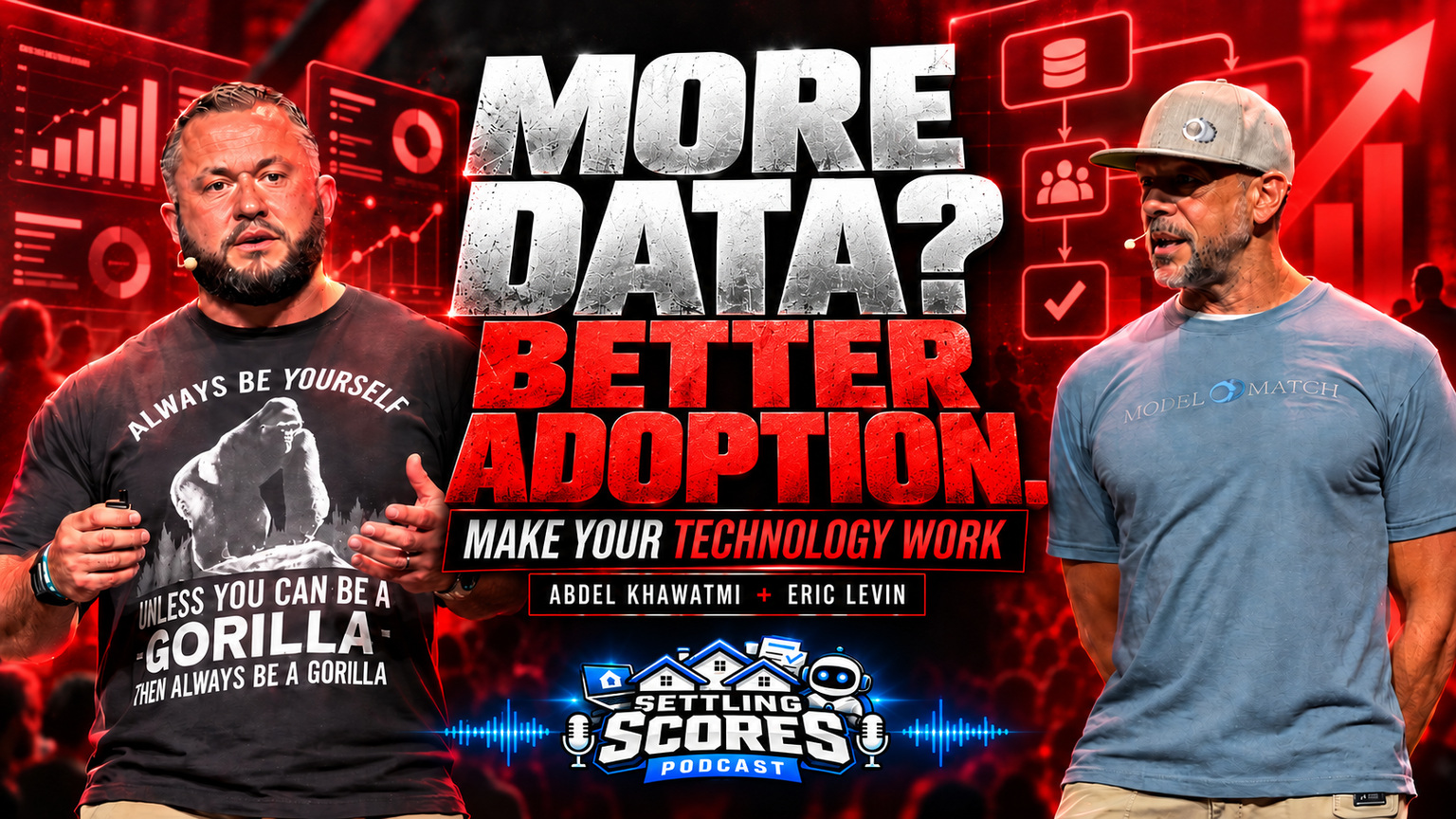
The mortgage industry’s technology challenge is not simply finding more data. It is making useful information easy enough to act on during a real workday. In Settling Scores Episode 9, cohosts Abdel Khawatmi of PRMG Got Mortgages and Eric Levin, cofounder of Model Match, argue that adoption improves when connected tools support an originator’s existing workflow instead of demanding another login and another manual handoff.
Episode originally published July 3, 2026. Archive recap added October 24, 2026.
Watch the original July 3 conversation on YouTube.
Key takeaways: remove friction, not responsibility
- Conference learning becomes useful when it produces implementation steps, tracking and a review.
- A connected working environment can reduce the effort of moving information between platforms.
- Keep useful underlying systems; simplify how people reach them.
- Define the business question before asking an assistant to search or compare.
- Judge AI-assisted work by accuracy and appropriate follow-through, not the number of outputs generated.
- Technology supports relationships and authentic service; it does not replace them.
Why another dashboard may not solve the problem
Eric’s central distinction is between owning technology and using it. A company leader may recognize a platform’s value while expecting loan officers not to adopt it. He sees two responsibilities: leadership must address the cultural disconnect, and technology providers must improve service, efficiency and ease of use.
That is more specific than telling people to embrace AI. A tool can contain valuable information and still fail in practice if using it means interrupting work, finding the right screen, rebuilding filters, exporting results and formatting them somewhere else. The obstacle may be the path to the answer rather than the answer itself.
The episode therefore asks a practical question: where does the originator already work, and can relevant information become accessible there? The aim is not to eliminate every specialized system. It is to reduce the effort required to use those systems for a meaningful next step.
Turn an industry event into an implementation process
Abdel describes attending a mastermind event with a different approach to notes. He recorded sessions and placed their transcripts into a Claude project. His requested outputs covered three functions: action steps, ways to track implementation and a recap process for accountability.
He also explains that the event did not necessarily reveal a completely new direction for his business. Some sessions confirmed work already underway, including tracking conversion and maintaining visibility. That distinction matters: learning can validate a sound process without requiring a new purchase or a complete operational reset.
A suggested adaptation is to select one idea after an event and write a short implementation brief. State what will change, who will own it, how completion will be observed and when the team will review it. Use recordings or shared materials only through appropriate permissions and approved processes.
For example, a team might leave a marketing session with a plan to improve educational follow-up. Rather than generating a long summary and stopping, assign someone to prepare a reviewed resource, identify its intended audience and schedule the follow-up. The event’s value then becomes an observable change in service, not merely a folder of notes.
Consolidation is different from canceling everything
Abdel gives concrete examples of reviewing his own subscriptions. He says he removed Gamma after building presentation workflows in Claude, stopped using CapCut and reduced his StreamYard plan. These are accounts of his July decisions, not a recommendation that every mortgage team should use the same stack.
Just as important, he describes discussing connectivity with his revenue manager. A subscription may support a CRM connection or a Zapier workflow even when its purpose is not immediately obvious. Removing it without understanding that dependency could undo useful work.
A suggested review separates three questions: Is the capability still needed? Is someone actually using it? Does another process depend on it? A presentation tool that has genuinely been replaced is different from a connection that quietly supports an active workflow. Consolidation should reduce duplication without breaking the chain between information and service.
The hub should not have to be the loan officer
Eric uses a hub-and-spoke analogy to describe the burden of disconnected technology. When every platform operates separately, the originator becomes the hub: the person who remembers where information lives, moves it between systems and reconciles the results.
In the July conversation, he says Model Match had released an MCP connection that week. He describes connecting an assistant such as Claude, GPT or a company’s proprietary agent to Model Match information. His emphasis is the working experience: people should be able to use an environment they are comfortable with rather than being locked into one interface.
This is a report of what Eric described at the time, not a claim that every account, assistant or organization has the same connection today. A team considering this approach should establish which connections its approved environment actually supports and what information those connections can access.
Eric explicitly says a useful CRM should not be discarded just because an assistant can provide another access point. The underlying system can remain valuable while the interaction becomes simpler. Abdel’s corresponding benefit is fewer steps between retrieving information and receiving a useful guide, PDF or step-by-step explanation.
Ask a business question precise enough to answer
Eric illustrates connected analysis with a specific comparison. His example concerns originators in North Carolina, South Carolina and Georgia, working for independent mortgage bankers, with at least $10 million in volume over the preceding 24 months and more than half their business in purchases. He then wants to compare trends, volume groups, market-share direction and possible product context.
Those numbers define his example query; they are not a market statistic or a recommended production target. The lesson is the structure of the request. Geography, company type, time period, purchase mix and the reason for comparison all narrow the question before the assistant begins.
Abdel offers a Toms River example: asking only for loan officers producing $10 million to $30 million does not explain what kind of business the user wants to understand. A refinance-heavy practice, a conventional-focused practice and one with different loan sizes or HELOC activity may not represent the same opportunity.
A suggested prompt structure is: “Using the connected source, compare this geography and company group over this defined period. Separate purchase and refinance activity, explain the available product context, identify missing information and show which results support the comparison.” Review the source coverage and definitions before treating the output as a decision.
A local application for Ocean and Monmouth County teams
For teams serving Ocean County and Monmouth County, the same discipline can make local relationship work more intentional. A Toms River originator considering professional outreach can first define the type of practice and business need being evaluated. An Eatontown team planning partner education can start with the questions its partners actually ask.
These are suggested applications, not findings about either market. Do not assume that an agent’s or originator’s production profile explains their goals, service expectations or willingness to collaborate. Use relevant information to prepare better questions, then have the conversation.
For example, after a partner discussion about educational resources, prepare a concise recap of the agreed topic, the intended audience and the promised next step. If connected research informed that preparation, distinguish the research from what the partner actually said. That keeps local service personal rather than turning a data profile into a substitute for listening.
Make the follow-up useful, not just abundant
Later in the episode, Abdel describes using meeting transcripts with chat tools or Claude and then NotebookLM. He discusses creating different formats, including audio, an overview, an infographic, an implementation brief and a checklist. Fireflies and Otter appear as examples of transcript capture tools.
The substantive idea is translating a conversation into something the recipient can use. A checklist may clarify a sequence; a short brief may preserve decisions; an audio format may suit someone who prefers listening. Producing every format is not automatically better than sending one accurate, relevant resource.
Eric supplies the quality test: if the summary, next action or outcome is wrong, using AI does not excuse it. A suggested review asks whether the output accurately reflects the discussion, separates commitments from suggestions and assigns the correct next step. Keep confidential information within approved systems and share only material appropriate for the recipient.
Update the process without chasing every release
Abdel warns that an AI-related standard operating procedure may need revision as tools change. His broader point is knowing what you want the technology to accomplish. A rapidly changing toolset is not a reason to let the business objective become vague.
A manageable suggested trial is one repeatable workflow: prepare for a partner conversation, produce a reviewed recap and record the agreed follow-up. Compare how much manual movement it requires before and after a connection is introduced. Also check whether the recap is correct and whether the commitment is completed.
Adoption is not demonstrated by opening an assistant every day. It is demonstrated when a useful process becomes easier to execute reliably. That is why the episode closes on daily rhythm and authenticity: connected technology should give professionals more capacity to do the work that earns trust.
Frequently asked questions
Who hosts this episode of Settling Scores?
Abdel Khawatmi of PRMG Got Mortgages and Eric Levin, cofounder of Model Match, cohost the July 3, 2026 conversation about industry events, connected technology and practical adoption.
What does “adoption problem” mean here?
It means access to information is not enough. People need an understandable, low-friction way to use it within prospecting, preparation, follow-up and other work they already perform.
What did Eric say about MCP connections?
He said Model Match had released a connection that week allowing assistants to access its information. He framed the benefit as working through a familiar environment rather than repeatedly switching interfaces.
Does using an assistant mean replacing the CRM?
No. Eric specifically argues against dropping a useful CRM merely because an assistant can connect to it. Simplifying access and replacing the underlying system are different decisions.
How did Abdel use conference transcripts?
He described placing session transcripts into a Claude project to develop action steps, tracking and an accountability recap. The useful pattern is learning followed by implementation and review.
Why is a production range not enough for a comparison?
A range alone omits geography, period, company structure and business mix. The hosts explain that purchase activity, refinance activity, product context and loan sizes can change what a comparison means.
Should a team copy Abdel’s subscription changes?
Not automatically. His examples reflect his own usage. Review whether a tool is redundant and whether any CRM connections or other workflows still depend on it before removing it.
How should AI-generated meeting resources be reviewed?
Compare them with the source discussion, confirm commitments and remove unsupported conclusions. Choose the format the recipient needs, and use approved processes for sensitive information.
How can this apply in Toms River or Eatontown?
Define one local outreach or educational workflow, use relevant information for preparation and check that promised follow-up happens. Do not substitute assumed local benchmarks for the team’s actual observations.
How can I contact Got Mortgages?
Call 973-536-0276 or visit GotMortgages.com to begin a conversation with PRMG Got Mortgages.
Make information easier to act on
The strongest takeaway is not to accumulate more tools. Define the question, connect the necessary information, review the result and complete the next action. That makes technology a support for dependable relationships rather than another task competing with them.
To talk with PRMG Got Mortgages, call 973-536-0276, visit GotMortgages.com, contact the team or build your mortgage plan.
Explore more Mortgage Intel and Abdel Khawatmi’s profile. Explore more conversations at the Got Mortgages Podcast website.
Author: Abdel Khawatmi with PRMG Got Mortgages | 973-536-0276
This article is general mortgage information only. It is not a commitment to lend, a rate quote, or legal or tax advice. Loan approval, terms and pricing depend on a full application, credit review and property details, and market conditions change. Talk with a licensed loan officer and your own legal or tax professional about your situation. NMLS #1712023 | PRMG NMLS #75243.