
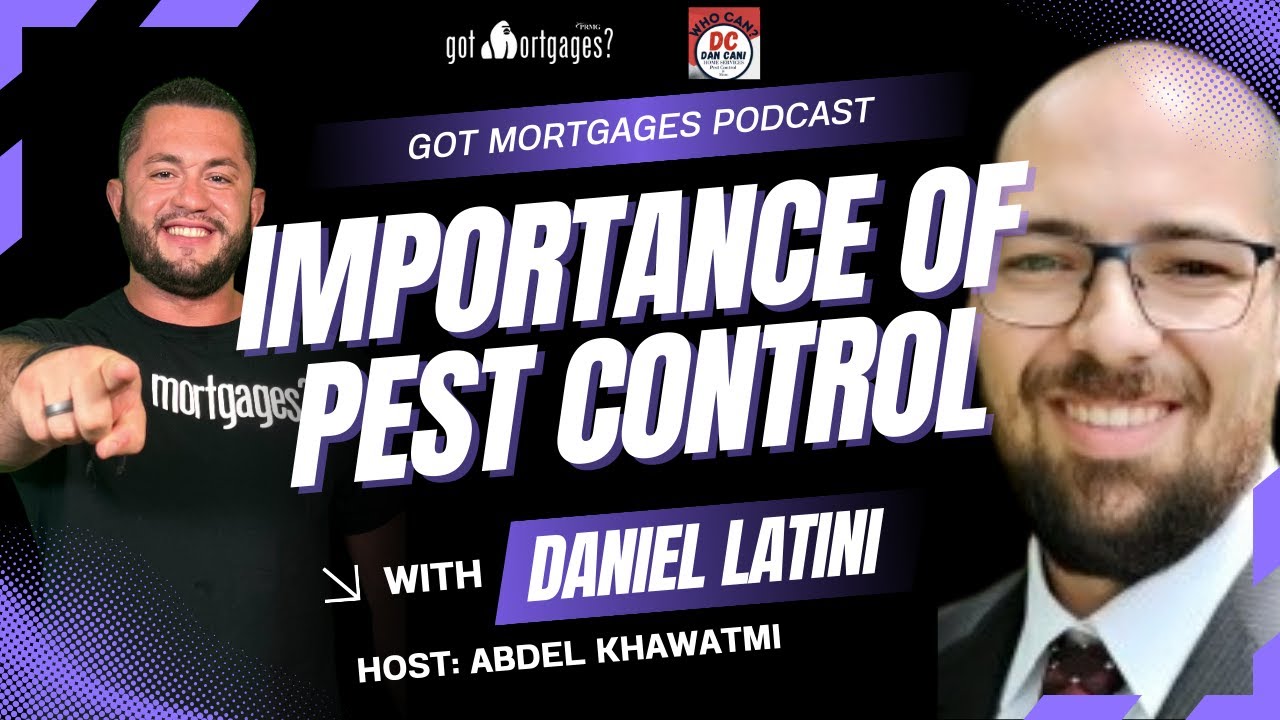
Pest control belongs in both the homebuying process and the ongoing maintenance budget—not just on the to-do list after insects appear. On the Got Mortgages Podcast, Dan “The Bug Man” Latini, founder of Dan Can Home Services, explains why moisture, overlooked crawl spaces, and small exterior openings deserve attention before they become larger problems. His conversation with Abdel Khawatmi connects practical property care with purchase inspections, mortgage-closing preparation, and the service relationships homeowners rely on after moving in.
Conversation originally published March 5, 2025. Recap added October 24, 2026.
Watch the original conversation on YouTube.
Key Takeaways: Inspect Conditions, Not Just Insects
Dan’s central message is that effective pest care includes looking for the conditions that invite problems. Standing water, drainage issues, loose crawl-space vents, and gaps around openings can matter even when no obvious infestation is visible. A service visit should help the homeowner understand both what was found and what needs attention next.
For buyers and sellers, the transaction lesson is to address wood-destroying insect concerns early. An inspection finding can create a need for treatment, repairs, documentation, or further review. Waiting until the closing deadline leaves less room to coordinate those steps, especially when the lender needs a particular report or evidence that a condition has been resolved.
For ongoing ownership, Dan favors regular observation and a service schedule matched to the property. He describes quarterly residential visits, while acknowledging that budgets and needs differ. The practical takeaway is not that every home needs the same contract; it is that homeowners need a deliberate plan rather than relying entirely on whether they happen to see a bug.
Moisture Is a Pest Issue and a Maintenance Signal
Asked what buyers should watch for, Dan puts moisture first. He connects damp conditions with termite concerns and with broader maintenance issues involving mold, mildew, and building materials. That makes moisture a useful starting point for a buyer’s questions: Where is water collecting, why is it there, and who will evaluate the underlying cause?
His discussion of gutters shows how pest prevention overlaps with ordinary upkeep. Water that collects near a house may support unwanted pest activity while also signaling a drainage problem. Treating insects without addressing persistent water accumulation leaves an important part of the situation unresolved. Conversely, a drainage repair does not by itself establish that an existing pest problem has been eliminated.
A practical application is to observe the property after rain from safe, accessible areas. Note overflowing gutters, water collecting near the foundation, and containers that retain water. Share those observations with the appropriate professional rather than trying to diagnose structural damage yourself. Dan’s broader service philosophy is to notice concerns outside the immediate treatment task; the homeowner’s job is to make sure those concerns reach someone qualified to resolve them.
Crawl Spaces Need Documented Attention, Even in Newer Homes
Crawl spaces receive repeated attention because they are easy for owners to overlook. Dan mentions collected water and fallen insulation as visible conditions worth investigating. His concern is not simply that pests can occupy an out-of-sight area; it is that a homeowner may assume the area has been checked without understanding what an inspection actually covered.
He also challenges the assumption that new construction means pest-resistant construction. His examples include gaps around crawl-space vents and vents that are not securely attached. A house can be recently built and still have openings that deserve correction. Construction age is therefore not a substitute for examining entry points, moisture conditions, and accessible areas beneath the home.
For a purchase inspection, ask whether the crawl space was accessible, which areas were examined, and whether limitations prevented a complete review. Photographs and written observations are more useful than a general reassurance that everything looked fine. If an inspector identifies cracks or another possible building concern, seek the appropriate evaluation; a pest observation alone does not establish its cause or structural significance.
Owners should not enter confined or potentially hazardous spaces just to perform a routine check. Use safely accessible observations and arrange professional inspection where access is difficult. The goal is dependable information about an overlooked part of the property, not an unsafe do-it-yourself inspection.
Wood-Destroying Insect Reports Can Affect the Closing Timeline
Abdel and Dan discuss the connection between pest findings and mortgage closings, with particular attention to VA transactions. Dan describes a wood-destroying insect report, referred to in the conversation as a WDIR, as something that can record more than a visible termite infestation. He gives carpenter-bee damage on a deck as an example of a finding that should not be ignored.
The useful distinction is between documenting a condition and deciding what the transaction requires next. A report may raise questions about activity, damage, treatment, or repair. Those questions should be answered through the inspector and the transaction team rather than collapsed into a simple promise that the property will receive a universally applicable clean bill of health.
For a VA purchase, confirm the applicable inspection and clearance requirements with the lender early. Requirements depend on the property, location, and circumstances of the loan; the conversation’s shorthand should not be treated as a rule that every reported condition has the same outcome. Ask what documentation is needed, who must provide it, and whether a follow-up inspection will be necessary.
Sellers can apply Dan’s advice by investigating known concerns before a buyer’s deadline makes them urgent. Buyers should track any required work alongside other closing conditions. Keep the report, treatment records, repair documentation, and any required follow-up together so that a completed job does not remain an unresolved paperwork issue.
Separate Pest Treatment From Damage Repair and Insurance
Dan emphasizes the potential consequences of wood-destroying pests: an issue that was hidden can eventually require contractors and disruptive repairs. For an owner, that creates two separate questions. What needs to happen to address the pest activity, and what needs to happen to assess or restore affected materials?
Those are not automatically the same service. A treatment proposal should explain the pest work being performed; it should not be assumed to include building repairs or an assessment of structural adequacy. When damage is identified, ask which additional professional needs to review it and whether that review affects the purchase timeline or maintenance budget.
The episode also raises homeowners insurance, but coverage should not be reduced to an absolute statement about every policy. Review the actual policy and ask the insurer about the specific circumstances. Financially, the sound application is to keep pest prevention and ordinary property maintenance in the ownership budget rather than assuming insurance will absorb any eventual cost. Preventive attention does not eliminate all risk, but it can help an owner make decisions before a problem becomes urgent.
Choose a Service Schedule With a Clear Scope
Dan describes a residential model built around visits every three months, combining seasonal pest service with inspection. He also mentions monthly mosquito-and-tick visits and commercial schedules that can be more frequent. These are examples of how he organizes services, not a recommendation that every property adopt one identical calendar.
The important purchasing question is what the recurring service actually includes. Ask which pests are covered, which areas are inspected, what happens between scheduled visits, and whether wood-destroying insect work is separate. Also ask how recommendations are recorded. A recurring fee is easier to evaluate when the homeowner can see what was inspected, what was done, and what remains their responsibility.
Dan acknowledges a familiar consumer concern: if no pests are visible, why keep paying? His answer is that prevention may be doing useful work before the owner notices trouble. Still, absence of visible pests is not, by itself, proof of a service’s effectiveness. Written observations and a property-specific explanation provide a stronger basis for evaluating ongoing care.
He is also open to homeowners handling some tasks themselves. A sensible division is to keep basic housekeeping, accessible water removal, and routine observation on the owner’s list while seeking professional identification or treatment when the problem is uncertain. Convenience and reassurance have value, but the service should fit the home rather than the other way around.
Identification and Continuing Education Matter More Than Indiscriminate Spraying
One of Dan’s most practical examples is the call about flying ants that may actually involve termites. To an untrained observer, winged insects can look similar. The decision should not rest on a quick guess, particularly when the possible alternatives have very different implications for the property.
His broader point is that pest management requires continuing education. He names invasive species, including spotted lanternflies, brown marmorated stink bugs, and Asian lady beetles, while describing the need to adapt to unfamiliar problems. He also stresses avoiding unnecessary harm to beneficial organisms rather than treating every insect as a target.
For homeowners, that translates into better questions before treatment: What pest has been identified? What evidence supports that identification? What conditions are contributing to it? What approach is proposed, and what preparation or follow-up is required? A clear explanation of the target and the plan is more useful than equating a larger amount of spraying with better service.
A Trusted Home-Service Network Should Improve Follow-Through
Dan presents Dan Can Home Services as a point of contact supported by a wider professional network. Pest control is his core business, but he wants to connect customers with someone capable when a job falls outside his own work. For homeowners, that approach is useful when an inspection uncovers a drainage, repair, or maintenance need that requires another trade.
He credits involvement with the Toms River Chamber of Commerce and consistent networking with helping him build relationships and become more involved in the community. The business lesson is specific: repeated participation gives people opportunities to learn how someone communicates and follows through. It is different from collecting names and expecting immediate referrals.
Dan also describes leaving work environments where he felt route timing and sales pressure conflicted with the care he wanted to provide. His preferred distinction is time to inspect, explain, and communicate—not merely complete a treatment stop. These are his experiences and priorities, rather than evidence that every larger provider works the same way.
For consumers, a referral is a starting point, not a substitute for checking scope and suitability. Ask who will perform the work, what they are responsible for, and how completion will be documented. A useful network connects the right expertise to the problem without blurring responsibility between the pest professional, repair contractor, and transaction team.
Final Checklist: Before Closing and After Moving In
Before ordering inspections, ask the lender which pest-related reports or clearance documents apply to the transaction. Confirm who will arrange them and leave time for findings to be reviewed before the closing deadline.
During due diligence, request clear information about crawl-space access, moisture observations, exterior openings, and any wood-destroying insect findings. Read inspection limitations as carefully as the conclusions, and arrange further evaluation where a material question remains unanswered.
If work is needed, separate identification, treatment, damage evaluation, and repair into clear responsibilities. Confirm what evidence the lender or other transaction participants need to consider the issue resolved, rather than assuming a paid invoice is sufficient.
After moving in, create a maintenance routine for drainage, accessible standing water, and visible gaps or loose vents. Keep professional observations and repair records together. Revisit the pest-service schedule when property conditions change, and ask for an explanation whenever the recommended scope changes.
Frequently asked questions
What pest-related red flag should a buyer look for first?
Dan puts moisture first. Look for visible water accumulation, drainage concerns, and reports of damp crawl-space conditions. Ask an appropriate professional to assess the cause and whether pest activity or affected materials also need attention.
Does a newly built home still need pest-related inspection?
New construction does not rule out entry gaps or moisture problems. Dan highlights crawl-space vents and their surrounding openings as areas worth checking. Ask what was inspected and whether inaccessible areas or installation issues require follow-up.
What should I ask about a wood-destroying insect report?
Ask what evidence was found, where it was found, what the inspector concludes, and what follow-up is recommended. Then confirm with the lender which treatment, repair, or clearance documents are needed for your transaction.
Does a VA loan require every pest report to be completely clear?
Do not rely on that blanket interpretation. Ask the lender which requirements apply to the property's location and circumstances, and how any particular finding must be resolved. Clarify whether additional evaluation, treatment, repairs, or reinspection is necessary.
Can carpenter-bee damage matter even if there are no termites?
Yes. Dan uses a carpenter-bee hole on a deck to illustrate that wood-destroying insect reporting is not limited to termites. The inspector should explain the finding, and the lender should clarify any resulting transaction requirements.
What should a quarterly pest-control agreement explain?
It should identify covered pests, inspection areas, scheduled services, between-visit support, exclusions, and reporting practices. Ask specifically whether termite or other wood-destroying insect services are included rather than assuming general pest coverage includes them.
What should I do if I see insects that look like flying ants?
Seek reliable identification before deciding on treatment, because winged ants and termites can be confused. If practical, provide clear photographs or ask the pest professional how to preserve a specimen for identification. Do not assume appearance alone rules out termites.
How can a seller reduce pest-related surprises before closing?
Investigate known moisture, entry-point, and wood-damage concerns early. Arrange appropriate inspection and work, retain documentation, and ask the transaction team whether follow-up reporting is needed. Early attention creates time to resolve both the physical issue and the paperwork.
To talk with PRMG Got Mortgages, call 973-536-0276, visit GotMortgages.com, contact the team or build your mortgage plan.
Explore more Got Mortgages Insights and Abdel Khawatmi’s profile. Explore more conversations at the Got Mortgages Podcast website.
Author: Abdel Khawatmi with PRMG Got Mortgages | 973-536-0276
This article is general mortgage information only. It is not a commitment to lend, a rate quote, or legal or tax advice. Loan approval, terms and pricing depend on a full application, credit review and property details, and market conditions change. Talk with a licensed loan officer and your own legal or tax professional about your situation. NMLS #1712023 | PRMG NMLS #75243.