
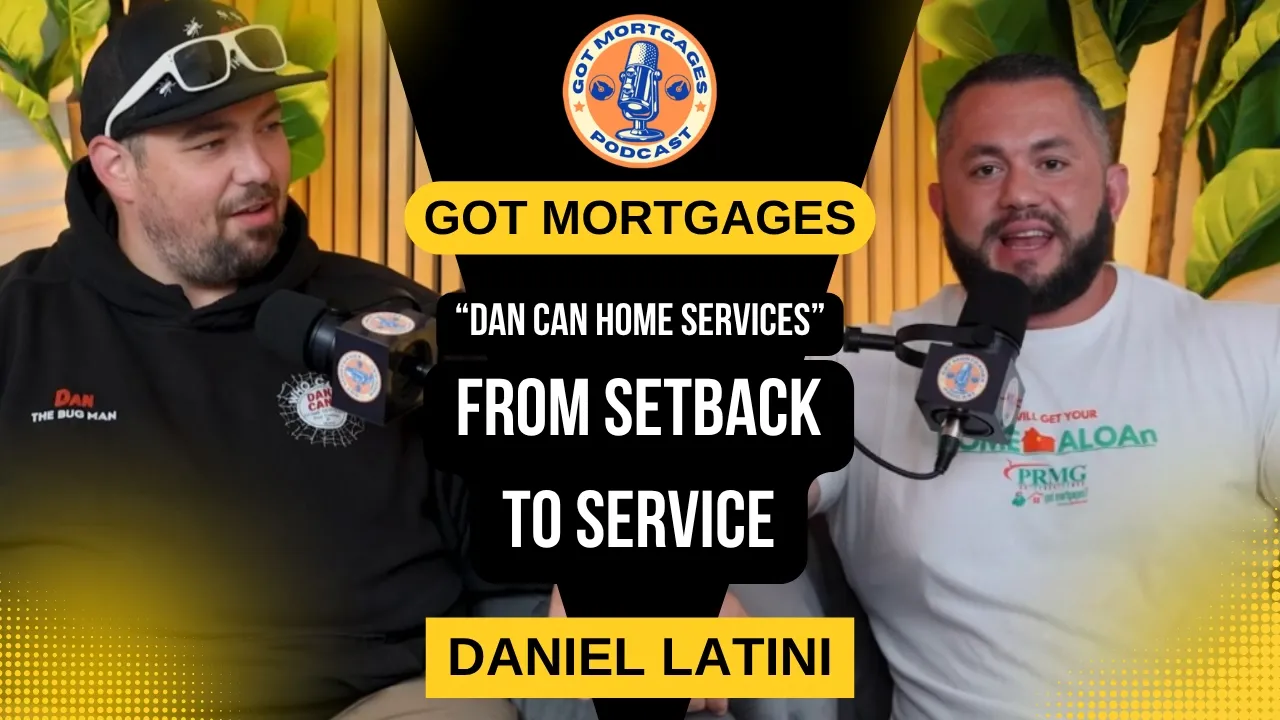
Dan Can Home Services built its early momentum through community relationships, a recognizable local identity, and a willingness to act before every marketing detail was ready. On the Got Mortgages Podcast, Dan Latini, known as Dan the Bugman, tells Abdel Khawatmi how an unexpected job loss accelerated his move into business ownership. His story also exposes the next challenge for a growing service company: turning an owner's personal reputation into a business that other people can help deliver. For home-service entrepreneurs, the practical lesson is not simply to network more. It is to make your work understood, build relationships before you urgently need them, and create enough team capacity to keep the promises that bring customers in.
Conversation originally published May 13, 2026. Recap added October 24, 2026.
Watch the original conversation on YouTube.
Key Takeaways: Relationships Open Doors, Capacity Keeps Them Open
Dan's experience connects three stages that business owners often treat separately: learning the work, becoming known for it, and building an organization around it. His technical experience gave him something useful to offer. His community involvement helped people remember him. Delegation became important when personally handling the work, customer communication, and marketing threatened to limit what the company could do.
Several details make the story practical rather than motivational alone. Dan handed out handwritten contact information when he had no business cards. His memorable nickname sometimes obscured the full range of pests he handled. And his ambition to build a million-dollar company was a future goal supported by a staffing vision, not a claim that he had already reached that milestone. Growth, in this conversation, means moving from individual effort toward repeatable service.
An Unexpected Career Became a Problem-Solving Business
Dan did not describe pest control as a lifelong career plan. He entered the industry during COVID after losing other work, when pest-control businesses were still operating as essential services. What began as a way to earn a living became work he genuinely enjoyed because it required continual observation and problem-solving.
His description of the job goes beyond treating a visible pest. He asks what the organism is, why it appeared, where it came from, and how to address it without harming other things. That sequence explains why he found the work engaging: each property presents a different combination of conditions rather than an identical task to repeat.
For a homeowner evaluating a provider, this suggests useful questions about the assessment, not just the visit price. What has the provider identified? What conditions may be contributing to the issue? What does the proposed response address? Those questions apply Dan's approach to common home-maintenance situations. For a business owner, the branding lesson is equally useful: explain the thinking behind the service so customers understand the value beyond the visible activity.
The Launch Was Accelerated, Not Invented, by Job Loss
Before operating independently, Dan worked for two pest-control companies and gained experience in field service as well as management and sales. He had already considered starting his own company. He says he established the LLC in 2022 and began working the business in 2023. The idea therefore existed before the employment setback that forced a faster launch.
Dan recounts planning to leave his employer ahead of a busier season. When that intention reached management, he was fired before Christmas. Instead of having several more months to prepare, he faced an immediate need for customers during a slower period. He describes those first months as survival mode, with no existing customer base for the new operation.
The distinction matters. This is not evidence that an abrupt exit is the best way to start a business. Dan brought technical experience, exposure to sales, an existing business idea, and community connections into an unplanned transition. A practical application is to separate readiness from timing: know what service you can deliver, which relationships you can legitimately approach, and how you will cover a slow start. A setback may accelerate a decision, but it does not replace preparation.
Handwritten Contact Details Made an Imperfect Launch Usable
One of the episode's clearest examples of taking action happens on the day Dan says he was fired. A nighttime networking event through the Toms River Chamber of Commerce was available. He attended without business cards, writing his name, phone number, and business name on pieces of paper and handing them out.
The strength of that move was not the stationery. He gave people enough information to remember him and make contact while showing up in a community where he had already developed relationships. He did not wait for finished promotional materials before making his availability known. At the same time, the episode provides no conversion figures, so the handwritten slips should not be treated as a proven marketing formula.
For an early-stage operator, the useful standard is whether a prospective customer can understand the offer and take the next step. A clear service description, accurate contact details, and a dependable response process can matter more at launch than polished collateral. Presentation still has value; it simply should not become an excuse to postpone appropriate outreach.
A Memorable Nickname Can Also Narrow Customer Expectations
Dan the Bugman is easy to remember, but Dan explains that customers sometimes interpret the nickname too literally. Some have hired another provider for mice because they associated him only with bugs. His example shows a real branding tension: the same shorthand that makes a person memorable can leave customers with an incomplete understanding of the business.
He describes Dan Can Home Services as a full-service pest-control business and mentions ants, ticks, mosquitoes, termites, and mice during the conversation. The broader company identity and the personal nickname therefore perform different jobs. One provides a recognizable person; the other needs to communicate the actual service scope.
The practical response is not necessarily to abandon a successful nickname. It is to pair it consistently with plain-language service information on introductions, contact pages, event materials, and follow-up messages. A homeowner should not have to guess whether a familiar local provider handles a particular problem. The episode discusses service categories, but it does not establish package prices, treatment schedules, or detailed coverage terms; those belong in a direct conversation with the business.
Community Networking Became Collaboration, Not Card Distribution
Dan credits chamber involvement with more than introductions to prospective customers. Being around other entrepreneurs exposed him to people pursuing their own plans despite discomfort and uncertainty. That environment helped him see business ownership as something he could pursue, too. The relationships offered encouragement as well as commercial opportunity.
He is candid that entering a room full of strangers did not feel natural. The value emerged through participation and familiarity, rather than an assumption that successful owners are automatically comfortable networking. By the time he launched independently, people already knew him as Dan the Bugman, and he did not want to lose the relationships built around that identity.
Abdel prefers collaboration to networking because it better describes working with other professionals rather than simply exchanging cards. He makes a similar distinction between recruiting and business development: the emphasis is on helping another professional grow through available resources. Applied locally, that means learning what other businesses do, recognizing where you can be useful, and following up with a specific reason to stay connected. It is a different objective from collecting the largest possible contact list.
Delegation Turns an Owner's Reputation Into Business Capacity
Abdel frames the operational challenge through sales, service, and support. A home-service owner can finish a day in the field and still face customer callbacks, social media, and other work needed to keep the business moving. Being good at the service does not create unlimited time for the surrounding responsibilities.
Dan brings prior team-management experience to that challenge, but he still recognizes the entrepreneurial instinct to believe nobody else can do the work as well. His answer is direct: owners need people who are smarter than they are in relevant areas and can perform certain responsibilities better. Leadership is not the same as personally completing every task.
He also acknowledges an economic constraint. Knowing that a team is necessary does not mean an early business can immediately afford one. He describes reaching a point where supporting a team had become more feasible, while recognizing that remaining alone would cap his capacity. The practical step is to identify the actual bottleneck before hiring: field appointments, unanswered inquiries, scheduling, or owner follow-through may require different solutions.
Dan's stated vision is a million-dollar business by year five, with three to five technicians and one or two customer service representatives. Those are ambitions expressed in the interview, not verified results or a current staffing report. Their importance is the connection between the growth goal and the work required to support it. A larger business needs both service delivery and someone reliably handling customer communication.
Family Involvement Can Build Skills Without Dictating a Career
Dan describes the business as a family effort, but he does not expect his children to share identical interests. His daughter enjoys talking with people at vendor tables and events while showing little interest in pests. His son is more interested in the science. Dan sees value in encouraging those different strengths rather than assigning everyone the same role.
The transferable benefit is broader than learning pest control. Supervised participation in suitable community events can introduce conversation skills, confidence, and the experience of explaining what a business does. Curiosity about science can be encouraged through safe learning activities. Neither requires assuming that children should perform technical service work.
Dan also makes room for a future outside the company. He supports his daughter's interest in nursing and says his children would not have to continue the business. His legacy goal is to create options and pass along skills he wishes he had learned earlier. For other family-business owners, that distinction is valuable: involving children can be an invitation to learn, not an obligation to inherit an occupation.
Final Checklist: Put the Local-Trust Model Into Practice
Check your introduction. State both the memorable brand and the actual service category. Ask whether someone hearing your nickname for the first time would know the range of problems you handle and how to contact you.
Check your relationships. Choose a relevant local business community, participate consistently, and follow up with a useful next step. Measure the quality of the relationships you are developing, not merely how many cards or contacts you collect.
Check your capacity. Separate sales, service, and support responsibilities, then identify where customers or commitments are waiting on you. Define what a teammate would own before assuming that any additional hire will relieve the pressure.
Check your growth plan and family goals together. Describe the people and responsibilities needed to support the business you want, distinguish ambitions from achieved results, and make room for family participation that respects individual interests. Dan's story points toward a business that can serve customers and create opportunity without requiring the founder to do everything forever.
Frequently asked questions
What does Dan Can Home Services do?
Dan describes it as a full-service pest-control business. During the episode, he discusses ants, ticks, mosquitoes, termites, and mice. Homeowners should contact the business directly about their particular issue, service availability, and proposed scope.
Why did Dan Latini start his own pest-control company?
Dan had already considered ownership and gained experience in both technical service and management or sales. Being fired before Christmas accelerated his planned transition, pushing him to begin finding customers sooner than intended.
How did Dan promote the business before he had business cards?
He attended a Toms River Chamber of Commerce networking event with handwritten slips containing his name, phone number, and business name. The practical lesson is to make it easy for people to understand your availability and contact you, even before your promotional materials are finished.
What branding problem did the name Dan the Bugman create?
Some people assumed he handled only bugs and contacted other providers for mice. Pairing the memorable nickname with a clear pest-control service description helps communicate the wider scope without losing the recognition the nickname creates.
What did chamber networking offer beyond customer leads?
Dan says it introduced him to other entrepreneurs whose ambition and willingness to act encouraged his own plans. It also helped him develop personal and professional relationships before launching independently. Abdel describes that deeper purpose as collaboration rather than simply exchanging business cards.
How does the episode suggest deciding what to delegate?
Abdel separates the business into sales, service, and support, while Dan explains that doing everything himself would limit growth. A practical application is to identify the responsibility causing delays, then define a role around it. A field-service bottleneck and a customer-callback bottleneck may call for different hires.
Had Dan already built a million-dollar company in the interview?
No. Dan presents a million-dollar business by year five as his goal. He connects that ambition to a proposed team of three to five technicians and one or two customer service representatives. The conversation does not establish that those milestones were achieved.
Where can homeowners learn more about Dan Can Home Services?
The publisher's episode description directs listeners to WhoCanDanCan.com. Before booking, explain the pest issue, confirm that your location is served, and ask what the recommended service includes. The interview does not provide package pricing or detailed treatment terms.
To talk with PRMG Got Mortgages, call 973-536-0276, visit GotMortgages.com, contact the team or build your mortgage plan.
Explore more Got Mortgages Insights and Abdel Khawatmi’s profile. Explore more conversations at the Got Mortgages Podcast website.
Author: Abdel Khawatmi with PRMG Got Mortgages | 973-536-0276
This article is general mortgage information only. It is not a commitment to lend, a rate quote, or legal or tax advice. Loan approval, terms and pricing depend on a full application, credit review and property details, and market conditions change. Talk with a licensed loan officer and your own legal or tax professional about your situation. NMLS #1712023 | PRMG NMLS #75243.