
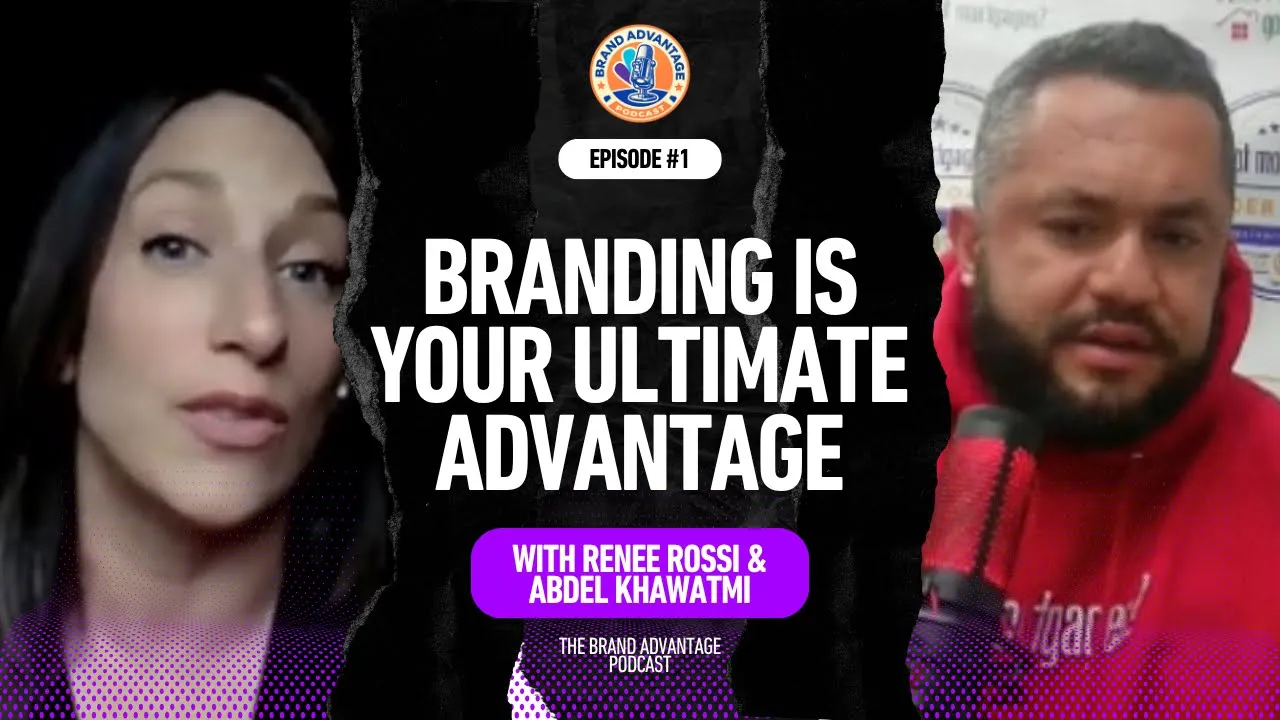
In the debut episode of The Brand Advantage Podcast, host Abdel Khawatmi and Renee Rossi, Vice President at Social Trend Marketing Solutions, explore the fundamental pillars of modern business growth. Branding is no longer confined to a simple logo or a business card; it is a living digital ecosystem comprising social media strategy, reputation management, and the tactical use of Artificial Intelligence. Rossi, a Google-certified specialist with over a decade of experience, shares how small to medium-sized businesses can move from basic visibility to authentic conversion. By prioritizing consistency and authenticity over the elusive 'viral moment,' brands can build the credibility necessary to dominate their local markets.
Conversation originally published April 4, 2026. Recap added October 24, 2026.
Watch the original conversation on YouTube.
The Core of Modern Branding: Beyond the Logo
Branding in the current market is a multifaceted discipline that lives through your digital footprint. It is defined by how a business executes its content strategy, manages its reputation, and utilizes emerging technologies like AI. According to Renee Rossi, a successful brand is built by educating the audience rather than just selling to them. This involves a shift from high-production, manicured content to authentic, behind-the-scenes glimpses that allow potential clients to build a personal connection with the business owner, rather than just seeing a corporate facade.
A common pitfall for many entrepreneurs is the obsession with 'going viral.' Rossi emphasizes that while viral content provides eyes, it rarely provides long-term stability or business conversion. Viral success is often a 'happy accident' that is difficult to replicate in a professional context, especially for those who attempt to copy younger creators without understanding the business application. Instead, the focus should be on building credibility through consistent messaging that showcases the expert's knowledge and passion for their specific industry rather than chasing temporary social media trends.
When consumers visit a social media profile, they are vetting the professional; they want to see the person behind the title, which builds the trust necessary to initiate a transaction. Khawatmi notes that the modern consumer uses social media to determine if they 'click' with an individual before ever reaching out. Rossi suggests that even if a business owner is simply shooting video from their truck, that level of raw honesty often resonates more with a modern audience than a suit-and-tie presentation in front of a green screen.
Social Media: The Front Line of Lead Generation
The evolution of social media has transitioned from a purely organic landscape to a 'pay-to-play' environment. In the early days of platforms like Facebook, organic reach was sufficient for business growth, and anything posted was seen by almost everyone in a user's network. Today, the landscape is much more crowded, and businesses must navigate the complexities of Meta's ad manager to see real results. Rossi observes that to show up on the feeds of those not already following you, a financial investment is now required.
Rossi distinguishes between 'boosting' posts for awareness and running dedicated lead generation campaigns. While boosting is an easy way for a business owner to dip their toe into advertising and gain brand recognition, high-quality leads require a strategic approach within the ad manager. Boosting may get eyes on a fancy video, but lead generation is what captures specific customer data. By understanding the difference, business owners can avoid the frustration of spending money on reach that doesn't result in actual phone calls or sales.
Strategic placement of content is equally important for modern lead generation. High-quality video assets may perform significantly better as YouTube advertisements targeted at large-screen televisions rather than being lost in a fast-scrolling mobile feed where they might only be viewed for two seconds. Every social media action should serve as a vehicle to drive traffic back to a centralized digital storefront—the company website. By using social platforms to capture attention, businesses can lead prospects to a controlled environment where their message is the primary focus.
The Digital Storefront and the Role of SEO
A website is no longer optional; it is a business's primary digital storefront that serves as the foundation of its online presence. Rossi points out that consumers take less than a second to judge a business based on how quickly its website loads and how it functions. Even for brick-and-mortar businesses, such as a boutique open only half the year, a website is critical for planning and validation. Without a functioning landing page, a business risks appearing illegitimate or closed to prospective customers who research every purchase online.
Furthermore, the groundwork laid through traditional Search Engine Optimization (SEO) is now paying significant dividends in the age of Artificial Intelligence. Chatbots and AI search tools pull data from established websites that have spent years building organic authority. Those who have prioritized their Google Business Profile and consistent SEO are finding themselves prioritized by AI-driven search engines. This synergy between traditional search tools and new AI technology highlights the importance of mastering the basics of online visibility rather than skipping straight to advanced tools.
The Google Business Profile acts as the primary hub for customer reviews, which Rossi describes as modern social proof. Because consumers rely heavily on the experiences of others, a profile filled with ratings and photos is often the deciding factor in whether a prospect makes a call. Business owners must actively collect and manage these reviews to maintain a competitive advantage. If a search engine brings up a profile that hasn't been updated in months, it can create doubt in the consumer's mind about the business's current status.
Budgeting for Growth: The 5% to 10% Rule
A significant hurdle for many small business owners is the lack of a defined marketing budget. Rossi suggests a rule of thumb for sustainable growth: B2B (business-to-business) companies should allocate 5% to 7% of their annual gross revenue toward marketing, while B2C (business-to-consumer) companies should aim for 7% to 10%. This budget needs to account for not just historical revenue, but the revenue goals of the upcoming year. It is about presenting the company as the size it aspires to become.
This allocation should be comprehensive, covering Google advertising, agency fees, content creation, and even professional memberships like local Chambers of Commerce. Many entrepreneurs are unsure what they can handle financially, leading to inconsistent marketing efforts. By treating marketing as a fixed percentage of revenue, business owners can ensure they have the resources to stay ahead of their competitors. Budgeting allows a brand to maintain a presence across multiple media platforms where their ideal clients are likely to spend their time.
Consistency in budgeting leads to consistency in visibility. Rossi notes that staying ahead of the competition requires a business to be the one consumers recognize when they finally conduct a search. By investing steadily in brand awareness, a company ensures that when a prospect is ready to buy, the brand is already familiar to them. This proactive approach prevents the 'feast or famine' cycle that many small businesses experience when they only market their services during slow periods or when they have extra cash.
Leveraging AI Without Losing the Human Touch
Artificial Intelligence is a tool for efficiency and time-saving, not a replacement for human connection. Rossi and Khawatmi discuss using AI to assist with tasks like generating content ideas, drafting captions from different personas, and tracking KPIs. AI has been integrated into tools like Google Ads for years through automated learning, but its public-facing applications are now more accessible. However, they warn against over-reliance on AI-generated avatars or stock-heavy automation, as these can make a brand feel disconnected and robotic.
The most effective way to use AI is to treat it as a starting point for creativity rather than the end product. A business owner can use AI to prompt a draft or organize data, but they must then apply a 'human touch'—anecdotes, personal experiences, and unique brand voice. As more businesses use the same AI templates and stock photos, digital content runs the risk of becoming repetitive noise. Tweak the AI's output to ensure it matches the consistent branding established on your website and other social profiles.
Khawatmi expresses a specific distaste for AI video avatars, noting that they take away the personal element that clients expect. He emphasizes that shooting a simple 20-second video is more effective than using an AI avatar because it provides the authenticity that builds relationships. Rossi agrees, noting that AI technology isn't yet at the level where it can fully replicate the nuances of human interaction. The goal should be to use AI to handle the 'weeds' of marketing so that professionals can focus on their actual jobs.
The Importance of Social Media Consistency
Consistency is the most vital element of any social media strategy. Rossi warns that creating a page and leaving it dormant for months can actively harm a brand's reputation. If a customer visits a Facebook page and sees that the last post was a 'Merry Christmas' message from six months ago, they may wonder if the business is still operating or if anyone will answer the phone. It is better to focus on one or two platforms consistently than to be present but inactive on many.
Social media acts as a relationship-building tool where customers can get to know the business owner. Rossi explains that authenticity is what differentiates one professional from their competitors. If a prospect gets along better with a competitor's personality, that is a natural filter that ensures business owners attract the right 'matching' clients. Sharing the behind-the-scenes aspects of a business helps facilitate this connection, making social media the ideal place for communicating a brand's core values and unique professional identity.
To maintain this consistency without feeling overwhelmed, businesses can use scheduling tools to plan their content in advance. Khawatmi mentions that while some content, like market updates, should be done live to remain timely, other posts can be automated by a team. This balance allows the business to stay active in the eyes of the algorithms on platforms like Instagram and LinkedIn. By staying top-of-mind through regular updates, a business ensures it is the first choice when a consumer's need for their specific service arises.
Establishing a Hierarchy of Digital Needs
To build a brand that connects and converts, businesses should follow a specific hierarchy of digital needs, starting with the foundation. First, establish a strong foundation with a functional, fast-loading website that serves as the home base for all messaging. Second, maintain a Google Business Profile to collect and showcase reviews. Third, choose social media platforms where the ideal client resides and commit to a schedule. Adding advanced tools on top of a weak foundation will only cause a business model to crumble.
The 'SCTE' approach used by Khawatmi's team—Social, Call, Text, Email—highlights social media as the critical first point of contact. By the time a professional reaches out via phone or email, the prospect has likely already vetted their social profiles and website. This 'social selling' happens before the first direct conversation even begins. If the digital presence is professional and authentic, it does the heavy lifting of building trust, making the subsequent sales calls and emails much more effective for the professional.
Ultimately, the goal of visibility is to reach the 'ideal' client in the 'right' lake rather than fishing in a vast, unfiltered ocean. Rossi emphasizes that digital marketing is about making the right decisions for the specific business, rather than following every trend. By focusing on the power of digital attention and leveraging a combination of SEO, social media, and strategic advertising, a business can transition from being just another name in the market to a dominant, trusted brand that attracts high-quality leads.
Staying Ahead of the Competition
In a crowded marketplace with numerous competitors, staying ahead requires constant evolution and education. Rossi and her team at Social Trend Marketing Solutions prioritize staying ahead of trends to help small businesses make informed marketing decisions. This includes being a Google Partner, which allows them to beta test new tools before they are widely released. Business owners who stay educated on these changes are better equipped to adapt their strategies as the digital landscape shifts faster than ever before.
The transition toward AI and automated learning is one of the fastest shifts the industry has seen. Rossi suggests that instead of panicking or resisting these changes, business owners should find ways to integrate them into their existing workflows. The goal is to avoid being replaced by those who are using the tools more effectively. By staying informed through resources like The Brand Advantage Podcast, entrepreneurs can learn to collaborate with marketing experts to navigate these technological shifts while maintaining their human-centric business values.
Networking also plays a crucial role in brand infiltration, complementing a digital strategy with in-person presence. Khawatmi and Rossi plan to explore how physical networking and community involvement can strengthen a digital brand in future discussions. The combination of a strong online storefront and active participation in local events creates a comprehensive brand advantage. By showing how the work is actually being done, rather than just talking about it, they aim to provide a roadmap for business owners to achieve long-term growth and market dominance.
Frequently asked questions
What is the most important factor in a social media strategy?
Consistency and authenticity are the two most important factors. Renee Rossi explains that it is more valuable to post regularly and show the 'behind-the-scenes' human element of your business than to try to go viral with a single post, as virality is often a 'happy accident' that cannot be easily replicated.
How much should a business budget for marketing?
A good rule of thumb shared by Rossi is 5% to 7% of annual gross revenue for B2B companies and 7% to 10% for B2C companies. This budget should be based on both current revenue and the growth goals the company has for the upcoming year.
Do small brick-and-mortar businesses really need a website?
Yes. A website acts as a digital storefront. Consumers use websites to verify if a business is open, check inventory, and vet the company’s legitimacy. Rossi notes that it takes less than a second for a user to judge a business based on whether their website loads properly.
What is the difference between boosting a post and lead generation ads?
Boosting a post is a simple way to increase brand awareness and reach a wider audience outside of your followers. However, dedicated lead generation through an ad manager is necessary to capture specific customer data and drive high-quality conversions.
How is AI changing the search engine landscape?
AI chatbots and search tools pull information from established websites. Rossi points out that businesses that have invested in long-term organic SEO are now being prioritized by AI tools because they have built years of back-end authority that the AI recognizes.
Can AI replace the need for content creators?
AI is an excellent tool for efficiency, ideation, and saving time, but it lacks the 'human touch' and authenticity needed to build deep relationships. Rossi and Khawatmi warn that over-reliance on AI can make content sound like 'noise' that lacks unique brand voice.
Why is a Google Business Profile essential?
It is the primary hub for customer reviews and local search visibility. Most consumers choose who to call based on the ratings and photos found on a business's Google profile, making it a critical component of a company's digital presence.
What should a brand do if they cannot be active on all social platforms?
Rossi advises focusing only on the platforms where you can be consistent. A dormant social media page with old posts, such as a last post from 'Merry Christmas' seen months later, can hurt a brand's credibility by making customers wonder if the business is still active.
To talk with PRMG Got Mortgages, call 973-536-0276, visit GotMortgages.com, contact the team or build your mortgage plan.
Explore more Got Mortgages Insights and Abdel Khawatmi’s profile. Explore more conversations at the Got Mortgages Podcast website.
Author: Abdel Khawatmi with PRMG Got Mortgages | 973-536-0276
This article is general mortgage information only. It is not a commitment to lend, a rate quote, or legal or tax advice. Loan approval, terms and pricing depend on a full application, credit review and property details, and market conditions change. Talk with a licensed loan officer and your own legal or tax professional about your situation. NMLS #1712023 | PRMG NMLS #75243.