
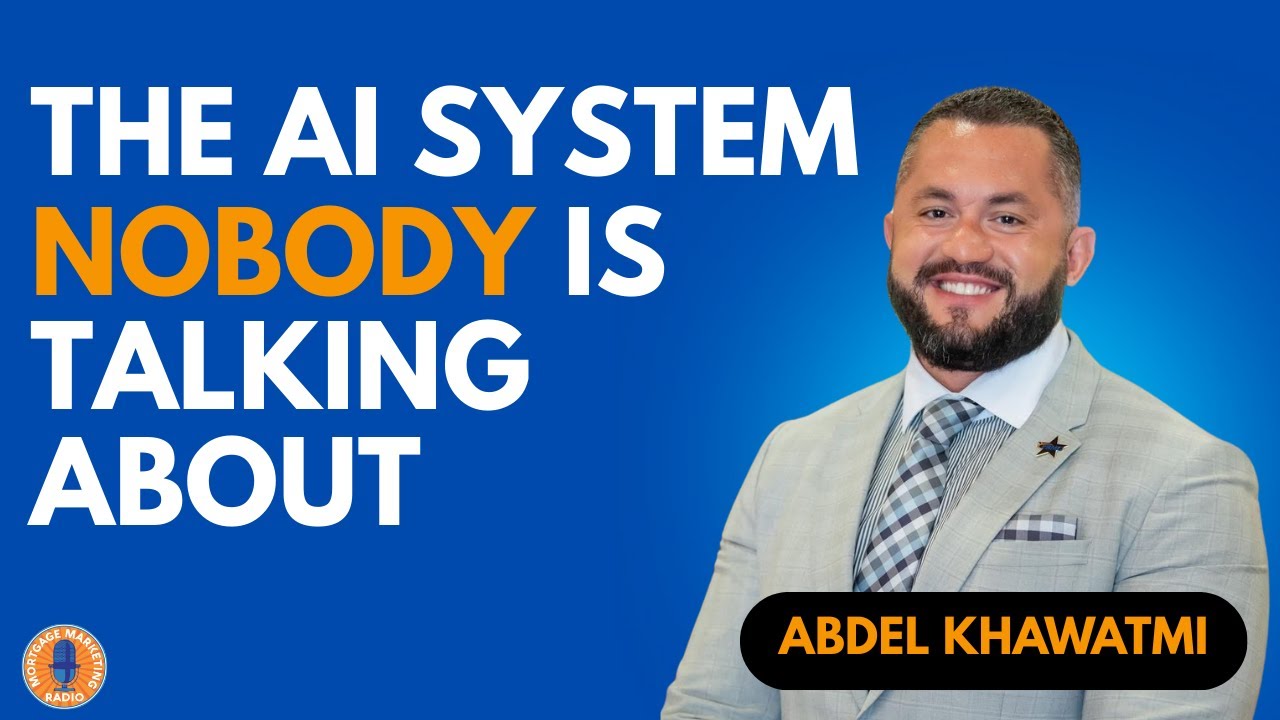
AI creates useful mortgage-team leverage when it removes repeatable administrative work without removing the originator from important conversations. That is the operating model Abdel Khawatmi describes to guest host Katie Shive on Mortgage Marketing Radio. The Got Mortgages founder and PRMG Area Manager discusses documented workflows, AI-assisted file preparation, delegated first contact and hyperlocal relationship building. His most revealing observation is not that he spends less time with borrowers: he says he spends more time on the phone because the work behind those conversations is better organized.
Conversation originally published March 11, 2026. Recap added October 24, 2026.
Watch the original conversation on YouTube.
Key Takeaways: Build the Operating System Before Buying More Tools
Abdel organizes the business around three categories: sales, service and support. His starting recommendation is to write down an actual working day, place its tasks into those categories and identify where effort is being lost. The technology decision comes after that exercise, not before it.
He reports 121 personal loan closings and just under $40 million in personal production for the year he discusses. He also describes reducing his directly employed offshore assistant team from seven people to three while training the remaining team to use AI. These are his reported business results, not a forecast for another operation or proof that a particular tool caused the production.
The broader lesson is that efficiency and personal service can reinforce each other. Document routine work, test tools in real production, give employees implementation support and deliberately spend recovered time explaining decisions to clients. A smaller administrative footprint is only useful if the experience remains dependable.
Communication Was the Business Problem Before AI Was the Solution
Before entering mortgage lending, Abdel managed a personal injury law firm. As clients moved toward purchasing homes, he referred them to mortgage professionals. The recurring complaint was straightforward: people were waiting for someone to respond. He found himself chasing updates on their behalf.
That background explains why the episode is about more than technology enthusiasm. His mortgage business grew out of a service gap he had already witnessed. Managing deadlines and coordinating work at the law firm also gave him a framework for building structured mortgage processes.
For a mortgage leader, the practical application is to define the service failure before prescribing automation. Is the borrower waiting for an initial call, an explanation of requested documents or a decision about next steps? An automated acknowledgement may solve none of those problems. The workflow needs a responsible person, a response expectation and a clear path for escalation.
Abdel also describes three audiences he serves: consumers, referral partners and loan officers. That distinction matters. Borrowers need clarity, partners need confidence in the handoff, and originators need operational support that helps them deliver both.
Use Sales, Service and Support to Find the Right First Workflow
When asked where someone should start with AI, Abdel declines to prescribe one universal subscription. A consumer-direct originator and a relationship-driven local lender may have very different bottlenecks. Their technology priorities should reflect those differences.
Sales includes where business comes from and how relationships develop. Service includes the work needed to assess and move a mortgage file forward. Support includes the administrative and marketing activity that keeps the operation functioning. Categorizing a real calendar makes those demands visible instead of relying on an impression that everyone is simply too busy.
A useful habit is to record the task, its trigger, its owner and the outcome it should produce. For example, preparing for a borrower consultation is not one task: it can involve collecting information, assembling a comparison, scheduling the discussion and documenting the outcome. Some steps are repeatable; others require judgment.
Choose one recurring friction point with a reviewable output. That creates a manageable pilot and a baseline for deciding whether the change actually helps. Buying several tools at once makes it harder to tell which workflow improved and which subscription merely added another place to work.
Document the Process Before Asking AI or an Assistant to Repeat It
Abdel identifies a familiar management problem: leaders want a task completed a particular way but have not fully explained what that means. Sometimes they have not clarified the requirement even for themselves. Delegation then produces frustration rather than leverage.
He describes using screen-recording documentation tools such as Scribe to capture processes and build standard operating procedures. Those instructions support both assistants and AI-assisted work. His preference for going deeper with ChatGPT rather than continually switching platforms follows the same logic: master a repeatable process instead of collecting demonstrations.
The important distinction is between an instruction and a usable operating procedure. A practical SOP should state the required inputs, the sequence of work, the expected output and the situations that require human review. A sample finished result helps the next person understand what successful execution looks like.
Abdel describes getting consistent results from workflows he developed. That experience should not be interpreted as AI eliminating error. A sound implementation still includes checking outputs and revising instructions when a task exposes ambiguity. The goal is a process the team can understand and maintain, not one that works only when its creator is present.
Keep Mortgage Judgment Inside AI-Assisted File Preparation
The operational examples go beyond marketing copy. Abdel discusses using AI to assist with Schedule C and Schedule E income calculations and to structure letters of explanation from conversations with consumers. He frames these tools as additional support for originators, including people who are still developing their technical experience.
These examples are useful precisely because they involve recurring work with meaningful consequences. Organizing rental-income information across multiple properties can consume substantial attention. An assistant that lays out the information and calculation steps may help a qualified reviewer work more efficiently, but it does not establish the correct qualifying income by itself.
Abdel explicitly tells listeners to check the work. In practice, that means reconciling inputs to the source documents, checking the applicable program and lender requirements, and retaining enough detail to explain the calculation. An AI-produced answer without a reviewable method is a weak foundation for a mortgage decision.
Letters of explanation require the same discipline. Drafting should clarify the borrower's actual account, not invent supporting facts or turn uncertainty into certainty. Before using these workflows, a lender also needs approved data-handling practices, appropriate access controls and a defined review process. Those are implementation safeguards, not features established by the episode.
Get Team Adoption Through Tested Workflows and Named Support
Katie raises a common failure pattern: a leader sees an exciting demonstration, buys the subscription and overwhelms the team with another initiative. Abdel's answer is to test a tool in his own production before asking others to adopt it.
He describes acting as the initial user, assessing client and referral-partner feedback, and refining the workflow until an administrator or processor can demonstrate it. His operating structure then supports adoption through four management functions: growth strategy, business development, sales and post-contract operations.
The distinction is important. Buying access is not implementation. Employees need to know who can answer a workflow question, who handles a difficult lending scenario and who owns the process after a contract is signed. Abdel also acknowledges that his own pace can exceed other people's comfort with a new system.
His leadership model makes the working originator's experience central to training. Rather than relying only on an outside presentation, show the team how a colleague uses the process under ordinary production pressures. A useful rollout measures time spent, rework and missed handoffs alongside adoption, rather than treating logins as evidence of success.
Use Four Client Stages to Delegate Without Disappearing
Abdel outlines four broad stages of the consumer experience: initial contact through application, preapproval and the home search, accepted offer through closing, and post-closing. Each stage needs coordination, but not every stage requires the same kind of personal involvement.
During the early stages, he emphasizes the client's need for conversation and reassurance. Once a buyer is searching, a routine birthday email does not substitute for someone who can discuss a disappointing offer or explain the next financing decision. Administrative consistency should support that relationship rather than stand in for it.
He has accepted that he cannot always be the first person a client reaches. Assistants can initiate scheduled calls and transfer the client to him, reducing the risk that an appointment disappears while he is handling a difficult file. He also maintains a dedicated missed-call and email review period.
Another change concerns documentation: instead of having an assistant remain on a call to take notes and update the CRM, he describes recorded-call transcription feeding that process. Any comparable implementation needs appropriate recording consent and data controls. The service principle is straightforward: delegate connection and documentation while preserving an accountable human conversation.
Turn Recovered Time Into Explanations, Not More Automated Messages
Abdel says he is on the phone with clients more after implementing AI. That is the clearest test of his stated strategy. The efficiency gain matters because it allows him to discuss information that previously might have been sent without a substantial conversation.
He describes calling after sending a mortgage comparison or local housing report and asking whether the client has reviewed it. If the borrower does not understand the material, that is an invitation to explain it. He mentions total-cost analysis, different loan-term comparisons and cost-of-waiting illustrations as discussion tools.
The practical distinction is between delivering information and helping someone use it. A report can be technically detailed yet leave a borrower uncertain about the next decision. A conversation can identify whether the real concern is payment comfort, available cash, time in the home or the assumptions behind a comparison.
He also asks about preferred communication methods. A highly digital operation can still accommodate an office meeting or a phone call. Preference should be established with the individual rather than assumed from age or background. The technology should make that flexibility easier to deliver.
Make Hyperlocal Relationships the Human Counterweight to Automation
The event discussion provides a distinctive extension of the operating model. Abdel describes moving beyond broad social-media visibility and conventional homebuying seminars toward more personal local experiences. He mentions manicure and pedicure events and a planned father-daughter salon experience, while continuing educational programming through webinars.
He says AI helps generate event ideas. The separation of roles is revealing: software can assist with brainstorming, but people still create the atmosphere, welcome attendees and build relationships. A locally meaningful event offers a different kind of connection from another mortgage post in a crowded feed.
His relationship-focused version of ROI stands for relevance, omnipresence and intimacy. In this context, intimacy means familiarity and authentic connection. The aim is to be useful, recognizable and approachable, not simply visible as often as possible.
Katie connects that approach to the importance of consistency between an online brand and the person someone meets. Both speakers express reservations about AI video doubles replacing personal communication. Their preference is not a universal finding about synthetic video; it reflects a relationship-led business strategy. For mortgage event planning, budgets, benefits and partner participation also warrant compliance review, including applicable referral-related rules.
Final Checklist: Build One Workflow the Team Can Own
First, document a real working day. Sort tasks into sales, service and support, then identify one repeated delay or handoff problem. Define the improvement you want before choosing software.
Second, capture the current process. Write down its inputs, steps, finished output and exceptions. Select an approved tool and specify what information may be entered, who reviews the work and when the task must return to a qualified person.
Third, pilot the workflow in actual production with appropriate oversight. Compare the effort, corrections and follow-up requirements with the previous process. Demonstrate the working version to the team and assign someone to support it.
Fourth, decide where the recovered time goes. Schedule borrower explanations, partner conversations or local relationship-building activity. If efficiency only produces more unattended messages, it has missed the most important feature of Abdel's approach.
Finally, revisit the SOP when integrations or responsibilities change. Abdel's longer-term goal is to keep developing the operating tools so originators can focus on clients. The durable lesson is not to copy his entire technology stack, but to build a repeatable system that makes good human service easier.
Frequently asked questions
What should a loan officer do before buying an AI tool?
Write down the tasks in a normal working day and classify them as sales, service or support. Abdel recommends this before choosing a platform because a referral-driven business and a consumer-direct business may need different solutions. Start with one recurring task whose output can be reviewed.
Did Abdel say AI replaced his entire support team?
No. He describes reducing his directly employed offshore assistant team from seven people to three and training the remaining team to use AI. He also describes management support across growth strategy, business development, sales and operations. His model combines people, documented processes and technology.
How does he use AI for Schedule C and Schedule E income work?
He describes developing AI-assisted income-calculation workflows for those schedules and emphasizes checking the work. A responsible implementation reconciles the inputs with source documents, checks applicable lending requirements and has a qualified person review the calculation before it is used.
Can AI write a borrower's letter of explanation?
The episode describes AI helping structure a letter from a conversation with the borrower. The draft should remain faithful to the borrower's facts and be reviewed for accuracy and applicable requirements. AI should not invent an explanation or imply that the letter guarantees an underwriting outcome.
What are the four stages of Abdel's mortgage client experience?
They are initial contact through application, preapproval and home search, accepted offer through closing, and post-closing. Mapping these stages helps a team decide where personal advice is essential and where scheduling, documentation and routine coordination can be delegated.
How can assistants handle first contact without weakening the relationship?
Give assistants clear expectations for welcoming clients, initiating scheduled calls, transferring conversations and escalating questions. Abdel combines that support with direct borrower conversations and a dedicated review of missed calls and emails. Delegation should improve access, not create an unexplained barrier.
What does relevance, omnipresence and intimacy mean for mortgage marketing?
It is Abdel's relationship-oriented interpretation of ROI: be useful to the audience, recognizable across relevant touchpoints and personally relatable. It complements rather than replaces financial measurement. His examples connect educational content and local events with genuine conversations.
What local event ideas does the episode discuss beyond a standard seminar?
Abdel mentions manicure and pedicure events and a planned father-daughter salon experience. He uses AI for brainstorming but keeps the relationship-building in person. A lender considering similar activities should assess audience fit, accessibility, cost and applicable event and referral-compliance requirements before proceeding.
To talk with PRMG Got Mortgages, call 973-536-0276, visit GotMortgages.com, contact the team or build your mortgage plan.
Explore more Got Mortgages Insights and Abdel Khawatmi’s profile. Explore more conversations at the Got Mortgages Podcast website.
Author: Abdel Khawatmi with PRMG Got Mortgages | 973-536-0276
This article is general mortgage information only. It is not a commitment to lend, a rate quote, or legal or tax advice. Loan approval, terms and pricing depend on a full application, credit review and property details, and market conditions change. Talk with a licensed loan officer and your own legal or tax professional about your situation. NMLS #1712023 | PRMG NMLS #75243.