
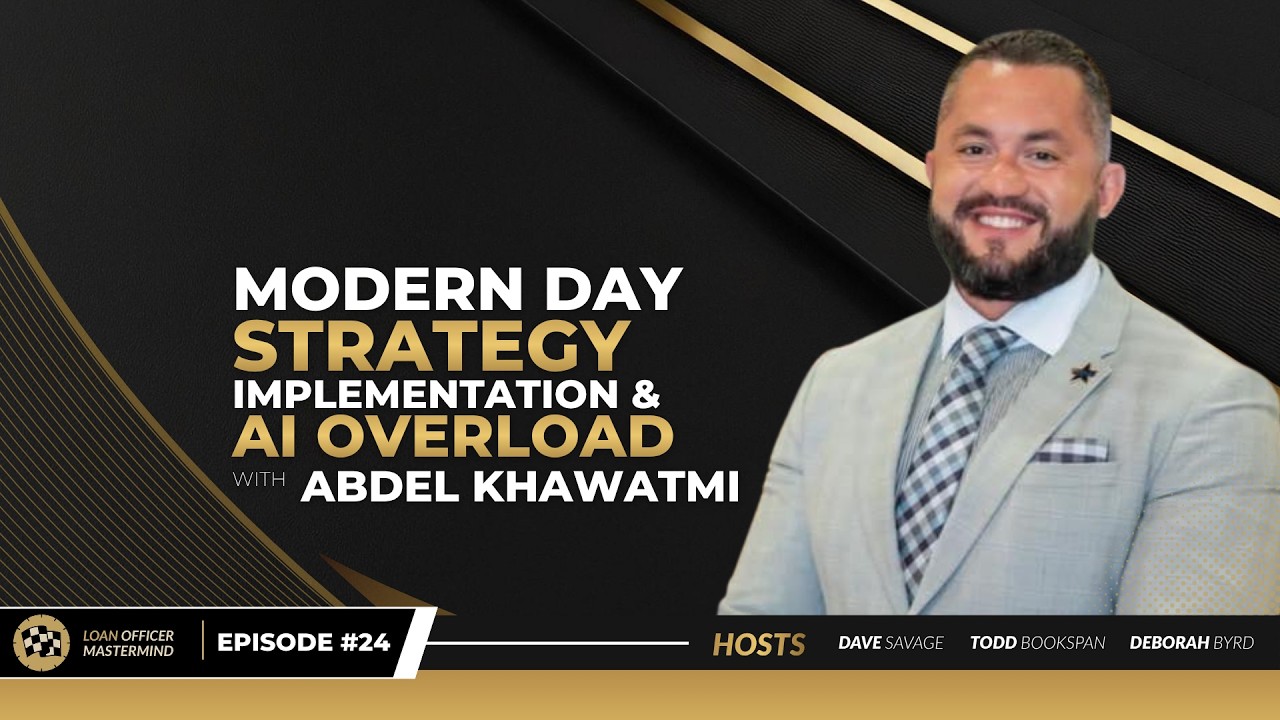
The answer to AI overload is not another subscription. It is choosing a business problem, documenting the process, and finishing a workflow your team will actually use. On Win By Noon’s Loan Officer Mastermind, Abdel Khawatmi joins Todd Bookspan, Dave Savage, and Deborah Byrd to explain how he approaches modern strategy implementation at Got Mortgages. His central distinction is practical: technology can organize information, prepare comparisons, and prompt follow-up, but the loan officer still owns the explanation, judgment, and relationship. For mortgage teams, that means evaluating AI by the work it helps complete rather than the number of tools it adds.
Conversation originally published September 18, 2026. Recap added October 24, 2026.
Watch the original conversation on YouTube.
Key Takeaways: Implementation Matters More Than Experimentation
Abdel describes modern strategies as familiar business fundamentals supported by better tools. Lead generation, clear communication, documented responsibilities, and consistent follow-through still determine whether a mortgage operation works. AI becomes useful when it supports those responsibilities, not when it creates a parallel collection of unfinished projects.
The episode offers several connected takeaways: choose one high-impact workflow to finish; establish checklists before building software; put team resources in a central workspace; measure conversion between meaningful activities; and use automation to create room for human conversations. These are operating decisions before they are technology decisions.
A particularly important distinction is between speed and completion. Sending a mortgage comparison quickly is helpful, but it does not finish the advisory work. The consumer must understand the payment, the assumptions, and the next decision. Likewise, producing an impressive referral-partner audit is only a starting point if nobody follows up with a useful conversation.
Choose the Next AI Project by Impact, Effort, and Cost
Todd describes finding himself with numerous open AI projects and little finished work. His response was to identify the projects that were easiest to implement and likely to have the greatest impact, finish one, and then move to the next. Abdel reinforces that discipline by distinguishing an actual business outcome from enthusiasm about somebody else’s new tool.
Abdel uses different AI tools for different purposes, describing Claude as helpful for writing and thinking and ChatGPT as useful for operational work. Those are his preferences, not a universal ranking. His larger point is that a functioning setup does not need to be replaced whenever another platform attracts attention.
A practical application is to define a project’s finish line before testing software. For an inquiry workflow, that might mean a team member receives the inquiry, prepares an approved response, assigns the next call, and records the outcome. Evaluate subscription costs, usage charges, integrations, and maintenance alongside convenience. A workflow that is exciting to build but expensive to operate has not automatically improved the business.
Build the Process Before Building the Workspace
Asked how a solo loan officer could create a centralized workspace, Abdel starts with the resources rather than the platform. His building analogy is straightforward: establish the blueprint and structure before choosing the interior finishes. In operational terms, that means knowing what the team should do before designing the screen where it will do it.
He divides the business into sales, service, and support. Sales covers where opportunities originate and how relationships develop. Service covers the operational checklist and the points at which the loan officer or another team member must step in. Support includes marketing distribution and the resources that keep the business visible and organized.
His team’s loan officer launchpad brings pipeline information, calendars, scripts, templates, prompts, training, and workflows into one environment. The practical benefit is less searching and clearer execution, not simply a more attractive dashboard. A smaller operation can apply the same principle with a simpler approved workspace.
The conversation also establishes a firm boundary: use company-approved systems and follow the organization’s AI rules. N/A Connecting calendars, email, or other systems should follow approved access and data-handling practices, not precede them.
Use the BUILDERS Framework to Keep Technology Attached to the Business
Abdel organizes his broader approach around BUILDERS: blueprint, unlocking action, blueprint, unlocking action, blueprint, unlocking action, identifying an edge, leadership, a distinctive brand, energy and accountability, replacing operational work, and smart hiring. Its value is that it starts with the loan officer’s role rather than an inventory of software features.
The blueprint asks where business comes from and how communication should work. Unlocking action means translating that plan into procedures, delivery expectations, and metrics. Identifying an edge asks what makes the experience different. Abdel emphasizes authenticity here: technology should help him communicate more effectively without substituting a manufactured personality for his own.
Leadership extends beyond presenting an idea. He describes supporting educational sessions with an accountability tracker, presentation materials, an implementation workbook, and an infographic. Those formats serve different needs: understanding the concept, acting on it, and remembering it later. His energy-and-accountability component asks whether calendar commitments connect to business results. Replacing operational work means reducing repetitive effort, not surrendering judgment. Smart hiring rounds out the framework by examining whether a prospective team member’s public activity aligns with what they say.
Make Referral Outreach Useful Before Asking for a Meeting
One of Abdel’s most specific examples is a brand audit prepared before contacting a prospective referral partner. The review looks at SEO, GEO, social media, and consistency of business information like name, address, and phone number. Instead of beginning with a request for referrals, he arrives with something the professional can examine and potentially use.
The editorial lesson is to keep that deliverable focused. A concise review showing inconsistent contact information or an outdated profile is easier to act on than an overwhelming packet of AI-generated material. Check findings manually and avoid promising that particular edits will produce search visibility or AI recommendations.
That digital preparation complements in-person networking. Abdel describes local professional groups, chambers of commerce, and his own mastermind, with an emphasis on a few meaningful conversations rather than meeting everyone in the room. He also values introductions from existing partners because they establish context before the first conversation.
For a mortgage team applying this approach, select a relevant professional, identify a genuine public-facing issue, and ask whether the review would be useful. Keep collaboration grounded in education and service, subject to applicable referral and marketing rules, rather than presenting resources as payment for business.
Turn Mortgage Comparisons Into Conversations About Affordability
Abdel describes a workflow in which an application leads to an initial comparison using basic transaction assumptions, including purchase price, down payment, and loan type. His example contrasts a scenario with discount points against one without them. Crucially, the team then calls the consumer rather than treating delivery of the comparison as the completed task.
The reason is practical: buyers can form a budget around an online principal-and-interest estimate and discover too late that taxes and insurance change the payment substantially. Discussing the payment early helps make the home search more informed. Mortgage insurance and applicable association charges also belong in a realistic affordability discussion when relevant.
An initial illustration should clearly identify its assumptions and should not be mistaken for a personalized locked offer. The useful advisory work is explaining what changes when the borrower pays points, changes the down payment, or considers another structure. Interactive tools may help a consumer explore questions, but someone still needs to confirm that the information is appropriate and understood.
This is where speed supports trust rather than competing with it: prepare the material efficiently, then spend the recovered time helping the borrower make sense of it.
Track the Six Cs to Find the Actual Conversion Problem
Abdel’s six Cs are content, conversations, clients, credit pulls, contracts, and closings. Content includes both online visibility and in-person activity. The framework follows the progression from being seen to having a conversation, developing a client relationship, and moving through meaningful mortgage milestones.
Its strength is the attention to the transitions. If content does not start conversations, the topic, audience, or invitation may need work. If conversations do not develop into client relationships, the team should examine the discussion and follow-up. Later-stage gaps call for a different investigation, rather than simply demanding more posting or more outreach.
For implementation, define each stage consistently and review comparable groups over time. A new inquiry and an established buyer should not be counted interchangeably. Credit inquiries must remain tied to legitimate borrower needs and appropriate authorization; the metric is not a reason to pull credit unnecessarily.
Abdel connects accountability to quarterly discussions about personal goals as well as production. That matters because tracking should reveal where support is needed. It should not reward activity that looks impressive while consuming time without advancing a relationship or transaction.
Use Call Feedback to Improve Clarity, Listening, and Empathy
Abdel describes using AI to critique conversations rather than simply summarize them. His call-grading approach looks for issues such as talking too much, asking too many or too few questions, and failing to leave space for the consumer. He deliberately wants challenging feedback rather than automatic agreement.
Deborah adds an important communication problem: mortgage professionals can fill explanations with acronyms that are familiar internally but confusing to consumers. A call may sound knowledgeable and still fail to help the borrower decide what to do next.
A useful coaching review can therefore examine whether the loan officer explained unfamiliar terms, acknowledged concerns, checked understanding, and established a specific next step. Use recording and transcription only through approved processes with required consent and safeguards. Treat the AI assessment as a coaching aid to review, not an objective verdict.
Abdel’s preference for less judgmental wording around credit illustrates the same principle. Respectful language can lower defensiveness, but it must still lead to a clear explanation of the relevant score, its implications, and available next steps. Empathy and precision should work together.
Make Ongoing Reviews Part of the Relationship, Not Just Another Campaign
Abdel describes quarterly check-ins and annual financial reviews as opportunities to learn what has changed in a client’s life. The purpose is not to force a mortgage transaction into every interaction. It is to remain useful when household priorities, future plans, or financial questions evolve.
He also explicitly distinguishes educational conversations from expertise he does not hold. When a question moves into investment, tax, or other specialized advice, he describes introducing an appropriate professional. For loan officers, the practical boundary is to recognize a planning need without trying to solve every part of it personally.
Calendar discipline makes that service possible. Abdel emphasizes recording commitments, choosing meetings intentionally, and protecting responsibilities outside work. Automation can remind a team to schedule reviews and prepare follow-up, but an empty or inaccurate calendar gives it little useful structure. The aim is not to fill every recovered minute with another task. It is to make important work and personal commitments less likely to be displaced by whatever arrives next.
Final Implementation Checklist: Finish One Useful Workflow
Choose one recurring problem. Describe the current failure in plain language, such as a payment comparison arriving without an explanation or a networking conversation receiving no follow-up. Select a problem important enough to solve and small enough to finish.
Write the process before choosing another tool. Identify the trigger, responsible person, required information, approved resources, human conversation, and next action. Confirm company permissions and data boundaries before connecting systems.
Build the smallest usable version in a place the team already knows. Test the entire handoff, not just the AI output. Check whether another team member can follow it without needing the builder to explain every step.
Measure completion and usefulness. Review missed follow-ups, clarity of communication, relevant conversion stages, operating cost, and team adoption. Ask whether the workflow reduced friction or merely moved it elsewhere.
Keep the next experiment on a waiting list until this workflow is functioning. Protect time for borrower calls, partner relationships, coaching, and life outside work. That is the episode’s implementation standard: technology should strengthen the business you intend to run, not continually distract you from running it.
Frequently asked questions
How should a loan officer choose the first AI workflow to finish?
Start with a recurring bottleneck that has a clear owner and an observable outcome. Rank potential projects by likely impact, implementation effort, and ongoing cost. Finish one complete process, including its human follow-up, before expanding to another.
What are Abdel Khawatmi’s six Cs for mortgage business accountability?
They are content, conversations, clients, credit pulls, contracts, and closings. The framework is designed to examine progression between stages so a team can identify whether its problem is visibility, communication, follow-through, or a later transaction obstacle.
What belongs in a loan officer launchpad?
Abdel describes a central workspace containing pipeline information, calendars, scripts, templates, prompts, training, and workflows. Begin with the resources needed for daily execution rather than adding every available tool. Establish responsibilities and checklists before building the interface.
How can a brand audit support referral-partner outreach?
Review a prospective partner’s public business profiles for useful, verifiable issues such as inconsistent contact information or outdated details. Share a focused finding as a conversation starter. Do not promise search rankings or treat the resource as compensation for referrals.
Why should a loan officer call after sending a mortgage comparison?
The borrower may not understand the assumptions, the effect of discount points, or which housing costs are included. A call lets the loan officer explain the comparison, check understanding, and connect the numbers to the borrower’s budget and next decision.
What should an AI call-coaching review assess?
Useful criteria include listening time, question quality, plain-language explanations, acknowledgment of concerns, and a clear next step. Review the feedback yourself. Recording, transcription, and AI processing must follow company requirements and applicable consent and privacy rules.
What if a mortgage company only permits one AI platform?
Work within the approved platform and its authorized integrations. The episode emphasizes following company rules rather than bypassing them. Documenting workflows, improving checklists, and organizing approved resources can create value without access to every new AI product.
How can annual mortgage reviews avoid becoming sales pitches?
Start with changes in the client’s circumstances and priorities, then determine whether there is a mortgage-related question worth reviewing. Explain what falls within your role and introduce qualified professionals for specialized questions. A useful review does not have to result in a new loan.
To talk with PRMG Got Mortgages, call 973-536-0276, visit GotMortgages.com, contact the team or build your mortgage plan.
Explore more Got Mortgages Insights and Abdel Khawatmi’s profile. Explore more conversations at the Got Mortgages Podcast website.
Author: Abdel Khawatmi with PRMG Got Mortgages | 973-536-0276
This article is general mortgage information only. It is not a commitment to lend, a rate quote, or legal or tax advice. Loan approval, terms and pricing depend on a full application, credit review and property details, and market conditions change. Talk with a licensed loan officer and your own legal or tax professional about your situation. NMLS #1712023 | PRMG NMLS #75243.