
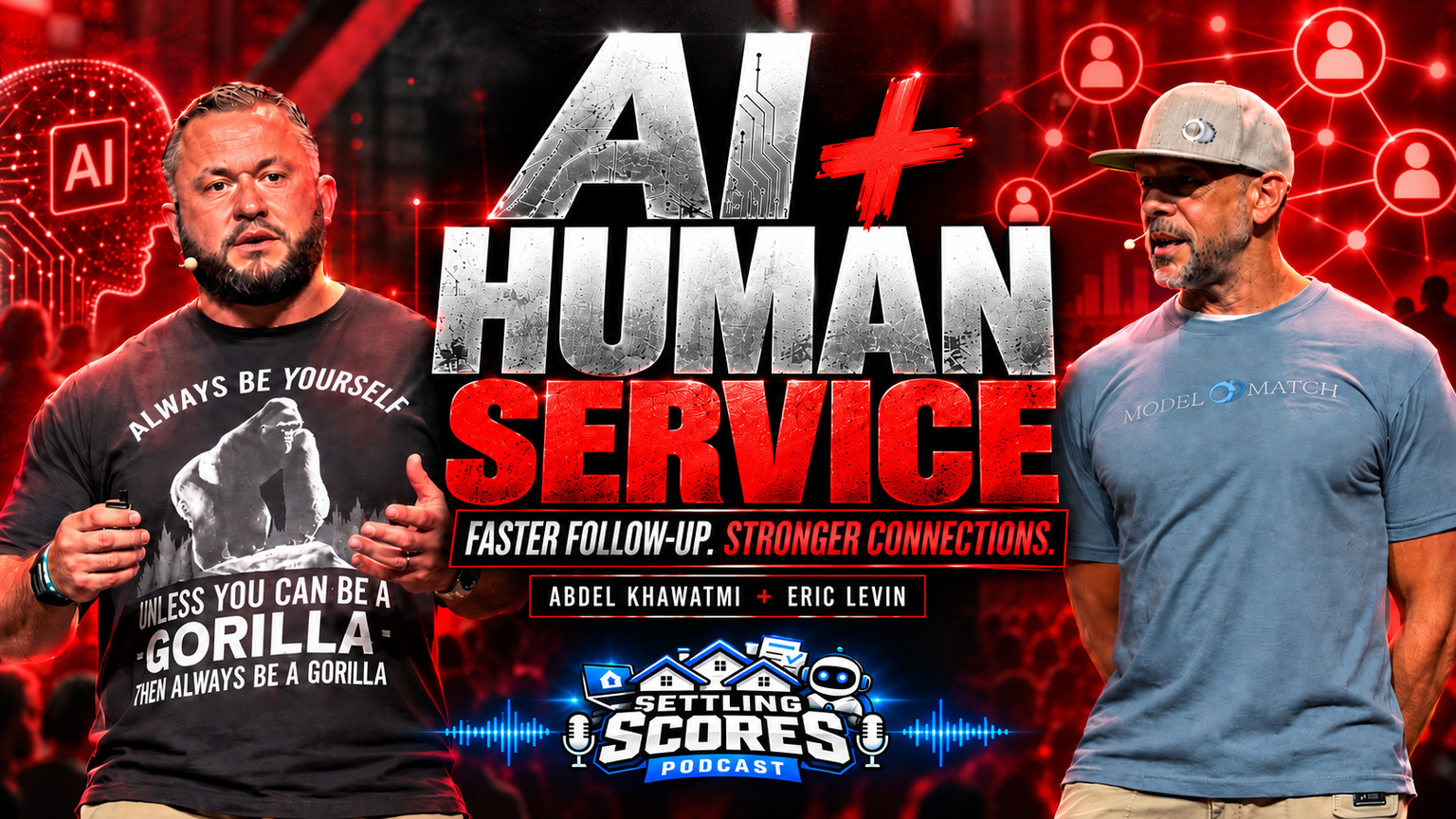
AI should remove the work around a mortgage conversation, not remove the person from it. That is the central answer in this August 18 episode of Settling Scores. Cohosts Abdel Khawatmi of PRMG Got Mortgages and Eric Levin, cofounder of Model Match, discuss how faster research, connected information and prompt follow-up can support more meaningful human service.
Episode originally published August 18, 2026. Archive recap added October 24, 2026.
Returning from the HousingWire AI Summit in Dallas, the hosts move beyond demonstrations to a practical question: what happens between a real conversation and the next useful action? Their strongest examples involve explaining difficult choices, documenting the discussion and keeping clients and referral partners from wondering what comes next.
Watch the original Settling Scores conversation with Abdel Khawatmi and Eric Levin on YouTube.
Key takeaways: automate friction, preserve judgment
- Choose a defined service problem before choosing another platform.
- Connected information is useful when it reaches the professional during the conversation.
- Faster preparation should create more room for personal advice, not fewer conversations.
- A clear recap can preserve context when the answer is complicated or disappointing.
- Measure whether people understand their next step, not simply how much content a system generates.
A changing CRM still needs a relationship strategy
Abdel recalls a Total Expert presentation describing a move beyond the traditional CRM toward AI infrastructure and customer intelligence. Eric makes an important distinction: he does not hear that as the end of customer relationship management. He hears a change in its definition.
That distinction matters for mortgage teams. Maintaining a contact record is different from helping an originator understand a relationship and respond appropriately. A system can contain extensive information while still leaving its user unsure whom to call, what to explain or which commitment needs attention.
Abdel offers a smaller example from content production. After experimenting with the Captions app for language changes, he noticed translation features inside Instagram. His point is that capabilities migrate into platforms people already use. A separate tool that once solved a problem may eventually duplicate an existing feature.
The suggested action is to review overlap before expanding the stack. Identify the outcome you need, inspect what your approved systems already support and decide who will own the workflow. Buying access is not the same as establishing a reliable process.
The human advisor helps the person, not just the transaction
Eric highlights a summit observation from Ryan Grant: a wealth manager is valuable not only for managing money, but for helping manage the person making decisions about it. Eric connects that idea to mortgage advice. Automation can handle more information without resolving a client's uncertainty about a consequential choice.
A borrower may understand the payment calculation and still need to discuss timing, competing priorities or an uncomfortable trade-off. A referral partner may receive a status notification and still need a conversation about whether a purchase plan is realistic.
Abdel describes using AI more heavily while also spending more time on consumer calls, including rate-lock and value conversations. Those activities are not opposites. Removing preparation and writing friction can make an originator more available for the part of the work that requires listening.
A suggested team exercise is to separate information from judgment in a training agenda. List which preparation tasks can be organized automatically and which conversations require a professional to listen and explain. This makes the boundary visible before the team introduces another tool.
Translate market information instead of forwarding headlines
Abdel describes learning to understand CPI, PPI, inflation and employment information so he could explain their relevance to consumers. His emphasis is not simply collecting economic releases. It is absorbing the information and translating it for a particular audience.
Eric adds that an originator can learn from a knowledgeable colleague and explain the same underlying ideas in their own vocabulary. The relationship still depends on making the information understandable rather than reciting somebody else's commentary.
A useful application is a short preparation brief with three parts: what the report measures, why mortgage markets may pay attention and what remains uncertain for this client's decision. The professional then connects that context to the actual financing conversation.
For an educational market brief, distinguish the report’s subject from its possible relevance to mortgage markets. Include the release date and flag uncertainty. AI can help organize that explanation, but the originator should verify the source and avoid converting general context into a prediction or a personalized instruction.
The most concrete workflow: conversation, recap, next action
Abdel describes moving from dictating notes after calls to using a recording-and-transcription device and routing the resulting material through four assistants. He says those assistants digest the conversation and prepare recaps for consumers or potential referral partners. Partner conversations can enter a more customized flow with visuals.
The important detail is the handoff. A recording that merely accumulates is not a communication system. In Abdel's example, the conversation becomes something another person can use while he moves to the next call.
A suggested recap structure is straightforward: summarize the objective, identify the options discussed, record unresolved questions and state the next action with its owner. Separate a possible financing path from an approval. Preserve conditions and limitations rather than shortening them away.
Before adopting a similar process, use organization-approved recording, consent, storage and sharing practices. Review the draft for accuracy and share only appropriate information with authorized recipients. A referral partner's need for an actionable update does not automatically justify sending the borrower's entire financial conversation.
Build a communication process before adding automation
Abdel’s workflow connects a call, a transcript, designated assistants and a recap that supports the next interaction. Each handoff has a purpose. A team can map that sequence before adding more automation, making clear who reviews the output and what should happen next.
Start by mapping the handoff without using client records. As a suggested implementation, write down the trigger, the assigned reviewer, the intended audience and the action the output should support. A partner-meeting recap might identify an agreed training topic, the person preparing materials and the next meeting date. That illustrates the workflow without revealing a household’s financial circumstances.
Keep separate versions for separate audiences. An internal task list may need more operational detail than an external update. A referral partner generally needs the status of an agreed next step, not a complete conversation history. Treat this separation as a design requirement rather than relying on someone to remove sensitive details at the last minute.
Use a review checklist before release: does the draft reflect what was actually said, distinguish decisions from open questions and identify who is responsible? Check that the system has not converted a tentative idea into a promise. When the source is unclear, ask the person responsible instead of allowing polished language to hide uncertainty.
Define an exception route as well as the normal route. If transcription fails, the reviewer is unavailable or the intended recipient is uncertain, pause the automated message and assign a manual follow-up. This suggested safeguard puts Eric’s closing point into practice: the value is a specific follow-up action, not the AI label attached to it.
Make adoption and iteration observable
At the summit, Abdel repeatedly heard adoption and iteration emphasized together. His examples of overlapping translation tools show why a purchase decision cannot be the end of the evaluation. Capabilities change, and a tool may stop being the simplest way to achieve an outcome.
A suggested review log can track one workflow at a time: what friction it was intended to remove, where people still intervene and what recipients still find unclear. Review a small set of approved outputs with the people doing the work. If staff repeatedly rewrite the same passage, fix the template or instructions rather than treating every correction as an isolated problem.
Measure the service result before broadening the trial. Useful checks include whether commitments have owners, whether promised follow-ups occur and whether recipients can identify the next step. These are proposed operating checks, not performance results reported by the hosts. Stop or simplify a connection that creates more checking work than useful clarity.
Connected information should serve the live conversation
Eric recalls Abdel and Dan Snyder comparing things they had built using Model Match data connected through an MCP server. The hosts do not provide a technical implementation lesson. Their example illustrates a direction: bringing useful information into an existing interaction rather than requiring another disconnected search.
Abdel also describes retrieving professional information on his phone as names came up in conversation. His enthusiasm centers on reduced friction and access to a team he trusts, not simply on having another interface.
The suggested test is practical: does the connection help you prepare a more relevant question or deliver something useful? Fast access without a clear purpose can become another distraction. Keep permissions, data handling and business relevance part of the design.
A suggested service-first trial for a New Jersey team
Start with one recurring communication gap, such as the missing recap after a purchase consultation. Do not attempt to automate the entire borrower journey before defining what a good handoff looks like.
- Describe the gap. Identify what borrowers or agents repeatedly need clarified.
- Define the output. Use a brief recap with the objective, open questions and next action.
- Assign responsibility. Name the person who reviews and releases the message.
- Check understanding. Ask whether the recipient knows what happens next.
- Adjust the workflow. Fix missing context before adding more automation.
For a team serving Ocean or Monmouth County, a suggested starting point is an internal training recap. Review whether staff can identify their responsibilities without another clarification meeting. Once the process works, adapt its structure to approved external updates while retaining audience-specific privacy controls.
Abdel's standard is that consumers and partners should not need to ask what is happening with a deal. He applies a similar standard to loan-officer onboarding: repeated questions about the next step can reveal a systems gap. Leaders exploring that issue can learn more through career conversations.
Frequently asked questions
What is this episode's main answer about AI and service?
Use AI to reduce research, documentation and follow-up friction while keeping a knowledgeable professional responsible for listening, explaining trade-offs and guiding the conversation.
Who are the cohosts?
The cohosts are Abdel Khawatmi of PRMG Got Mortgages and Eric Levin, cofounder of Model Match. This conversation follows their HousingWire AI Summit experience in Dallas.
Does Eric say the CRM is dead?
No. He interprets the summit discussion as a changing definition of CRM, with more connected intelligence rather than the disappearance of relationship management.
Why choose one AI platform instead of trying everything?
Abdel recommends staying focused long enough to understand where a platform belongs in your work. Switching constantly can consume time without improving a defined service outcome.
What should an AI-assisted call recap contain?
A suggested format includes the client's objective, options discussed, unresolved questions and the next action. Have a responsible person review accuracy and recipient access before sharing.
How can a team test a recap workflow safely?
Use non-client material, such as a staff training meeting. Check whether the recap captures commitments, names the next action and reaches the correct reviewer. These are suggested testing steps, not a claim that the episode demonstrates a formal privacy audit.
What signals a communication gap?
Abdel points to consumers or partners repeatedly asking what is happening and new loan officers asking what comes next. Review the missing handoff, ownership or timing before adding more automated messages. A larger volume of updates will not fix an unclear process.
How can a New Jersey borrower use this lesson?
Ask for a clear explanation of the options discussed, remaining documentation and next steps. You should know which questions remain open and whom to contact for clarification.
How do I reach Got Mortgages?
Call 973-536-0276 or visit GotMortgages.com to start a conversation with PRMG Got Mortgages about your situation.
Make faster follow-up feel more personal
Eric closes the business discussion by describing the value as specific follow-up actions delivered faster. That is the practical standard: not how impressive the technology sounds, but whether people leave a conversation with clarity and receive the promised follow-through.
To talk with PRMG Got Mortgages, call 973-536-0276, visit GotMortgages.com, contact the team or build your mortgage plan.
Explore more Mortgage Intel and Abdel Khawatmi’s profile. Explore more conversations at the Got Mortgages Podcast website.
Author: Abdel Khawatmi with PRMG Got Mortgages | 973-536-0276
This article is general mortgage information only. It is not a commitment to lend, a rate quote, or legal or tax advice. Loan approval, terms and pricing depend on a full application, credit review and property details, and market conditions change. Talk with a licensed loan officer and your own legal or tax professional about your situation. NMLS #1712023 | PRMG NMLS #75243.