
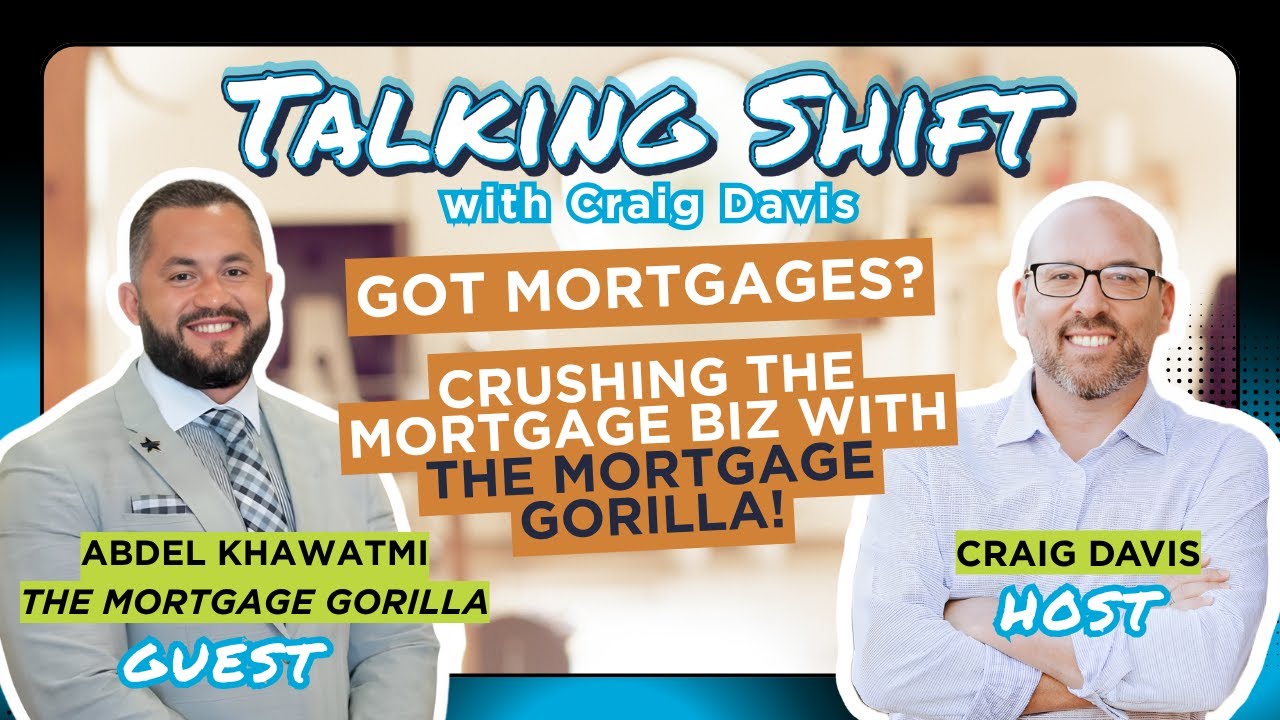
The modern mortgage industry is defined by rapid shifts, but for Abdel Khawatmi—affectionately known as 'The Mortgage Gorilla'—success isn't just about reacting to change; it is about proactive leadership and meticulous execution. In this detailed discussion with Craig Davis on Talking Shift, Khawatmi breaks down the 'Tesla model' of mortgage origination: a plug-and-play system that integrates advanced technology like AI while doubling down on the human connection that fuels client loyalty. From automating daily recaps to restructuring teams for maximum efficiency, Khawatmi provides a masterclass in how to lead people, manage processes, and maintain profitability amidst margin compression.
Conversation originally published November 14, 2025. Recap added October 24, 2026.
Watch the original conversation on YouTube.
The APB Framework: Automate, Predict, and Build
In a fast-moving market, Abdel Khawatmi emphasizes that the most successful mortgage leaders follow a specific order of operations: Plan, Implement, and Execute. He introduces his 'APB' framework—Automate, Predict, and Build—as the foundation for a forward-thinking origination business. This approach is not about replacing the hard work of 'smile and dial' sales tactics, but rather about enhancing them through modern-day efficiencies. Khawatmi argues that the industry has moved beyond simple tools like yellow books or newspaper articles. Today’s progressive originators are dabbling in advanced platforms like ChatGPT, Gemini, Perplexity, and Claude to streamline communication and data analysis.
The shift toward technology is no longer optional in Khawatmi's view, yet it must be structured within a disciplined workflow. By predicting market trends and building systems around those insights, originators can focus on 'green time'—the direct activities that generate revenue—rather than getting bogged down in administrative friction. This systematic approach allows a lender to remain agile, especially when economic indicators shift unexpectedly. Khawatmi explains that by automating the mundane, the originator creates the necessary space to behave like a modern-day professional rather than a reactive clerk, ensuring that every technological investment serves the larger goal of business scalability and operational consistency.
Khawatmi's framework also highlights the necessity of acting on the data provided by these tools. It is not enough to simply have access to ChatGPT or Claude; one must use them to predict outcomes and build better client experiences. During his appearance at the Sales Mastery conference, he demonstrated that the difference between those surviving and those 'crushing it' is the willingness to implement these systems fully. By mastering one tool at a time and integrating it into the APB workflow, lenders can transform their productivity and ensure they are always moving forward in an industry that often feels like it is standing still.
Leading with Education and the 'Why'
One of the core takeaways from the Sales Mastery conference is the importance of discovery. Khawatmi highlights Simon Sinek’s 'Golden Circles'—starting with Why, then How, then What—as the essential way to build lasting client relationships. Instead of acting transactionally, Khawatmi asks clients why they are seeking a new lender or why they are choosing to buy now. This 'hopes and dreams call' uncovers emotional motivations that a standard application link never could. He avoids the pitfall of being a 'stadium lender' who treats people like dollar signs, focusing instead on the authentic, human connection that creates a client for life.
By leading with education first, Khawatmi ensures that his clients aren't just getting a rate; they are getting a strategic analysis. He uses tools like NBS Highway and Mortgage Coach to provide visual breakdowns of the long-term financial implications of different loan options. This educational approach transforms a simple transaction into a high-trust relationship, shielding the client from the 'noise' of outside competitors and stadium lenders. When a client understands the financial impact of their choices through visual data, they are less likely to be swayed by a lower rate from an online competitor that offers no personalized guidance or expertise.
Furthermore, Khawatmi insists that education must be the primary driver for both the consumer and the referral partner. By showing a client the analytical difference between a 6.5% and a 6.9% rate—often proving that the higher rate might save more money long-term depending on the points paid—he positions himself as a consultant rather than a salesperson. This transparency builds a 'bubble wrap' around the customer, preventing them from being poached by competitors because they feel truly taken care of. Khawatmi believes that when you solve for the client’s 'why,' you eliminate the friction that typically derails the loan process.
Integrating AI for Operational Excellence
Abdel Khawatmi has successfully embedded AI into his daily workflow, utilizing it for everything from summarizing sales conferences to managing his calendar. He receives AI-generated summaries at 5:30 a.m. regarding economic indicators like CPI, PPI, and PCE to assist his rate lock decisions. By feeding his scribbled notes into AI, he generates actionable recaps for his team, ensuring that no insight from a conference or mastermind goes to waste. This integration is seamless, allowing him to track his productivity across personal and professional categories, ensuring that his focus remains aligned with his long-term goals and family obligations.
Crucially, Khawatmi uses AI to amplify his humanity rather than replace it. He leverages ChatGPT to articulate complex mortgage guidelines from the HUD handbook and Fannie Mae selling guides, creating a 'Got Mortgages University' for his clients. This infrastructure allows his team to produce content—such as 1031 exchange guides or first-time homebuyer powerpoints—at a scale and speed that was previously impossible. Even his 13-year-old daughter was involved in the process, using Canva and AI tools to modernize over 2,600 pieces of content, ensuring that the brand remains fresh and relevant to a modern audience while maintaining its core value proposition.
The use of AI extends to social media and team communication as well. Khawatmi uses AI to generate captions, refine social media posts, and even create humorous visuals, like him in a cowboy hat riding a gorilla, to keep the brand engaging. By using these tools for heavy lifting, he ensures that his team can focus on high-value interactions. He advocates for picking one tool, mastering it, and then moving to the next, rather than trying to overhaul everything at once. This measured approach to technology ensures that the tools actually solve problems rather than creating new technical hurdles for his staff to overcome.
Overcoming Margin Compression through Cost Efficiency
The mortgage industry is currently plagued by margin compression, particularly in distributed retail lending. Khawatmi addresses this head-on by using AI to lower his cost to produce. By training his Virtual Assistants (VAs) and Loan Officer Assistants (LOAs) to be 'disgustingly dangerous' with AI, he was able to restructure his team for better profitability. This strategic move allowed him to save upwards of $17,000 per month by reducing the number of employees needed while increasing the overall output and speed of his operations. He views this as a necessary evolution to stay competitive against fintech and stadium lenders.
These savings provide a competitive edge in a market where every basis point counts. The reclaimed capital can be reinvested into buying more leads, going consumer-direct, or lowering margins to provide more attractive pricing to borrowers. This 'lethal' combination of lower overhead and higher output allows a local IMB or broker to compete with large fintech disruptors who traditionally win on speed and cost. Khawatmi's model proves that you can be both high-tech and high-touch without sacrificing the bottom line, provided you are willing to make the difficult decisions regarding team structure and technological adoption.
Khawatmi emphasizes that being a leader means managing these processes efficiently while leading people with empathy. When he realized that AI could perform many of the administrative tasks previously handled by staff, he transitioned those roles to maximize profitability. This isn't just about cutting costs; it's about reallocating resources to where they can have the most impact on the customer experience. By operating with a leaner, tech-empowered team, Khawatmi can offer better service and more competitive rates, effectively neutralizing the advantages that much larger companies typically have over independent mortgage professionals.
The implementation of these systems also protects the business during seasonal lulls. In New Jersey, where market activity tends to slow in the fourth quarter, Khawatmi's cost-efficient model ensures that the branch remains profitable even when volume dips. By having the infrastructure in place to handle high volume without adding significant payroll, he creates a resilient business that can weather any market condition. This approach to margin compression is a blueprint for any originator looking to survive the current landscape while positioning themselves for massive growth when interest rates inevitably shift again.
Systematizing the Client Journey
Khawatmi’s client interaction is a five-step process designed to eliminate friction and maximize conversion, which he notes has jumped by nearly 70% since implementing these systems. It begins with the 'hopes and dreams' call, followed by a flexible application process where clients choose their communication preference—whether that is a self-guided online form or a guided call with a consultant. By asking for the preferred method of communication early on, he removes the frustration many clients feel when they are bombarded with emails or texts when they actually prefer a phone call.
Once the data is collected, the 'Combo Strategy' takes over. Khawatmi uses BombBomb to send personalized video messages, creating an immediate personal connection. He uses Zoom to walk clients through a financial analysis using NBS Highway, then leverages ChatGPT and Gamma to turn the data into 'immaculate' presentations. By controlling the relationship through scheduled, high-value interactions, Khawatmi avoids the trap of being a 24/7 'reactive' lender. Instead, he positions himself as a disciplined leader who respects both his time and the client's goals, ensuring that every step of the process adds value and builds confidence in the borrower.
This system also ensures that the 'Four C's' of mortgage—Credit, Capital, Collateral, and Capacity—are addressed early and clearly. By using tools like NBS Highway during Zoom calls, Khawatmi provides a visual roadmap of the loan process that helps the client feel in control. This level of transparency and structure is rare in an industry that often feels chaotic to the consumer. Because the process is so well-defined, the client is less likely to feel anxious or shop around, as they have already received a higher level of service and education than they would get from a standard transactional lender.
The Tesla Model: Plug-and-Play Origination
Abdel Khawatmi describes his branch management philosophy as the 'Tesla model.' The goal is to provide a complete, plug-and-play system for loan officers where they can simply 'log in and drive.' This means providing access to a pre-built infrastructure of marketing materials, AI-powered processing, and established workflows. This approach eliminates the need for lengthy onboarding or complicated manual processes, allowing new originators to hit the ground running and focus entirely on building their referral networks and closing loans rather than managing administrative hurdles.
The Tesla model is built on transparency and efficiency. Khawatmi wants his team members to have the specs they need—whether it's pricing, compensation, or team structure—without the 'shackles' of old-school sign-on bonuses or restrictive contracts. By creating a high-performance environment where technology does the heavy lifting, he attracts top-tier talent who want to grow their business without being bogged down by legacy systems. This model also allows for collaborative growth, as Khawatmi often incorporates new nuggets of wisdom from his originators back into the overall system for the benefit of the entire branch.
Leadership in this model means providing the tools for success while getting out of the way of the sales process. Khawatmi provides his team with 'Training Gorillas' and 'Got Mortgages Blueprint' resources, ensuring they have the educational support to handle any loan scenario, from 1031 exchanges to non-QM products. By offering this comprehensive ecosystem, he ensures that his originators are the most knowledgeable and efficient in their market. This systemic support is what allows a branch to scale rapidly, as it provides a consistent, high-quality experience for both the loan officer and their referral partners.
Strategic Relationship Control and Follow-Up
Success in mortgage origination is heavily dependent on how a lender manages their database and referral partners. Khawatmi uses tools like Model Match to identify and target high-performing realtors in his local market, focusing on those who close between 10 and 40 deals a year. He emphasizes that one should never call a partner without doing diligence first. By researching an agent's history and mesh points, he ensures that every connection is purposeful and likely to lead to a productive, long-term partnership rather than a one-off transaction.
To maintain what he calls 'bubble wrap' around his database, Khawatmi uses a CRM strategy he calls SCTE: Social, Call, Text, and Email. This ensures that he stays top-of-mind with his clients and partners through multiple touchpoints. He also leverages platforms like Big Purple Dot and Follow-Up Boss to ensure that no lead is lost and that every interaction is tracked and followed up on systematically. This level of relationship control is what prevents clients from being distracted by the 'noise' of online lead aggregators or competing lenders who only reach out when rates drop.
Khawatmi's approach to networking is equally disciplined. After every event, he and his team ensure that every business card collected is followed by a LinkedIn connection and a scheduled follow-up. He doesn't believe in just attending events for the sake of being seen; he makes it a point to convert every handshake into a data point in his system. By controlling the follow-up process, he ensures that the momentum gained from a face-to-face meeting is not lost, ultimately leading to a more robust referral network and a more predictable flow of new business.
Final Checklist for Mortgage Mastery
To replicate Abdel Khawatmi’s success, originators should start by picking one AI tool and mastering it before moving to the next. Audit your tech stack to ensure you aren't paying for redundant platforms, and focus on building an 'ecosystem' rather than just a collection of apps. Most importantly, ensure that every technological advancement is backed by the 'four C's' of mortgage—credit, capital, collateral, and capacity—and a genuine interest in the client's 'why.' The goal is not to be a 24/7 reactive lender, but a disciplined professional with clear boundaries and superior systems.
Transitioning from an originator to a leader requires managing processes while leading people. Whether it is using Model Match to identify local realtor partners or using Big Purple Dot and Follow Up Boss to maintain 'bubble wrap' around your database, the goal is total relationship control. As Khawatmi demonstrates, when you own the process and lead with heart, you don't just survive market shifts—you make them happen. By integrating AI for leverage and Scale, you can reclaim your time for the 'green time' activities that truly move the needle for your business and your family.
The final takeaway from Khawatmi’s journey is that the mortgage business is still inherently human, despite the influx of technology. The tools are there to amplify the human connection, not to hide behind. By maintaining a 'belly-to-belly' presence at local events and combining it with the speed of AI-driven follow-up, an originator becomes unstoppable. The 'Mortgage Gorilla' brand represents a balance of strength in process and heart in leadership, proving that the modern-day originator can thrive by being both high-tech and intensely personal in every client interaction.
Frequently asked questions
What is the 'APB' framework mentioned by Abdel Khawatmi?
APB stands for Automate, Predict, and Build. It is a strategic framework for mortgage professionals to use technology to automate tasks, predict market trends, and build scalable business systems.
How did Abdel Khawatmi reduce his monthly overhead?
By integrating AI into his team's workflow, he increased the efficiency of his VAs, LOAs, and processors, allowing him to restructure his team and save approximately $17,000 per month in payroll and operational costs.
What is the 'Hopes and Dreams' call?
This is the first step in Khawatmi’s client process. It is a discovery call focused on the client's 'Why'—their goals, motivations, and life situation—rather than just the 'What' of mortgage rates and programs.
Which AI tools does Khawatmi recommend for mortgage originators?
He highlights several tools including ChatGPT for communication and recaps, Gamma for creating instant presentations, Perplexity and Claude for data, and AI-integrated calendars for tracking goals and productivity.
Why does Khawatmi avoid having a voicemail?
He forwards all calls to his office where a team is available from 8:00 a.m. to 9:00 p.m. This ensures that realtors and clients always reach a human who can immediately assist them or route the call to the appropriate department.
What are the 'Four C's' of mortgage Khawatmi still uses?
Despite using modern AI, he sticks to the foundational basics of mortgage lending: Credit, Capital, Collateral, and Capacity.
How does Khawatmi use AI to stay updated on market trends?
He has AI integrated to provide 5:30 a.m. updates on economic indicators like CPI, PPI, and PCE, helping him provide expert 'lock or float' advice to his clients and team.
What are the three types of clients Khawatmi caters to?
He views his business through three lenses: the Consumer (Got Mortgages University), the Referral Partner (Got Mortgages Blueprint), and the Loan Officers (Training Gorillas).
To talk with PRMG Got Mortgages, call 973-536-0276, visit GotMortgages.com, contact the team or build your mortgage plan.
Explore more Got Mortgages Insights and Abdel Khawatmi’s profile. Explore more conversations at the Got Mortgages Podcast website.
Author: Abdel Khawatmi with PRMG Got Mortgages | 973-536-0276
This article is general mortgage information only. It is not a commitment to lend, a rate quote, or legal or tax advice. Loan approval, terms and pricing depend on a full application, credit review and property details, and market conditions change. Talk with a licensed loan officer and your own legal or tax professional about your situation. NMLS #1712023 | PRMG NMLS #75243.