
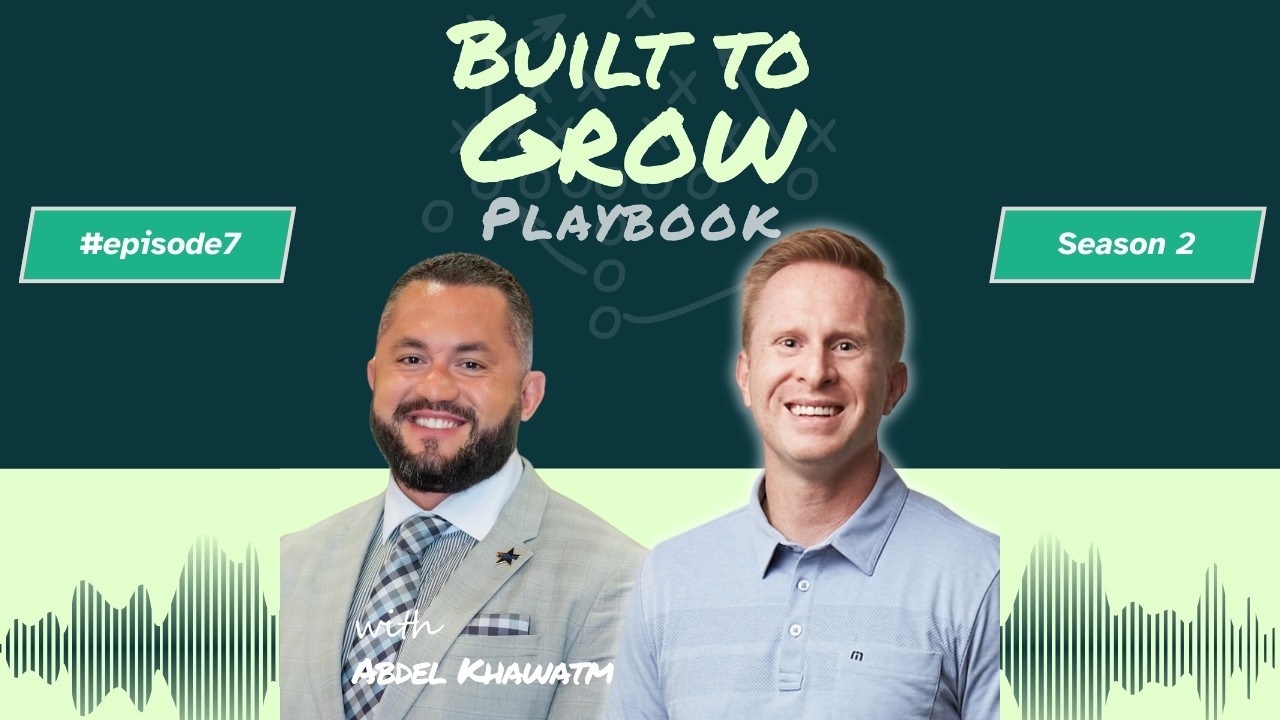
What does it take to scale a mortgage business to seven figures without losing your connection to family and faith? In this conversation hosted by Ryan Naylor on the AvaHR channel, Abdel Khawatmi, founder of Got Mortgages, joins to detail his journey from law school hopeful to industry leader. Khawatmi reveals his proprietary 'SCALE' and 'REPS' frameworks, designed to turn inconsistent sales efforts into a high-octane growth engine. By blending aggressive automation with radical authenticity, Khawatmi demonstrates how individual mortgage professionals can outcompete massive corporate marketing budgets through personal branding and disciplined routine.
Conversation originally published May 29, 2026. Recap added October 24, 2026.
Watch the original conversation on YouTube.
The Pivot: From Law School to Mortgage Mastery
Abdel Khawatmi’s entry into the mortgage sector was born of necessity rather than a lifelong dream. Originally bound for law school after meeting his wife at Rutgers University, a senior-year pregnancy shifted his focus toward immediate financial stability. After five successful years at a personal injury law firm—where he managed settlements and medical relationships—Khawatmi noticed a recurring pain point: clients frequently asked for home-buying advice because they despised the complexity of the mortgage process. He realized that the industry lacked clear communication and expectation-setting based on his own early investment experiences.
Drawing from his own experience of purchasing two properties by age 24, Khawatmi realized that the industry lacked clear communication and expectation-setting. He transitioned into the mortgage space with a commitment to these fundamentals, viewing his eight-year tenure as equivalent to '50 dog years' due to the intensity of sales. Today, he leads Got Mortgages, a nationally recognized brand built on the pillars of systems-first growth and operational transparency. His background in managing complex legal distributions provided a unique perspective on handling high-stakes financial transactions for families.
Khawatmi emphasizes that his success stems from simply 'picking the damn thing up' and executing where others hesitate. By applying a legalistic rigor to mortgage origination, he transformed a process he once despised into a streamlined service model. This transition from the 'traditional 9-to-5' at a law firm to the high-stakes world of mortgage entrepreneurship allowed him to build a footprint that extends far beyond his original New Jersey base. The evolution was fueled by a desire to provide the clarity he found lacking when he was a young consumer himself.
The SCALE Framework for Sustainable Growth
Khawatmi argues that many loan officers work too hard because they fail to scale properly. To address this, he uses the 'SCALE' acronym to guide business development. The first pillar is Systems before Sales. He emphasizes that one must understand the operational background and briefs—much like a legal professional—before perfecting a sales script. Without a robust system, a high volume of sales leads to chaos rather than growth, making the operational foundation the most critical step for any mortgage professional.
The remaining pillars include Consistency over intensity, where small daily repetitions outperform short bursts of effort; Automation to handle repetitive tasks without losing human connection; and Leverage by delegating to a team to handle follow-ups that an individual cannot physically manage. Khawatmi notes that leverage is essential because one person cannot possibly call, text, and email every lead with the necessary frequency. By utilizing a team to manage the consistent touchpoints, the lead originator is freed to focus on high-value conversations and closing complex deals.
The final pillar is Execution. Khawatmi notes that most professionals possess the necessary tools, such as a laptop and seasoned leads, but fail at the final stage of actual execution. He believes that many entrepreneurs fall at this hurdle because they have a playbook but lack the discipline to follow it daily. Execution is the differentiator between those with great ideas and those with seven-figure businesses. The SCALE framework ensures that every action taken by the team is supported by a system that allows for predictable and repeatable success.
Building Consistency Through REPS
To foster a culture of high performance within his sales team, Khawatmi introduces the 'REPS' acronym: Routine, Expectations, Pipeline, and Standards. Consistency begins at 4:00 a.m. for Khawatmi, utilizing a home sauna for meditation and early workouts to prepare for the day. He holds his team to similar standards, insisting that sales professionals be ready to work by 8:59 a.m. sharp. This disciplined start prevents 'cracks in the system' that can derail productivity before the workday even begins.
Expectations are managed through clear Key Performance Indicators (KPIs). Khawatmi encourages his commission-based employees to calculate their hourly wage based on total production. This 'data over drama' approach helps originators identify when they are being busy versus when they are being productive. By tracking metrics such as the time of day calls are most effective, the team makes decisions based on evidence rather than intuition. He notes that a professional earning $75,000 on 30 hours a week is more efficient than one working 50 hours for the same return.
Pipeline and Standards round out the REPS framework, ensuring that the sales vehicle does not become toxic. Khawatmi maintains high standards regardless of whether an originator closes three deals or ten. By focusing on the 'small reps' of daily activity, Khawatmi reached the best production month of his entire career in April, surpassing even the COVID-era boom. This success is attributed to the relentless pursuit of routine and the refusal to let standards slip, even when the market shifts or individual motivation wanes.
Authenticity as a Competitive Advantage
In a market dominated by large institutions with massive marketing budgets, Khawatmi leverages personal branding to compete. His strategy involves high visibility through platforms like Instagram and YouTube, where he shares 'Monday Market Updates,' 'Wednesday Wins,' and 'Friday Fires.' The 'Friday Fires' segment is particularly popular as it focuses on how complex deals that 'blew up' were salvaged, demonstrating transparency and problem-solving skills to potential clients. This regular content schedule builds a bridge of trust before a formal meeting.
His approach to social media is intentionally authentic. Whether recording a video in a tank top from his backyard or driving a Cybertruck wrapped in a patriotic gorilla theme, the goal is to be found through Answer Engine Optimization (AEO) and Generative Engine Optimization (GEO). By answering specific consumer questions online, he ensures he is discovered by AI bots and generative search engines. He believes that people buy from the person, not the letters on their chest, making personal visibility the ultimate tool for small business relevance.
Khawatmi highlights that in 2025, approximately 13% of his business was attributed directly to social media leads. He encourages other entrepreneurs to stop wasting small budgets on Meta ads and instead invest their energy into a personal brand that reflects their true personality. By being 'proactive and transparent' online, he creates a relationship with his audience that large corporations cannot replicate. This authenticity allows him to reach diverse demographics, from Millennials and Gen Z to Boomers, through a variety of video and written content.
Leveraging AI for Human Connection
Contrary to the fear that AI will replace professionals, Khawatmi uses it to enhance the human element of his business. AI runs his back-end operations, content ideation, and automated follow-up sequences. This technological leverage allows him to spend more time on the phone having genuine, high-value conversations with clients. He tracks his phone time down to the minute, ensuring that automation is handling the 'busy work' while he focuses on relationship-building and complex financial analysis for his borrowers.
He uses AI tools to provide 'Total Cost Analysis' presentations, helping clients visualize the difference between interest rate options and inflation impacts. By stripping away the noise of energy and food costs to look at core personal consumption expenditures, he educates his audience on the Federal Reserve's decisions. This analytical depth, supported by AI-generated data, helps both first-time buyers and seasoned investors make cognitive decisions. Technology acts as a catalyst for clearer communication rather than a barrier between the lender and the consumer.
The integration of AI also helps Khawatmi manage his three freedoms: time, relationship, and financial. Because automation handles the repetitive touchpoints, he can maintain a high volume of business without sacrificing the quality of his client interactions. He believes that professionals who try to use AI to hide from their clients will fail, while those who use it to free up time for 'eyes open, hands shut' sales work will thrive. This balance ensures that the client experience remains personal despite the scale of the organization.
Leadership and Team Culture building
Khawatmi’s leadership style is rooted in 'leading from the front.' He participates in the same daily disciplines he asks of his team, including a Friday morning huddle at 9:00 a.m. sharp. To maintain a non-toxic environment, he encourages team-building activities, such as working together in his backyard during the 'hot season.' This allows team members to overhear each other's calls, providing opportunities for real-time coaching and support. Watching his team collaborate in an informal setting reinforces a culture of mutual accountability.
Retention is high at Got Mortgages because Khawatmi avoids the 'song and dance' of sign-on bonuses and golden handcuffs. His core operations and sales staff have been with him since the beginning, a rarity in the high-turnover mortgage industry. He encourages his team to view referrals and relationships as the lifeblood of the business, rather than just chasing the next transaction. By sharing his own struggles and successes openly, he creates an environment where 'boomeranging' originators often return after realizing the value of his systems.
Culture is also built through client appreciation, which Khawatmi treats as a team effort. The firm hosts events like private movie screenings for families, renting out theaters for films like 'Wonka' and 'Mufasa.' These events are not just marketing; they are an extension of the brand's 'family-first' value system. By involving the team in these legacy-building activities, he ensures that everyone is aligned with the long-term vision of the company. Leadership, for Khawatmi, means creating a space where professionals can succeed financially while maintaining their personal values.
Balancing Legacy and Leadership
For Khawatmi, entrepreneurship is defined by 'Four Fs': Faith, Family, Fitness, and Finance. The passing of his father two years ago served as a catalyst to redefine his version of success. He shifted from a focus on sheer work volume to physical presence, ensuring he attends his daughter’s lacrosse games and his son’s jiu-jitsu tournaments. This loss taught him that hard work is only valuable if it supports a legacy of presence, rather than just a legacy of financial provision.
He advocates for radical transparency with one's spouse, sharing digital calendars to ensure alignment on business demands. Khawatmi notes that his wife often knows his schedule better than he does, which helps prevent the isolation often felt by high-achievers. By involving his family in his vision, he transforms the 'entrepreneurial headwind' into a shared journey. He advises other business owners to live on a 'low budget' and maintain a security cushion, acknowledging that the market's highs can quickly turn into lows.
Success, according to Khawatmi, is the ability to conduct a Zoom call in a tank top from his backyard while still delivering seven-figure results. This level of freedom is only possible through the rigorous application of systems and the courage to remain authentic. By balancing his relationship with God, his family, and his physical health alongside his finances, he has built a business that serves his life rather than consuming it. His journey from a Rutgers senior facing an uncertain future to a national mortgage leader serves as a blueprint for modern entrepreneurship.
Practical Insights for Modern Sales Professionals
For those looking to replicate his success, Khawatmi stresses the importance of 'eyes open, hands shut' sales discipline. He believes that objections are merely 'rebuttals and oxygen,' necessary components of a healthy sales dialogue. He shares strategies such as learning how to code and adapting to new technologies like AEO and GEO to remain relevant in an AI-driven search environment. The goal is to be found where the consumer is looking, whether that is on Reddit, TikTok, or generative AI bots.
His content strategy is a mix of structured updates and 'John Madden content'—sharing everything as it happens. This includes everything from deep-dive YouTube masterminds that were once private to short-form videos recorded in his car. By making his internal training public, he builds authority and invites others into his professional ecosystem. He views every interaction as an opportunity to learn, stating that he is just as eager to learn from his referral partners as they are to learn from him.
Ultimately, Khawatmi’s message to entrepreneurs is to leverage 'tools over toys.' By investing in the systems and technology that drive efficiency, business owners can reclaim their time and focus on what truly matters. Whether it is through a branded Cybertruck or a highly technical market report, the objective is to remain visible, authentic, and disciplined. As he continues to grow Got Mortgages, he remains committed to the idea that helping others get what they want is the fastest path to achieving one's own goals.
Frequently asked questions
What is the SCALE framework in mortgage sales?
SCALE stands for Systems before sales, Consistency over intensity, Automation, Leverage of your team, and Execution. It focuses on building an operational foundation before focusing on scripts.
How does Khawatmi define 'REPS' for sales professionals?
REPS refers to Routine, Expectations, Pipeline, and Standards. It sets the daily discipline required for a sales professional to remain productive and accountable.
What is AEO and GEO in modern mortgage marketing?
AEO (Answer Engine Optimization) is about answering specific consumer questions to be found by AI bots, while GEO (Generative Engine Optimization) focuses on how a brand is discovered through generative search technologies.
How does Khawatmi use AI in his mortgage business?
He uses AI for back-end operations, content ideation, and automated follow-ups. This allows him to spend more time on the phone having authentic conversations with clients.
Why does Khawatmi emphasize calculating an hourly wage for 1099 employees?
It helps sales professionals understand their productivity. If an originator makes $75,000 working 30 hours a week, they are more efficient than someone earning the same in 50 hours, allowing for better life balance.
What is the purpose of Khawatmi’s 'Friday Fires' content?
It is a social media segment where he shares stories of deals that almost failed ('blew up') and explains the strategies used to fix them, building transparency and trust with his audience.
How did Khawatmi’s legal background influence his mortgage career?
His experience in a personal injury firm taught him the importance of managing settlement distributions and professional relationships, which he translated into a systems-heavy approach to mortgage originations.
What advice does Khawatmi give entrepreneurs regarding their spouses?
He recommends involving spouses in the business vision and sharing digital calendars so they understand the demands of the market and can support the entrepreneur’s long-term goals.
To talk with PRMG Got Mortgages, call 973-536-0276, visit GotMortgages.com, contact the team or build your mortgage plan.
Explore more Got Mortgages Insights and Abdel Khawatmi’s profile. Explore more conversations at the Got Mortgages Podcast website.
Author: Abdel Khawatmi with PRMG Got Mortgages | 973-536-0276
This article is general mortgage information only. It is not a commitment to lend, a rate quote, or legal or tax advice. Loan approval, terms and pricing depend on a full application, credit review and property details, and market conditions change. Talk with a licensed loan officer and your own legal or tax professional about your situation. NMLS #1712023 | PRMG NMLS #75243.