
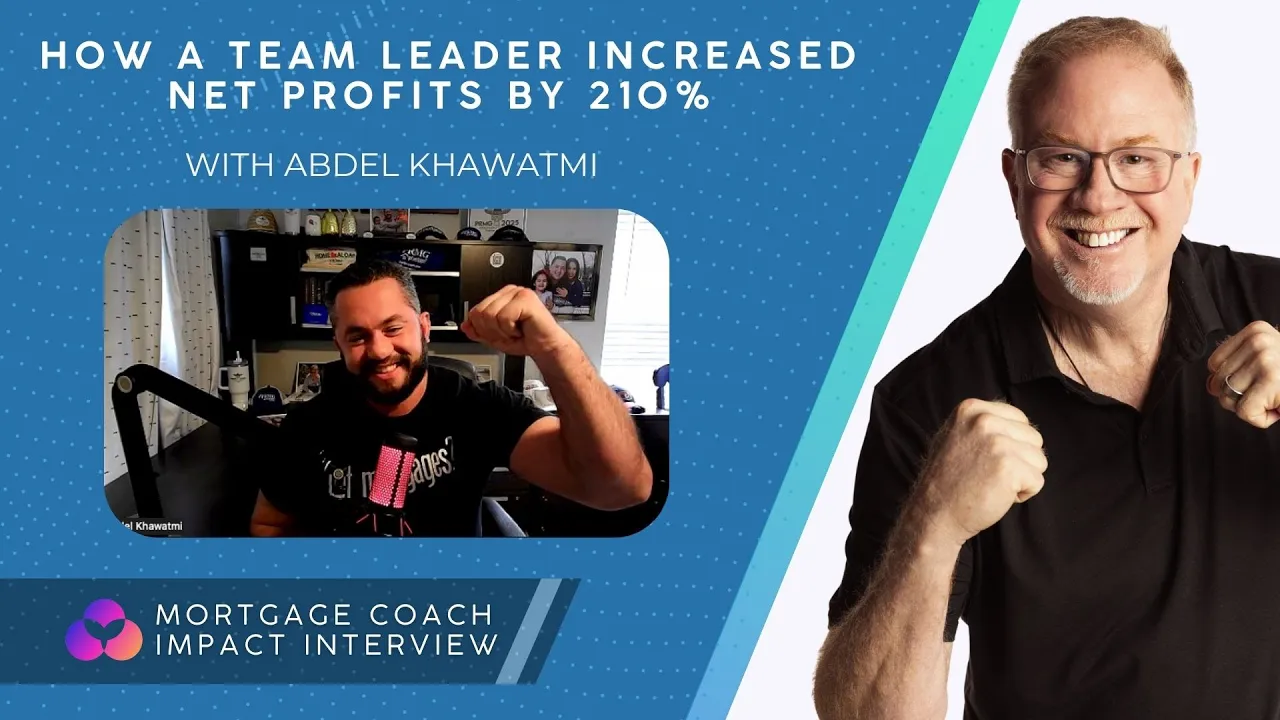
In the evolving mortgage landscape of 2026, scaling a team without adding headcount requires a shift from legacy operations to future-proof, technology-driven systems. Abdel Khawatmi, leader of a 16-loan-officer platform, reveals the exact playbook that drove a staggering 210% increase in his team's net profit. By integrating AI prompts, standardizing the Total Cost Analysis (TCA) process via Mortgage Coach, and treating real estate agents as integral stakeholders in every communication, Khawatmi has transformed the loan origination process from a transactional task into a high-value advisory service. His approach proves that modern mortgage leadership is less about manual labor and more about strategic execution through advanced digital tools.
Conversation originally published January 28, 2026. Recap added October 24, 2026.
Watch the original conversation on YouTube.
The 210% Net Profit Playbook
Abdel Khawatmi’s success is rooted in the strategic leverage of AI and technology to amplify human effort rather than replace it. By focusing on execution and consistency, Khawatmi’s team managed to more than double their net profits in a year where many lenders struggled to maintain margins. The core of this growth lies in a 'non-negotiable' commitment to delivering value-added presentations to every prospect, ensuring that every lead is treated with a high-tech, high-touch advisory approach that separates his team from transactional competitors in the New Jersey market and beyond.
A central component of this strategy is the use of the Total Cost Analysis (TCA) provided by Mortgage Coach. Khawatmi mandates that every loan officer on his 16-person team delivers a TCA immediately following the mortgage application—often even before credit is pulled or financial documents are collected. This proactive approach sets a professional tone from the initial touch, establishing the loan officer as a 'quarterback' of the transaction. By providing this clarity early, Khawatmi helps consumers avoid payment shock by visualizing different down payment and rate scenarios long before they make an offer on a home.
The impressive 210% increase in net profit was achieved without increasing headcount, a feat Khawatmi attributes to unlearning legacy habits. Instead of relying on old-school fee worksheets, his team uses digital tools to create a 'future-proof' business model. This efficiency allows the platform to scale while maintaining a personalized customer experience. By focusing on the 'basics' of communication but enhancing them with modern tech, the team has turned their presentation layer into a primary driver of revenue and referral loyalty, proving that technology is the ultimate margin expander.
AI-Powered Efficiency and Prompt Engineering
Efficiency is the engine of Khawatmi’s profit growth, specifically through the elimination of administrative friction. To solve the common loan officer complaint that detailed financial presentations take too much time, Khawatmi utilizes a standardized system of Google Doc prompts. These templates allow loan officers or their assistants (LOAs) to input data and generate a full TCA in as little as two minutes. This systematic approach removes the 'it's too complicated' excuse, ensuring that the high-value presentation is a consistent part of the workflow for every single borrower.
Khawatmi also highlights the upcoming Mortgage Coach Next Gen AI features, which allow for natural language dictation and automated presentation curation. By using simple prompts for common scenarios—such as FHA versus Conventional or 'Cost of Waiting' analyses—loan officers can create high-impact visual aids while in the field, at home, or even between meetings. During the demonstration, Khawatmi showed how the AI can curate a presentation in seconds, allowing the originator to remain mobile and present for their family or partners without sacrificing the quality of their professional output.
The use of prompt engineering extends beyond just creating charts; it creates a predictable narrative for the consumer. Khawatmi suggests that originators keep a central document of prompts to maintain consistency. This ensures that whether a loan officer is at a soccer game or in a meeting, they can auto-dictate into their phone to trigger a TCA. This reduction in manual labor is what allows his 16 loan officers to handle significantly higher volume without the need for additional support staff, directly contributing to the team's massive bottom-line growth.
Treating Realtors as a Second Client
A critical differentiator in Khawatmi’s business model is the treatment of the real estate agent as a 'second client.' During the initial touchpoint, Khawatmi asks agents for permission to include them in all communications throughout the lifecycle of the loan. This transparency fosters deep trust and positions the loan officer as a highly communicative partner rather than a black-box service provider. Most agents enthusiastically agree to this level of transparency, as it keeps them informed of the borrower’s purchasing power and progress without requiring manual follow-ups.
By CC'ing the agent on TCA presentations, the loan officer provides the agent with real-time insights into the borrower’s payment comfort zones. This 'over-communication' strategy is a powerful marketing tool that yields social proof. Khawatmi notes that agents are often blown away by the level of detail, leading to increased loyalty and more frequent referrals. When an agent sees a full-blown breakdown of monthly payments and refi analysis sent to their client immediately after a lead is captured, it validates the loan officer's status as a modern, tech-savvy advisor.
This strategy also benefits the loan officer's reputation through public validation. Khawatmi encourages his team to ask for reviews from both the consumer and the referral partner, capitalizing on the 'over-communication' feedback that frequently appears in their Google reviews. By involving the agent in the Mortgage Coach experience, the loan officer creates a shared language of affordability. This collaborative environment ensures that the agent is never left wondering about the status of a transaction, which is the number one complaint agents have about traditional mortgage originators.
The Pre-Credit TCA Strategy
While traditional mortgage workflows often delay detailed cost breakdowns until after a credit report is pulled, Khawatmi advocates for the 'pre-credit' Mortgage Coach experience. This involves using estimated rates—sourced from tools like Mortgage News Daily—to give the consumer an immediate sense of affordability. By intervening before the credit pull, the loan officer can steer the conversation toward the consumer's personal budget and 'payment sensitivity' rather than just their maximum qualification limit.
This early intervention prevents borrowers from falling in love with homes they cannot afford, which is a common source of friction in the home-buying process. The TCA allows them to interact with AI-driven tools to see how different variables, like shifting from 10% to 20% down, affect their monthly budget. This interactivity empowers the consumer to perform their own 'what-if' math. Khawatmi believes this 'quarterbacking' of the transaction early on is what builds the most trust, as it focuses on the borrower’s actual financial comfort rather than just a loan approval.
The pre-credit strategy also serves as a powerful conversion tool for new referral partners. When a realtor sees a loan officer providing a full cost breakdown in minutes for a new lead, it demonstrates a level of speed and professionalism that legacy loan officers cannot match. Khawatmi demonstrates that this proactive delivery avoids 'payment shock' later in the transaction when offers are placed. It positions the loan officer as a proactive advisor who is looking out for the client's long-term financial health from the very first minute of the relationship.
Scaling Through KPI Tracking and Standards
Khawatmi emphasizes that access to technology is useless without execution. He tracks specific metrics and Key Performance Indicators (KPIs) to ensure his team is actually using the tools provided. It is not enough to have a Mortgage Coach subscription; the goal is to ensure every loan officer is delivering a consistent number of TCAs per week. By monitoring these metrics, Khawatmi can identify which loan officers are truly becoming 'Uncommon LOs' and which ones are falling back into legacy, transactional habits.
By establishing a non-negotiable standard—such as delivering a TCA for every single application—Khawatmi ensures a high-quality, uniform experience across all 16 loan officers in his region. This standardization is what allows the platform to scale predictably while maintaining the 'personal touch' that drives consumer and realtor satisfaction. He argues that even if a branch has access to the best tools, they won't see profit growth unless those tools are integrated into a mandatory workflow that is audited regularly for compliance and quality.
This leadership style involves being 'in the trenches' with the team, demonstrating the tools personally to show their effectiveness. Khawatmi uses his own production and the 210% profit growth as proof that these systems work. By providing the team with a Google Doc containing all necessary prompts and strategy templates, he removes the barriers to adoption. This focus on consistent execution transforms the mortgage branch from a collection of individual producers into a high-performance platform that delivers a superior, tech-enabled consumer experience every time.
The Interactive Consumer AI Experience
A major shift in the mortgage industry is the move toward consumer-controlled data interaction. The Mortgage Coach Next Gen AI, as demonstrated by Khawatmi, includes a plugin that allows borrowers to ask questions directly within the presentation. For instance, a borrower can click a button to see how their principal and interest payment changes if they increase their down payment. This immediate feedback loop satisfies the modern consumer's desire for instant information without needing to wait for a return phone call from their loan officer.
This interactivity does not just save time for the loan officer; it also provides valuable data. The originator receives an email transcription of the questions the consumer is asking the AI, providing insight into the borrower's concerns and priorities. If a client is constantly asking about 20% down payment scenarios, the loan officer knows to focus their next conversation on liquidity and long-term savings. This 'AI-enabled' experience ensures that the loan officer remains the primary source of truth while the technology handles the repetitive calculations.
Realtors also find immense value in this interactive layer. As shown in the interview with Shay Jenkins, top-tier agents are often 'blown away' by the visual and interactive nature of the TCA. They can use the link to help their clients understand affordability in real-time while touring homes. This collaborative tool turns the pre-approval letter into a dynamic financial plan. By providing a platform where both the agent and the borrower can explore options safely and accurately, Khawatmi’s team builds a 'future-proof' moat around their referral relationships.
Becoming an 'Uncommon LO' in 2026
The concept of the 'Uncommon LO' is central to Khawatmi’s philosophy. In a market where many originators are struggling, those who win are the ones who provide more than just a rate and a fee worksheet. An 'Uncommon LO' is a modern mortgage advisor who uses AI and visual presentations to provide deep financial clarity. Khawatmi explains that by using technology to handle the 'heavy lifting' of data entry and presentation creation, originators can spend more time on the 'personal touch' and high-level advisory tasks that build long-term wealth for clients.
Winning in the 2026 market requires unlearning old legacy ways and adopting a mindset of innovation. Khawatmi highlights that 2024 was about social selling and 2025 was the year of AI buzz, but 2026 is about the actual execution of these tools. The 'Uncommon LO' is not just someone who has a subscription to Mortgage Coach, but someone who uses it as a 'non-negotiable' part of their daily routine to create value. This commitment to modern best practices is what allows a producer to grow their business even when the broader market is experiencing volatility.
Ultimately, the goal of the 'Uncommon LO' is to make the mortgage process streamlined and easy for the consumer. By leveraging AI to amplify their efforts, loan officers can handle more volume and provide better service than ever before. Khawatmi’s playbook demonstrates that by focusing on being the 'quarterback' of the transaction and using tech to 'over-communicate,' any loan officer can transition from a transactional salesperson to a highly valued financial advisor, securing their place in the future of the industry.
Modern Mortgage Leadership Checklist
1. Adopt a non-negotiable policy for delivering a Total Cost Analysis (TCA) for every mortgage application immediately upon receipt. 2. Implement a standardized prompt template system in a central Google Doc to reduce the time spent on presentation creation to under two minutes per client. 3. Loop real estate agents into the communication stream early to provide transparency on affordability, ensuring they are treated as a 'second client' throughout the process. 4. Utilize AI dictation and curation tools to manage presentations while on the move, maintaining productivity without being tethered to a desk.
5. Regularly audit team metrics and KPIs to ensure high adoption of technology platforms across all team members, regardless of their experience level. 6. Ask for reviews from both the consumer and the referral partner to build multi-dimensional social proof that emphasizes communication and professionalism. 7. Use 'pre-credit' presentations to establish affordability and payment comfort before the borrower makes an offer on a home. 8. Continuously 'unlearn' legacy habits like the fee worksheet to make room for future-proof, AI-enabled advisory tools.
9. Monitor consumer interaction with AI tools to gain insights into their financial concerns and tailor future advisory conversations accordingly. 10. Position yourself as the 'quarterback' of the transaction by providing visual refi analyses and points-versus-no-points comparisons to empower the borrower. 11. Host in-person meetings with referral partners to demonstrate the tech-driven systems that move the needle in the current market. 12. Focus on consistency and execution, ensuring that every tool in the tech stack is being used to its full potential to drive net profit growth.
Frequently asked questions
How did Abdel Khawatmi increase his net profit by 210%?
Abdel Khawatmi achieved this significant growth by leveraging AI and Mortgage Coach technology to scale operations without increasing his 16-person headcount. By standardizing execution across his region and improving referral partner trust through hyper-communication and the Total Cost Analysis, he maximized efficiency and conversion.
When does Khawatmi send a Total Cost Analysis to a borrower?
Khawatmi mandates that a TCA is sent immediately after a mortgage application is completed. Crucially, this often happens before financial documents are collected or credit is pulled, allowing the team to set payment and affordability expectations before the borrower falls in love with a home.
How long does it take for Khawatmi’s team to create a TCA?
While traditional methods might take ten minutes, Khawatmi’s team uses standardized Google Doc prompts and templates to create a TCA in less than two minutes. The new Mortgage Coach Next Gen AI features showcased in the episode, currently in alpha testing, allow for curation in just seconds.
How does Khawatmi involve real estate agents in the loan process?
Khawatmi treats the realtor as a 'second client' by asking for authority to include them in all communications. By CC'ing agents on the TCA, he provides them with real-time insights into the borrower's payment preferences, which builds massive trust and professional social proof.
What tools does Khawatmi use to standardize his team's workflow?
He utilizes a central Google Doc that contains specific strategy templates and AI prompts. This ensures that all 16 loan officers under his leadership deliver a consistent, high-quality Mortgage Coach experience regardless of their individual experience level.
Can the consumer interact with the AI-powered Mortgage Coach presentation?
Yes, the AI-powered Mortgage Coach Next Gen platform, currently in alpha pilot, allows consumers to interact via a plugin. They can click buttons to ask questions, such as seeing how their monthly payment changes if they increase their down payment to 20%, receiving an updated answer in seconds.
What is the 'Uncommon LO' concept mentioned in the episode?
An 'Uncommon LO' is a modern mortgage advisor who rejects legacy, transactional habits in favor of technology-driven value. They win market share by using tools like AI and Mortgage Coach to provide superior financial clarity compared to traditional loan officers who only provide fee worksheets.
How does Khawatmi ensure his team actually uses the technology provided?
Khawatmi tracks specific metrics and Key Performance Indicators (KPIs) to monitor technology adoption. He views the use of Mortgage Coach as a 'non-negotiable' standard, ensuring that every application results in a TCA so the platform scales predictably.
To talk with PRMG Got Mortgages, call 973-536-0276, visit GotMortgages.com, contact the team or build your mortgage plan.
Explore more Got Mortgages Insights and Abdel Khawatmi’s profile. Explore more conversations at the Got Mortgages Podcast website.
Author: Abdel Khawatmi with PRMG Got Mortgages | 973-536-0276
This article is general mortgage information only. It is not a commitment to lend, a rate quote, or legal or tax advice. Loan approval, terms and pricing depend on a full application, credit review and property details, and market conditions change. Talk with a licensed loan officer and your own legal or tax professional about your situation. NMLS #1712023 | PRMG NMLS #75243.