
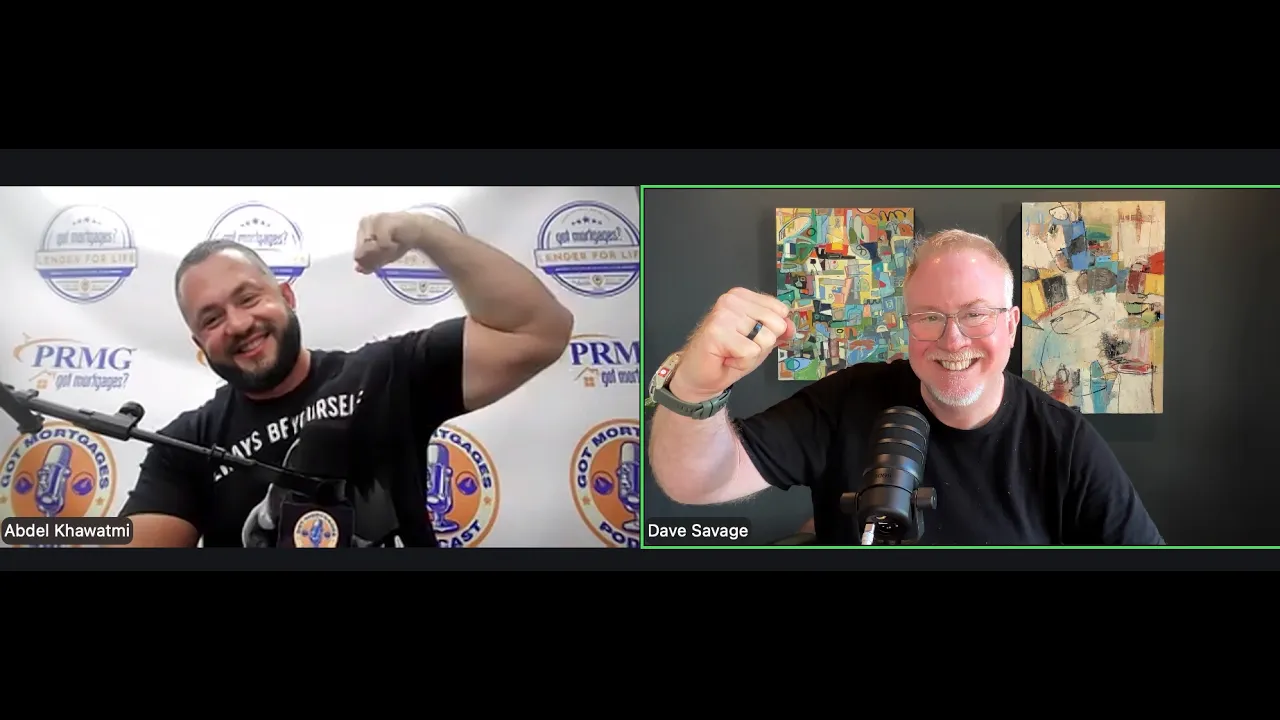
Abdel Khawatmi’s AI mortgage workflow connects application intake, team notifications, Claude-generated instructions and MortgageCoach loan comparisons, with a human still transferring the final prompt into the presentation tool. In this MortgageCoach conversation with Dave Savage, Abdel explains how that process supports an earlier discussion of payments, closing cash and discount points. The central lesson is not to replace borrower conversations with automation. It is to prepare useful information faster so the loan officer can spend more time explaining the decisions that matter.
Conversation originally published August 20, 2026. Recap added October 24, 2026.
Watch the original conversation on YouTube.
Key Takeaways: Automate Preparation, Preserve the Conversation
Abdel describes a workflow built around an existing lending process rather than a search for one platform that does everything. Application information moves through automation, Claude prepares instructions, and MortgageCoach turns those instructions into a borrower-facing Total Cost Analysis, or TCA. The comparison is an opening for advice, not the end of the loan officer’s involvement.
Three practices make the demonstration distinctive: introducing financial trade-offs immediately after intake, explicitly teaching borrowers how to ask questions inside their presentation, and following the digital delivery with a phone conversation. Abdel also involves the real estate agent so the financing discussion and home search are less likely to develop separately.
For teams considering a similar system, the practical priorities are a narrow data handoff, clear assumptions and a named human reviewer. The demonstration includes both automation and manual work. Treating those as separate responsibilities is more useful than describing the entire process as autonomous AI.
Start With the Hopes and Dreams Call
The process begins in one of two ways: a borrower completes an electronic application, or a team member gathers application information during a conversation. Abdel calls the latter the Hopes and Dreams Call. Its purpose is to make intake feel like a discussion about buying a home rather than an exercise in completing fields on a form.
He describes collecting the information needed for a full 1003, the standard mortgage application, within that conversation. The useful editorial distinction is between conversational intake and unclear intake. A comfortable conversation should still make the purpose of collecting information clear, particularly when identity details or credit authorization enter the discussion.
The workflow’s early handoff includes purchase price, loan amount, down payment, property type and an estimated credit score supplied by the consumer. These inputs help frame a preliminary comparison. They do not establish verified credit, eligibility or final pricing. A team adopting this approach should distinguish borrower estimates from confirmed information rather than letting both look equally authoritative downstream.
This intake design also gives the advisor context for the eventual comparison. A borrower’s expected time in the home, available cash and understanding of points can shape which explanation matters most. Automation can transfer the figures; the opening conversation helps establish what the borrower is trying to accomplish.
Map the Actual Handoff Between Blend, Zapier, Gmail and Claude
Abdel references PRMG’s LEO application experience and describes information being pulled from Blend into a Zapier-driven team notification. Loan officer assistants and administrators receive the relevant application details. A Claude project connected with Gmail then uses the notification information to prepare the next step.
Dave pauses to clarify whether the application is flowing directly into Claude. Abdel explains that the workflow is narrower: selected information is extracted and routed through the team’s notification process. That distinction matters operationally. Moving an email or notifying an assistant is automation; interpreting that information and generating instructions is the language-model task.
Abdel says the extraction instructions exclude Social Security numbers, dates of birth and full income information. That is an important boundary in the demonstration, though not a complete data-governance policy. An implementation should define which fields each system needs, who can access them and whether the connections are approved for that use. Prompt instructions should not be treated as the sole privacy control.
A useful workflow map therefore identifies the trigger, permitted fields, destination and responsible person at every handoff. If a purchase price changes or a notification is incomplete, the team needs to know where to correct it. Otherwise, an efficient transfer can simply spread an outdated assumption faster.
Use Claude to Write the MortgageCoach Prompt, Then Review the Assumptions
The prompt library is the bridge between intake and presentation. Claude creates the instructions that a team member copies into the MortgageCoach AI creator. Dave explicitly confirms that this copy-and-paste step is still part of the demonstrated process. A more direct integration is discussed as future development, not as an already completed connection.
Abdel’s initial template asks for two columns: one with a discount point and one without points. It requests the rate difference, total cost difference, monthly payment difference and break-even point. He also describes using a general rate reference and standardized placeholders for closing costs, escrows, insurance, taxes and association dues to keep the first comparison simple.
Those defaults make the presentation easier to produce, but they also create its main review obligation. A general market reference is not a borrower-specific lender quote. Property taxes, insurance and closing expenses cannot remain generic when the borrower is making an actual financing decision. The team should clearly identify preliminary assumptions and replace them as reliable information becomes available.
The best application of this prompt-library approach is consistency, not uncritical reuse. A reviewer should check that the loan amount, down payment, program, point charge and payment components agree with one another. The comparison should be understandable before it is sent, not merely polished enough to look finished.
Make the Points Decision About Cost and Time, Not the Lowest Rate
The demonstration’s central borrower decision is whether to pay upfront for a lower interest rate. Abdel’s point is that consumers may naturally choose the smaller rate without first comparing its cost with the monthly savings. A side-by-side TCA puts those competing considerations into the same conversation.
For a basic payment-savings comparison, a simple break-even calculation divides the incremental upfront cost by the monthly payment reduction. That is a starting point rather than a complete financial analysis. A fuller comparison can also consider remaining loan balances, other loan costs and the value of keeping cash available. The calculation should match the question the borrower is actually trying to answer.
Time matters because selling or refinancing can end the period during which the borrower receives the lower payment. But a future refinance is not certain, and paying points is not automatically a mistake. The advisor should explore the borrower’s likely plans and tolerance for uncertainty rather than turn a hypothetical holding period into a prediction.
Abdel also listens for the borrower’s existing beliefs. Someone who has never heard of points needs a definition; someone whose friend advised against them needs a comparison tied to their own circumstances. The same chart can support both conversations, but it should not force both borrowers through the same explanation.
Deliver an Updateable Comparison and Keep the Agent Appropriately Involved
Abdel describes sending the initial comparison promptly after application completion, alongside a document request, using email and a group text that includes the real estate agent. The purpose is to put payment and cash expectations in front of the borrower early enough to inform the home search.
Dave emphasizes that the MortgageCoach presentation is a link that can be updated rather than a static AI-generated document. He describes revising it as property information becomes available, the rate is locked and the loan moves toward closing. That creates a practical way to revisit the same decision framework instead of producing disconnected estimates at every milestone.
For the agent, visibility into the financing conversation can help align the search with the borrower’s comfort level. The practical step is to share useful, authorized information without treating the agent’s involvement as permission to distribute the full financial file. Payment expectations and next steps may be relevant; sensitive application details require a different level of care.
An updateable link also needs explanation when material figures change. A borrower should not have to discover that the payment is different and guess why. The loan officer can use the revised comparison to identify the changed input, explain its effect and confirm whether the borrower’s original budget still works.
Teach Borrowers How to Use the AI Button
Abdel does not leave the borrower-facing AI feature for consumers to discover on their own. He tells them it is available and suggests questions about changing the down payment or paying additional points. Dave adds examples involving the expected time in the home, faster repayment and the meaning of APR.
The practical lesson is that a feature introduction should include a concrete task. Telling a borrower to ask what changes with a larger down payment is more useful than simply announcing that the presentation has AI. A short live demonstration can show where to click, how to phrase a question and when to bring the answer back to the loan officer.
Dave also describes the loan officer’s ability to see the borrower’s AI conversation. Used appropriately, that can reveal which decision needs more attention. Repeated questions about paying off the loan faster may point toward a different discussion than repeated questions about available closing cash. Neither pattern, by itself, establishes a borrower’s preference.
Exploration should remain separate from execution. An AI response about another down payment or points structure is not a rate lock, underwriting decision or approved change to the loan. The advisor’s role is to turn useful questions into a reviewed comparison when the borrower wants to act.
Use Calls and Zoom to Turn Information Into Advice
One of the episode’s strongest moments comes when Abdel recalls a referral partner telling him he was sending too many emails and text messages. His response was not to abandon technology. It was to reconsider where digital communication was displacing a conversation that would be more effective by phone.
He describes calling after the initial TCA delivery, thanking the borrower for completing the application and walking through the relevant trade-offs. Later, when the borrower is under contract, he returns to the earlier discussion of points. The initial education becomes a reference point rather than a one-time presentation the borrower must remember unaided.
Abdel uses several formats at that later stage: the TCA, an analytical explanation in an email and a Claude-created presentation. He also describes using Zoom for many lock discussions. The practical value is giving borrowers different ways to understand the same decision, provided the figures and assumptions remain consistent across every format.
His intake discussion also includes his team’s soft-credit process and a credit-report charge credited back at closing. That is a practice to explain within the lender’s approved process, not a universal script to copy. Borrowers need clear information about authorization, charges, later credit checks and what any preliminary assessment does or does not establish.
This supports Dave’s broader vision of the loan officer as an advisor coordinating people and technology. The role is not expanded expertise in every financial discipline. It is better mortgage guidance, appropriate coordination with other professionals and responsibility for the client’s understanding.
Final Checklist: Build One Reliable Application-to-Advice Workflow
Choose one starting event. Define whether a completed application or completed intake call triggers the process. List the permitted data fields, the notification destination and the person responsible for incomplete information. Follow Abdel’s closing advice to go deeper with a focused toolset rather than continually switching platforms.
Build one comparison template. Start with a decision such as points versus no points, label preliminary assumptions and assign a reviewer. Preserve the manual handoff wherever it exists. Test the workflow with non-sensitive sample information before introducing real borrower data.
Plan delivery and explanation together. Decide who sends the TCA, who requests documents and who calls the borrower afterward. Confirm what may be shared with the real estate agent. Introduce the borrower AI feature with one relevant question rather than a general invitation to explore.
Set the update and measurement rules. Identify when property-specific costs and actual pricing replace estimates, and reconcile every presentation before a decision. Track preparation time, corrections and completed advisory conversations. The useful outcome is not simply a faster document; it is a clearer, reviewed financing discussion.
Frequently asked questions
Is Abdel’s application-to-TCA workflow fully automated?
No. The demonstrated process uses automation to route selected application information and Claude to generate instructions. A human then copies those instructions into the MortgageCoach AI creator. A more direct integration is discussed as future development.
What information feeds the initial mortgage comparison?
Abdel describes using details such as purchase price, loan amount, down payment, property type, loan program and an estimated credit score. The early comparison also uses standardized expense assumptions, which should be identified as preliminary and replaced with reliable borrower- and property-specific figures.
What is the purpose of the Hopes and Dreams Call?
It gathers application information through a conversation about the borrower’s homebuying plans. Its practical advantage is combining intake with context for advice. The team should still clearly explain information collection and obtain any required credit authorization.
How should a borrower compare paying points with taking a higher rate?
Compare the additional upfront cost, monthly payment reduction and expected time keeping the loan. Dividing the incremental cost by monthly savings gives a simple payment break-even estimate. Also consider cash reserves, loan balances and the uncertainty of selling or refinancing.
Can the workflow use a market-rate reference as a final borrower quote?
No. A general reference can help frame an illustration, but it does not establish the borrower’s available pricing. Before a financing decision, the comparison needs applicable lender pricing, eligibility information and accurate costs.
What questions can borrowers ask inside the MortgageCoach AI feature?
The episode suggests questions about changing the down payment, paying more points, keeping the home for a particular period, repaying the mortgage faster and understanding APR. Any answer that leads to a proposed loan change should be reviewed with the loan officer.
Why include the real estate agent when delivering the comparison?
Abdel wants the agent to see that payment and closing-cash expectations are being addressed early. This can help coordinate the home search with financing discussions. Sharing should stay within the borrower’s authorization and should not expose unnecessary application information.
When does the loan officer call instead of sending more automated messages?
Abdel describes a call after the initial comparison is delivered and a later review when the borrower is under contract and considering loan options. Calls are especially useful when a borrower misunderstands points, questions a changed payment or needs help weighing cash against monthly savings.
To talk with PRMG Got Mortgages, call 973-536-0276, visit GotMortgages.com, contact the team or build your mortgage plan.
Explore more Got Mortgages Insights and Abdel Khawatmi’s profile. Explore more conversations at the Got Mortgages Podcast website.
Author: Abdel Khawatmi with PRMG Got Mortgages | 973-536-0276
This article is general mortgage information only. It is not a commitment to lend, a rate quote, or legal or tax advice. Loan approval, terms and pricing depend on a full application, credit review and property details, and market conditions change. Talk with a licensed loan officer and your own legal or tax professional about your situation. NMLS #1712023 | PRMG NMLS #75243.