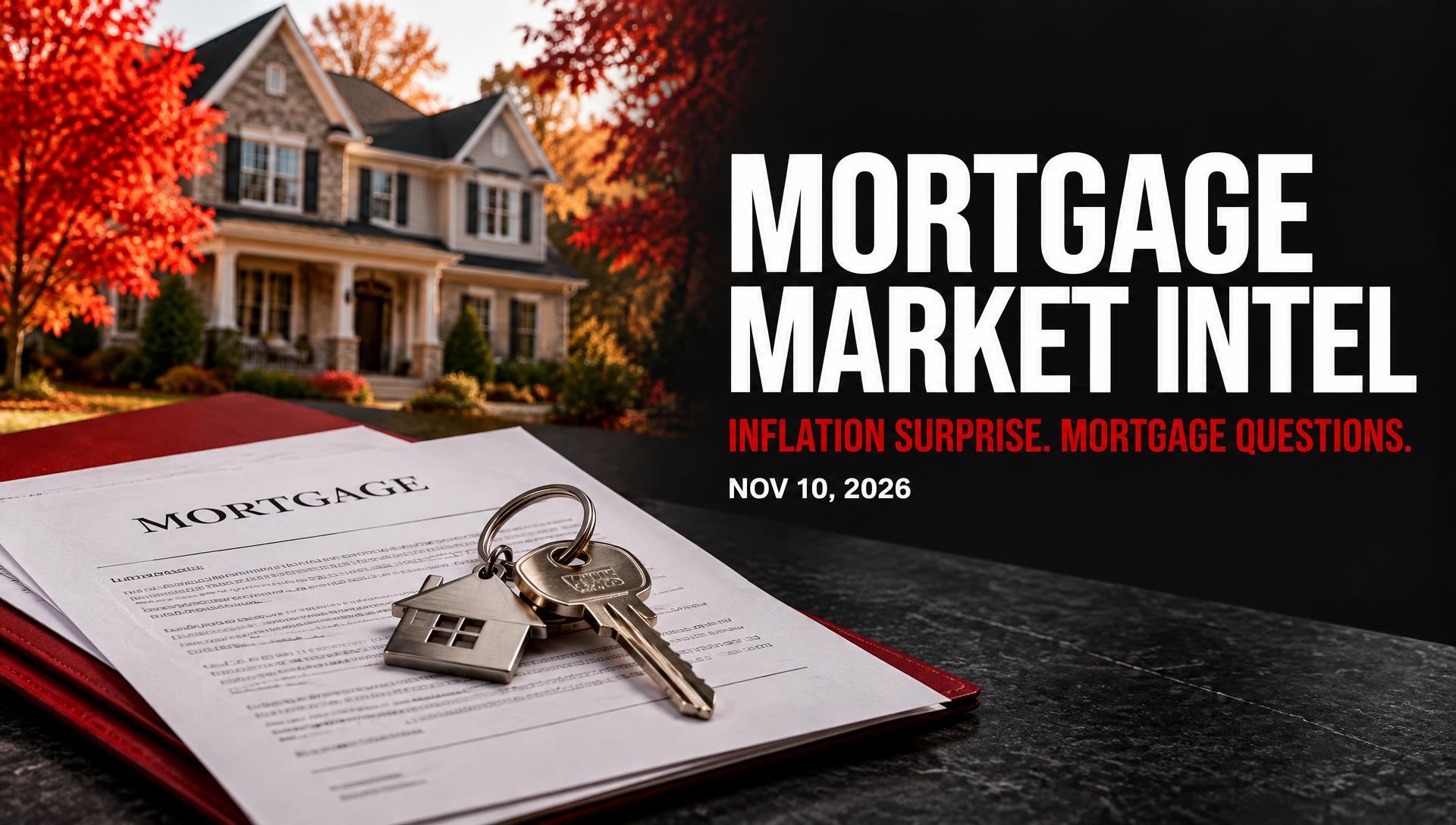
Bottom line (as of about 8:56 a.m. ET, Tuesday, November 10, 2026): October consumer prices rose faster than economists expected. Reuters reported that headline CPI climbed 0.4% for the month and core CPI rose 0.3%, each a tenth above forecasts. Headline inflation still slowed from September's 0.6% monthly pace. There is no regular annual CPI rate for October this time. The last daily mortgage-rate close we can cite is 7.18% for the 30-year fixed on November 9. For New Jersey buyers, the takeaway is simple: get a same-day quote, know your lock deadline, and negotiate on total cost, not on headlines.
| Measure | Latest reading | Comparison | Source / date |
|---|---|---|---|
| Headline CPI, monthly (SA) | +0.4% (October) | Forecast +0.3%; September +0.6% | Reuters, Nov. 10 |
| Core CPI, monthly (SA) | +0.3% (October) | Forecast +0.2% | Reuters, Nov. 10 |
| Annual CPI | Not published for October | Previous report: 3.7% (September) | Reuters, Nov. 10 |
| MND 30-yr fixed daily index | 7.18% (Nov. 9 close) | 7.17% on Nov. 6 | Mortgage News Daily |
| Freddie Mac PMMS 30-yr / 15-yr | 7.18% / 6.57% (Nov. 5) | 30-yr was 7.24% on Oct. 29 | Freddie Mac, Nov. 5 |
| October payrolls / unemployment | +165,000 / 4.1% | Released Nov. 6 | BLS |
The October CPI report: hotter than forecast, cooler than September
The October Consumer Price Index came out at 8:30 a.m. Eastern this morning, on the date shown in the Bureau of Labor Statistics 2026 release schedule. According to Reuters' November 10 coverage, with additional reporting from the Financial Times, headline prices rose 0.4% on a seasonally adjusted basis. That is above the 0.3% consensus but slower than September's 0.6% gain. Core CPI, which leaves out volatile food and energy prices, rose 0.3% against an expected 0.2%.
One caution about sources: the main BLS CPI news-release page may still show September's report while the site updates. That is why this edition cites Reuters for today's figures and the BLS calendar for the official release date. We have not reviewed the BLS October tables directly.
Why there is no annual CPI number this month
Usually the headline everyone quotes is the 12-month inflation rate. This month that number is missing. Reporting on the release says BLS did not publish a regular October 2026 year-over-year CPI rate because October 2025 price observations were missed during the government shutdown. Without a clean base month a year earlier, there is no standard annual comparison.
We are not going to fill that gap with our own estimate. Any article quoting an "October annual inflation rate" today should explain exactly how it got that figure. The most recent regular annual reading is from the previous report: 3.7% for September 2026. Treat it as last month's number, not October's.
How mortgage rates respond to inflation and MBS pricing
Your 30-year fixed rate is not set by a single official decision. Lenders build rate sheets from the prices investors pay for mortgage-backed securities (MBS), which are pools of home loans sold to investors. When investors expect higher inflation, the future fixed payments from those pools are worth less in real terms. Investors then pay less for MBS, yields rise, and lenders' rate sheets usually worsen. Cooler inflation tends to do the reverse.
Two practical points follow:
- Lenders can reprice during the day. If MBS prices move enough after 8:30 a.m., many lenders issue new rate sheets. A quote from yesterday afternoon may already be outdated.
- The Fed sets short-term rates, not your note rate. The Federal Reserve held its policy range at 3.75% to 4% on October 28.
As of this edition's cutoff, we are not reporting a November 10 daily close or claiming that quotes have moved since the release. The most recent close we can cite is Mortgage News Daily's 30-year fixed index at 7.18% on Monday, November 9, up 0.01 percentage point from 7.17% on Friday, November 6. Today's real number is whatever your lender quotes you, with points and credits shown, at the time you ask.
Freddie Mac, Mortgage News Daily and MBA: three different rulers
This week two well-known rate measures both read 7.18%. That is a coincidence. They measure different things:
Freddie Mac PMMS (weekly)
Freddie Mac's November 5 Primary Mortgage Market Survey put the 30-year fixed at 7.18%, down from 7.24% on October 29, and the 15-year at 6.57%. According to Freddie Mac's methodology page, PMMS tracks conventional, conforming purchase loans for borrowers with strong credit and 20% down. It is a weekly benchmark and lags fast daily moves.
Mortgage News Daily index (daily)
MND's index is built from lender rate sheets every business day, so it picks up market swings, such as a CPI surprise, much faster. It is useful for seeing direction, but it is still an average and not your quote.
MBA weekly application survey
The Mortgage Bankers Association's weekly survey reports contract rates and points from a different sample of lenders' applications. Its numbers often differ from both PMMS and MND for that reason.
None of these is an APR or a personal offer. Your rate depends on credit score, down payment, loan amount, property type, occupancy, program and lock period.
How this fits with the October jobs report
Our November 9 edition covered the jobs data in detail, so here is just the short version. On November 6 the BLS employment report showed 165,000 payroll jobs added in October and a 4.1% unemployment rate. Solid hiring together with core inflation running above forecast gives markets less reason to expect quick rate relief. It does not guarantee rates will rise. It does mean buyers should not plan around a drop that may not come before their closing.
Housing supply and your negotiating leverage
The report beat forecasts on both headline and core, so the surprise was not just food or energy. Inflation affects what you pay to borrow. Inventory affects how much room you have to negotiate. The latest national data points in a mixed direction:
- Realtor.com's October 2026 report (published November 4) showed national active listings up 7.4% from a year earlier, while new listings fell 7.5% and pending inventory fell 10.5%. The national median list price was $415,000, down 2.2% from a year earlier. That is an asking price, not a sale price.
- In the Northeast, Realtor.com reported active inventory up 16.5% from a year earlier but still 40.2% below its 2017–2019 average. That is a regional figure and does not describe any single New Jersey county.
- HousingWire's November 7 weekly tracker counted 902,740 active listings, down from 914,833 the prior week, and described mortgage demand as stabilizing. That is a weekly count from a different data source and should not be read as a national rebound or compared directly with Realtor.com's monthly data.
Overall: more homes are sitting on the market than a year ago, fewer sellers are listing, and fewer deals are going under contract. In many neighborhoods that can mean more room to ask for repairs, closing-cost help or a rate buydown, especially on homes that have been listed for a while. Your agent's local comparable sales matter more than any national headline.
County-by-county guidance for New Jersey buyers
The figures above are national and regional. We are not publishing county medians, inventory counts, appreciation or tax rates here. Check current local data with your agent and the municipal tax office. What we can offer is a checklist built around how each county tends to work.
Ocean County
Shore towns and inland towns can feel like separate markets. Near the water, get flood-zone status and a flood insurance quote before you make an offer. Insurance can change your monthly payment as much as a quarter-point rate move. Check property taxes for the exact municipality, HOA or condo association rules and dues, and whether seasonal or rental-use limits affect the financing. For condos, ask early whether the project meets your loan program's requirements.
Monmouth County
Prices vary widely between commuter towns and higher-end markets. Find out early whether your loan amount falls under the conforming limit or into jumbo territory. Confirm the current limit and guidelines with your lender, because jumbo loans can have different rates, reserve requirements and down-payment rules. On new construction, compare builder incentives, like rate buydowns or closing-cost credits, against the price of the house itself. A credit that comes with a higher price may not save you money.
Essex County
Property taxes can differ a lot from one town to the next, so price every address on its own. If you're buying a two-to-four-family home, ask how rental income will be documented and counted, whether through leases, appraisal rent schedules or tax returns. Older homes may need repairs that show up in the inspection or appraisal, and appraisers may struggle to find good comparable sales. Build both into your offer timeline.
Union County
Many Union County buyers weigh commute access against monthly cost. Compare municipal taxes and any HOA fees across the towns you're considering. For condos, ask for the association's budget, reserve fund status and any planned or pending special assessments early, since the condo review can delay or block some loan types.
For every county: add up the full monthly cost, including principal, interest, taxes, homeowners insurance, flood insurance if needed, HOA dues and a maintenance reserve. Then compare that total with your cash to close and the savings you'll have left afterward. A payment that only works at today's best-case rate is too tight.
Rate locks, float-downs and seller credits
A hotter-than-expected inflation report is a good time to review your rate lock plan:
- Lock or float? If you're under contract and a small rate increase would push your debt-to-income ratio past program limits, a lock protects your approval. Floating is a bet you should only make if you could absorb a worse rate.
- Float-down options. Some lenders offer a one-time float-down if rates improve after you lock. Ask whether one is available, what it costs, and how much rates must move before it applies.
- Seller credits. Concessions can pay closing costs or prepaid items, or fund a buydown. Limits depend on the loan program, occupancy and down payment. Confirm them before you write the offer so the credit can actually be used.
Discount-point break-even: divide the cost of the points by the monthly payment savings. For example, if points cost $3,000 and lower the payment by $50 a month, the break-even is 60 months, or five years. If you expect to sell or refinance before then, paying points may not make sense.
Loan options to compare: conventional, FHA, VA, non-QM and buydowns
Conventional
Conventional loans often suit borrowers with strong credit. With less than 20% down, mortgage insurance is usually required, and it can often be removed later under program rules.
FHA
FHA loans allow lower down payments and more flexible credit standards, but they come with upfront and annual mortgage insurance and property-condition requirements. Seller-concession limits and condo approval rules apply.
VA
Eligible veterans, service members and some surviving spouses may be able to buy with no down payment. Program funding fees, residual-income guidelines and VA appraisal requirements still apply. Eligibility must be confirmed.
Non-QM
Non-QM loans, such as bank-statement or investor cash-flow loans, can help self-employed buyers or investors whose income doesn't fit standard documentation. They usually cost more and may require larger down payments or reserves.
Permanent and temporary buydowns
A permanent buydown uses discount points to lower the rate for the life of the loan. A 2-1 temporary buydown lowers the payment for the first two years and is often paid for with a seller or builder credit. Lenders commonly qualify you at the full note rate, and program conditions apply. Plan for the full payment from year three on, and don't count on a refinance that may never be possible.
What to watch next
The BLS schedule lists the October Producer Price Index for Friday, November 13 at 8:30 a.m. ET. Those results are pending. Freddie Mac's next weekly survey and the MBA application data follow their usual schedules. Nobody can promise that rates will fall, so plan around a payment you can handle at today's levels.
Frequently asked questions
Did October inflation come in higher than expected?
Yes. According to Reuters' November 10 report on the October CPI release, headline consumer prices rose 0.4% for the month on a seasonally adjusted basis versus a surveyed forecast of 0.3%, and core prices excluding food and energy rose 0.3% versus an expected 0.2%. Headline inflation did cool from September's 0.6% monthly pace, so the report is hotter than forecast but not an acceleration from the prior month.
What is the annual inflation rate for October 2026?
There is no regular October 2026 year-over-year CPI figure. Reporting on the release indicates BLS did not publish one because October 2025 price observations were missed during the government shutdown. We are not estimating one. The most recent regular annual reading is from the previous report: 3.7% for September 2026.
Did mortgage rates jump after the 8:30 a.m. CPI release?
As of this morning's editorial cutoff we cannot say. The latest daily close we can cite is Mortgage News Daily's 7.18% for the 30-year fixed on Monday, November 9. Lenders often reprice during the day when bond markets move, so ask your loan officer for a same-day quote rather than assuming yesterday's level still applies.
Why do mortgage rates react to inflation reports?
Mortgage rates are tied to the price investors pay for mortgage-backed securities. Hotter-than-expected inflation erodes the future value of fixed payments, which can push bond yields up and MBS prices down. When MBS prices fall, lenders' rate sheets generally worsen. The reaction depends on what markets already expected, not just the headline number.
Freddie Mac and Mortgage News Daily both show 7.18%. Is that the same rate?
No. The match is a coincidence. Freddie Mac's November 5 PMMS is a weekly benchmark for conventional conforming purchase loans for strong-credit borrowers putting 20% down. Mortgage News Daily's index is a daily read of lender rate sheets. Both are note-rate indicators, not APRs or personal quotes.
Does the Federal Reserve set my mortgage rate?
Not directly. The Fed held its policy range at 3.75% to 4% on October 28. That rate influences short-term borrowing costs, but 30-year mortgage rates follow longer-term bond and MBS markets, which respond to inflation data, growth and expectations about future Fed moves.
Should I lock my rate today or float?
It depends on your closing date, budget cushion and tolerance for risk. If a modest rate increase would break your debt-to-income ratio or monthly budget, locking protects you. Floating can make sense only if you can absorb a worse rate. Ask whether your lender offers a float-down option, what it costs and when it can be used. Nobody can guarantee rates will fall.
Are seller credits or temporary buydowns worth negotiating right now?
They can be. With national active listings up year over year, some sellers may be more open to concessions. Seller-credit limits differ by program and down payment, and with a 2-1 temporary buydown lenders often qualify you at the full note rate. Compare options on same-day Loan Estimates before deciding.
How should Ocean, Monmouth, Essex and Union County buyers use this report?
Use it as a reason to budget conservatively, not as a local market forecast. National and Northeast inventory figures do not describe any one county. Price out the full monthly cost, including taxes, insurance, flood coverage where needed, HOA dues and maintenance, and compare it with your cash to close.
What data is coming next that could move rates?
The Bureau of Labor Statistics schedule shows the October Producer Price Index due Friday, November 13 at 8:30 a.m. ET. Weekly Freddie Mac and MBA updates follow their usual schedules. Each release can shift bond markets, so keep your lock deadline and documents ready.
Talk through your plan with Got Mortgages
Buying in Ocean, Monmouth, Essex or Union County? Call or text Abdel Khawatmi at 973-536-0276, start your plan at gotmortgages.com/plan, or read more daily briefings at Market Intel. We'll compare same-day quotes and help you build a lock strategy for your timeline.
Sources
- Reuters — US consumer prices rise above expectations in October (Nov. 10, 2026) — accessed/dated 2026-11-10
- Financial Times — October CPI coverage (Nov. 10, 2026) — accessed/dated 2026-11-10
- U.S. Bureau of Labor Statistics — 2026 release schedule — accessed/dated 2026-11-10
- Mortgage News Daily — 30-year fixed daily index (Nov. 9, 2026 close) — accessed/dated 2026-11-09
- Freddie Mac PMMS announcement via GlobeNewswire (Nov. 5, 2026) — accessed/dated 2026-11-05
- Freddie Mac — PMMS methodology — accessed/dated 2026-11-05
- BLS — Employment Situation: October 2026 (released Nov. 6) — accessed/dated 2026-11-06
- HousingWire — Weekly housing tracker (Nov. 7, 2026) — accessed/dated 2026-11-07
- Realtor.com — October 2026 Monthly Housing Data (Nov. 4, 2026) — accessed/dated 2026-11-04
Editorial cutoff: approximately 8:56 a.m. ET, November 10, 2026. Figures are attributed to the cited publishers; the October CPI figures are from Reuters' report on the BLS release.
Author: Abdel Khawatmi, CDLP | PRMG Got Mortgages | 973-536-0276
Disclosure: This article is for educational purposes only and is not a commitment to lend, a rate or APR quote, or a loan approval. Rates, terms and program availability change without notice and are subject to credit, income, assets, appraisal, property eligibility and lender underwriting. Loan options vary by program rules and borrower eligibility. Information is not an offer to lend, a rate lock, or a guarantee of any rate, APR or approval; all loans are subject to PRMG underwriting and approval. Paramount Residential Mortgage Group, Inc. (PRMG) is an Equal Housing Lender; see PRMG's website for NMLS licensing information. Got Mortgages does not offer tax, legal or insurance advice; consult qualified professionals.