
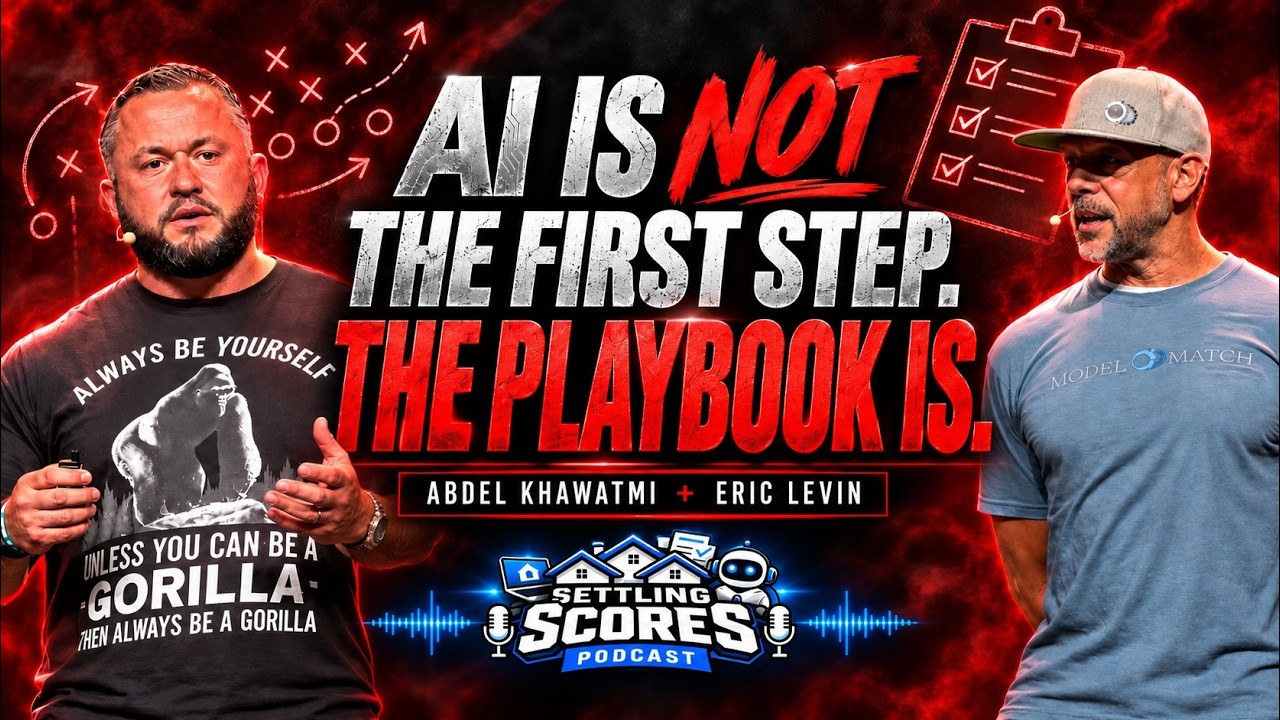
Before you build an AI agent, write the playbook it will follow. On this episode of Settling Scores, cohosts Abdel Khawatmi of Got Mortgages and Eric Levin of Model Match compare notes on what agentic tools have changed in their businesses, what still frustrates them, and how to start small. Abdel makes the case for SOPs and systems first; Eric shows how training agents exposed gaps in his own job descriptions and why every agent should ask permission before it acts.
Episode originally published November 10, 2026. Recap added November 15, 2026.
Watch the original Settling Scores conversation on YouTube.
Key Takeaways: Systems First, Agents Second
Eric opens with a reality check. The term AI is overused, he says, and much of what people call AI is really technology with an agentic component added (0:28–1:23). It can also be overwhelming. He describes days when he feels he has built something that will multiply his output, followed by days when he feels he spent too much time building and not enough time doing the work (1:23–2:17).
Abdel's answer is that agents only work as well as the systems underneath them. "You have to understand first what is the current system," he says, and what standard operating procedures you already have in place (3:02–3:56). Eric's answer is that the process of training agents forces you to get clear about what you actually want.
Both agree on the practical path: start with one workflow, write it down, add an approval step, house the knowledge somewhere simple, and resist chasing every new tool.
Why the Playbook Comes Before the Agent
Abdel explains SOPs in plain terms. If you want to teach someone a task, you can either tell them what they are supposed to do or give them step-by-step instructions for everything it involves (3:56). The second approach is what makes delegation possible, whether you are delegating to a person or to an AI agent.
He uses a football analogy. When a team has to change quarterbacks mid-season, the playbook stays in place. You can substitute another body, or an AI agent, and the work can still be completed (4:37–6:38). The first question to ask is which SOP in your workflow should be built first.
In his own business, that started with an agent ecosystem he calls Jungle, a nod to his Gorilla nickname. He now runs nine agents he built and controls (6:38). One of the first filled a gap he admits to: he has hundreds of videos on YouTube but rarely posted there, so he built an agent connected to his channel that downloads videos and cuts them into shorter clips (6:38–7:17). Tasks his team used to handle by hand came off their plates (7:17–8:14).
What Training Agents Teaches You About Managing People
Eric is candid about his limits. "I have no interest in going so far down the agent rabbit hole that I start to make myself really stupid," he says (8:14–8:52). He wants to understand what he is putting out, not hand his judgment to a tool.
His bigger insight is about management. As he trains agents, he has to think hard about exactly what he wants each one to do, and that exposed weaknesses in how he has hired and set up people in the past (8:52–9:40). He has an agent focused on digital marketing and social media, and within its first week he was able to tighten its job description. With a human, he notes, getting the job description wrong in the first two weeks is much harder to fix, because trust may already be damaged (9:40–10:25).
His second lesson: "You think you know your business model until you're forced to audit it and get it down on paper" (10:25–11:03). When an agent brings back the wrong result, it is often because the instructions were never communicated clearly in the first place.
There Is No Perfect Way, So Stay Flexible
Eric points out that people tend to split into two camps: the experts who seem to know everything and the skeptics who do not trust any of it. He has found a happy medium, and he encourages celebrating small wins instead of chasing perfection (11:03–12:45).
Abdel agrees there is no single right way. He compares it to basketball players with unorthodox shots: the form looked different, but the result is what mattered (12:45–13:39). He admits that early in his leadership career it was "my way or the highway," and he learned that was not the right approach. Agentic tools reinforce that lesson, he says: your brain should stay malleable (13:39–14:21).
He treats each agent like a department. Follow-up is a good example. He says agents have told him they work with his team because of its "follow-up, follow-through and follow-back," and when his calendar is packed, an agent helps make sure that standard does not slip (14:21–14:57). If he tells a partner he is going to do something, he wants a system that makes sure it gets done (16:54–17:23).
Meeting Prep: The One Workflow Neither Host Would Give Up
Eric tells a story from the episode itself. Before the recording, an agent saw the call on his calendar, found notes he had jotted down days earlier, and drafted an email to Abdel with four bullet points he had wanted to cover. Because he is still training that agent, it asked before sending (18:47–21:41). When he asks Abdel what he could never live without, the answer is the same: preparation before a meeting (21:41–22:15).
Abdel organizes meetings around his three avatars: clients, real estate agents and loan officers (22:15). Before meeting a real estate agent introduced by a home inspector who had attended his 2027 business planning session, he used a saved prompt in Ask Model Match to research her from his phone in seconds (23:32–24:24). A separate prep agent gathers public background, texts and emails him the summary, and sends the other person a front-facing email with an infographic and slide deck before the meeting. Afterward, it uses the transcript to send a follow-up, deliberately delayed (24:24–25:51).
None of this replaces the conversation. "You better be freaking good at your job," he says, because the meeting itself is still about building trust and showing empathy (24:59–25:51).
Guardrails, Approval Lists and Baby Steps
Abdel stresses that compliance is key. His team uses a review agent that checks videos before they are posted, so nothing goes out that should not (26:53–27:30). He also refuses to chase every shiny new tool. When a group chat lights up with the latest release, his response is "nope, not listening" (27:30). Eric adds that the rabbit hole gets deep fast: sometimes you need "the prep for the prep" (27:30–28:06).
Eric explains how connectors make his prep possible without overreach. He connects tools like Gmail, Slack, HubSpot and Notion, and creates an approved list for his text messages so family conversations stay off limits (28:06–29:01). One agent pulls scattered communication together so he understands who the real decision maker is before a call, and it delivers the prep the way he likes it: short bullets and a graphic (29:01–30:13).
His advice for beginners is to take baby steps. Tell your agent to build the workflow but not do anything until you approve it: no LinkedIn posts, no Facebook posts, no emails (30:54). When his AI assistant offered to make phone calls on his behalf, he said no, ask me first, and he would rather it send an email (30:54–31:28).
Pick One Thing: Follow-Up, Onboarding and Handoffs
Abdel's advice to originators is to pick one thing, and for most people that should be follow-up (32:03–32:38). "You can never over communicate," he says. Start with the basics: get everything into your calendar, then build out a client journey and a real estate partner journey.
When his team onboarded seven new loan officers, he built an onboarding agent, which he calls Atlas, that follows the onboarding communication, checks in with new loan officers by text about how their day went, and sends him a summary so he knows which parts of the process to clean up (32:38–34:09). Feedback from new loan officers also helped his team simplify its internal LO Launchpad platform from 21 tabs to seven (34:09).
For a solo originator, he suggests focusing on lead generation and content first. When you bring on your first loan officer assistant, define the handoffs: when the assistant takes over, when processing takes over and when you step back (34:50–35:27). He admits he still sometimes calls clients his team already has covered, and he asks the team to hold him accountable (35:27–36:34).
Final Checklist: House the Knowledge, Then Build
Eric's closing advice is to house your knowledge somewhere simple. It can be Notion, or it can be Google Docs with your AI given access to a folder (36:34–37:15). What matters is that your playbook lives somewhere your tools and your team can find it.
Write down one SOP step by step before you automate it. Give any new agent a clear job description and tighten it after the first week.
Add an approval step to anything that posts, emails or calls on your behalf, and create approved lists for sensitive data.
Choose one workflow to improve this month, whether that is meeting prep or follow-up, and use the time you buy back for more business development and better conversations.
Frequently asked questions
Who hosts Settling Scores?
Settling Scores is cohosted by Abdel Khawatmi of Got Mortgages and Eric Levin of Model Match. In this episode they discuss AI agents, standard operating procedures and meeting preparation.
Why does Abdel say SOPs come before AI?
An agent can only follow the instructions it is given. If you have not written down your current system step by step, you cannot delegate it reliably to a person or an AI agent.
What did Eric Levin learn from training AI agents?
He found that writing clear instructions for agents exposed gaps in how he had written job descriptions for people in the past. He also realized that putting your business model on paper reveals where you have been communicating it unclearly.
What does an AI meeting prep workflow look like?
Abdel's prep agent gathers background on the person, sends him the summary by text and email, and emails the other person an infographic and slide deck before the meeting. Afterward it uses the transcript to send a follow-up.
How can you keep AI agents from overstepping?
Eric recommends telling agents to build workflows but not act until you approve them. He also uses approved lists so agents only see the conversations they are allowed to see.
What should a loan officer automate first?
Abdel suggests picking one thing, and for most originators that is follow-up. Get everything into your calendar first, then map out the client journey and the real estate partner journey.
Where should you store your playbook for AI?
Somewhere simple that your tools can access. Eric uses Notion but says Google Docs with access to a folder works just as well.
Should you adopt every new AI tool?
No. Abdel says he deliberately ignores most new tool announcements and focuses on workflows that already work, with guardrails and consistency.
To talk with PRMG Got Mortgages, call 973-536-0276, visit GotMortgages.com, contact the team or build your mortgage plan.
Explore more Got Mortgages Insights and Abdel Khawatmi’s profile. Explore more conversations at the Got Mortgages Podcast website.
Author: Abdel Khawatmi | NMLS 1712023 | Powered by PRMG Got Mortgages | NMLS 75243 | 973-536-0276
This article is general mortgage information only. It is not a commitment to lend, a rate quote, or legal or tax advice. Loan approval, terms and pricing depend on a full application, credit review and property details, and market conditions change. Talk with a licensed loan officer and your own legal or tax professional about your situation. NMLS #1712023 | PRMG NMLS #75243.