
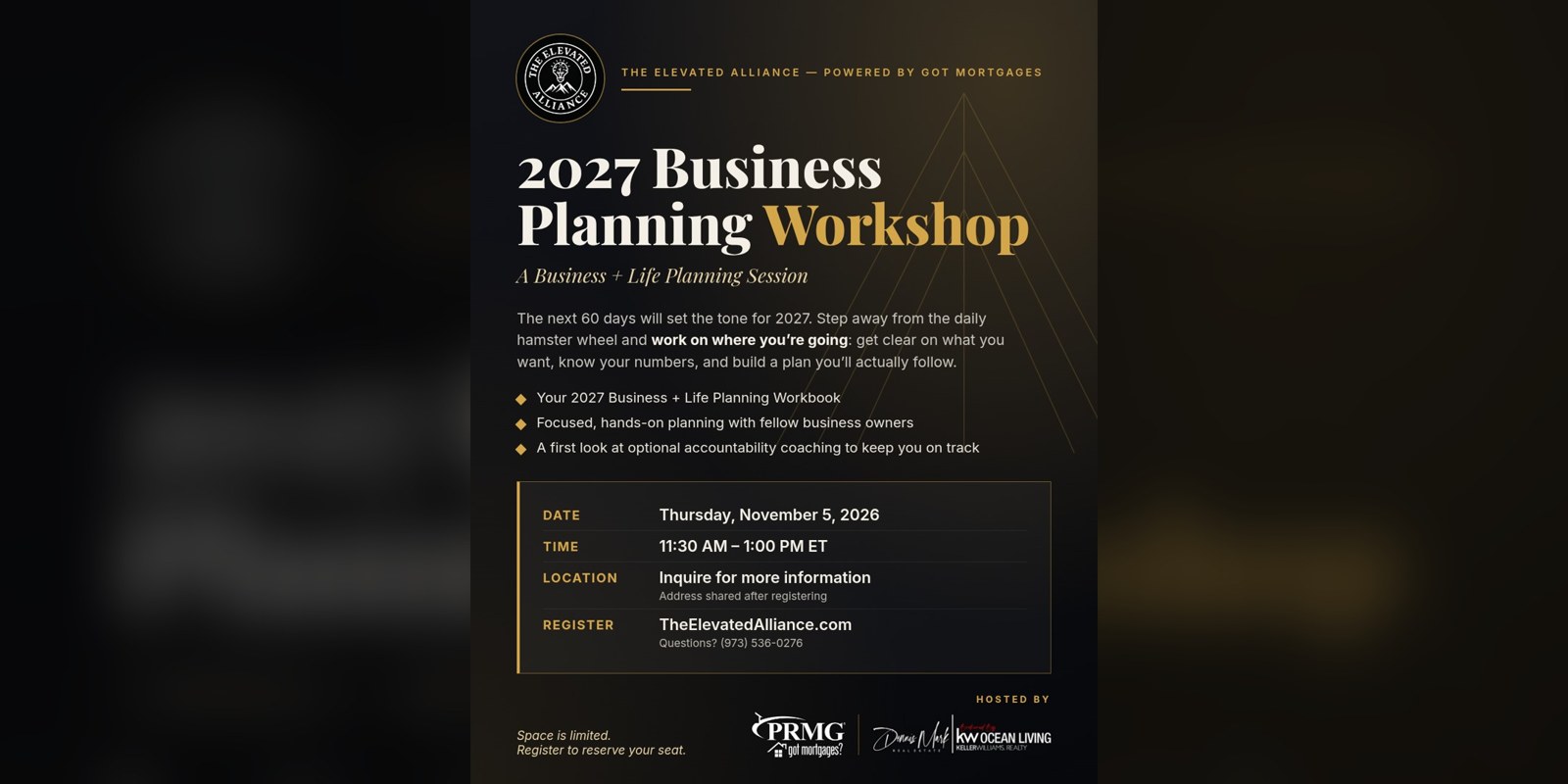
A good 2027 plan starts with an honest look at 2026. At The Elevated Alliance 2027 Business Planning Workshop on November 5, Abdel Khawatmi walked a room of business owners and real estate professionals cover to cover through the 2027 Business + Life Planning Workbook. The message was practical: measure the game, name the gap, choose no more than three outcomes, and turn them into daily and weekly activity you will actually follow.
Workshop held and recording published November 5, 2026. Recap added November 15, 2026.
Watch the original workshop recording on YouTube.
Key Takeaways: Business Planning Is Life Planning
Abdel opened the workshop by tying business results to the rest of life. "Faith, family, fitness, and finance," he reminded the room, and he set aside time to talk about significant others and how the people at home affect the business (0:00–1:23). The workbook is called a Business + Life Planning Workbook for a reason.
The workshop was hosted by The Elevated Alliance, which is powered by Got Mortgages, and was presented with co-host Dennis Mark of KW Ocean Living, whom Abdel credits with the deep dives the two of them have been doing into sharing resources across their businesses (1:35). The format was hands-on: work through each section, then go around the room and share what resonated and what each person wants to accomplish next year (1:23–1:35).
The core ideas are simple. Score the behaviors you control. Know your numbers cold. Find your biggest constraint and one thing to stop doing. Set three outcomes. Then protect the time it takes to hit them.
Measure the Game: Score the Behaviors You Control
"The most important part," Abdel said, is "measuring the game and then naming the gap" (1:35). Before setting goals, the workbook asks you to score yourself on controlling behaviors: daily lead generation, follow-up speed and consistency, referral partner relationships, client experience and reviews, and personal growth habits like reading and time blocking (4:51–7:40).
On lead generation, he warned against blind mass emails. Pay attention to how many people actually open and click what you send, because blasting a list with blind copies will get you flagged as spam quickly (4:51–7:01).
On reviews, he shared a habit from colleagues who meet clients in person: do not leave without asking for the five-star review, even if it feels a little awkward (7:40). The point is not the review alone. It is the exposure that comes from a client publicly vouching for you.
Relationship Capital: Never Eat Alone
Abdel recommended Never Eat Alone by Keith Ferrazzi as one of his favorite books of the year (7:01). The idea he highlighted is relationship capital. Everyone in the room is in sales, whatever their title, and the mistake is walking into a conversation thinking about how much business you can get. That is "the wrong way to look at" a relationship (7:01–7:40).
Near the end of the session he connected that idea to a line from his own coach: your client database is your annuity (26:45). For self-employed professionals, the relationships you have built are one of the most valuable assets in the business. Tools change. Social media changes. AI will keep changing. The relationships you keep are what last (28:09).
That is also why he encouraged the room to give new lead generation efforts a full quarter before judging them, especially on social media where nobody can predict the algorithm from one day to the next (25:40–26:45).
Know Your Numbers Cold, Then Put AI to Work
The workbook walks through the funnel every business owner should know: leads generated, appointments held, clients signed, sales closed, revenue collected and average revenue per client, plus the top lead sources behind your closed business so you can double down on what works and fix what does not (7:40–9:50).
Abdel's view is that this audit should not be a once-a-year exercise. "We could run this same audit every single month," he said, and connecting your calendar, email, CRM and closings to an AI platform means it no longer has to be done by hand (7:40–8:24). He described wanting his loan officers in one ecosystem, with one login and connected systems, so that when a client calls, the right information comes up immediately (2:35–4:51).
Even so, he still likes to print the workbook and write in it. Attendees received it as a PDF they could upload to their own AI tool for help, but he cautioned that an AI summary can miss a source only you know about, like a new referral relationship you have not started tracking yet (9:50–10:22).
Name the Gap: Your Why, Your Constraint, and One Thing to Stop
Next, the workbook asks you to start with your why and choose your one thing. Why do you wake up every day and do this work? Then name your biggest constraint, the one thing holding you back right now, and decide what you will stop doing in 2027 to make room for what matters (10:22–11:05).
Abdel shared his own example. His team hosts a lot of events, so he is consolidating them onto set days of the week and blocking those days for event work (10:22–11:05). Choosing what to stop is often harder than choosing what to start, which is exactly why the workbook asks for it in writing.
From there, set three annual outcomes and "no more than three" (11:05). For each one, the workbook asks what it would really require, what you would have to stop doing to get there, who will hold you to it, and what evidence will prove success (12:42).
Accountability and Clear Expectations
Abdel asked the room how many people have an accountability partner who is not their spouse. Whether it is a paid coach or a peer, he said he has always had at least one coach throughout his career, and he called it very important (12:42–13:27). Accountability works the way teachers did in school: someone outside your own head checking whether you did what you said.
He applies the same thinking to his team. When he delegates a task, he gives a clear expectation of how it should be done and a specific deadline (12:09). Without a deadline, a task can sit untouched for days. With one, people understand the urgency and the standard.
Turning outcomes into daily activity is, in his words, "probably one of the most important parts" (13:27). That includes knowing what share of your business comes from each source, so you can see where you are bringing value and where you are depending on a single channel (14:24).
Protect Your Capacity With Time Blocking
"It looks like Skittles," Abdel said of his calendar, because every type of work has its own color and there is always a time block (21:25). He does not take meetings on Monday mornings from nine to noon, because people are catching up and prospecting calls to attorneys, real estate agents and partners will not get their full attention then. He keeps set days for recruiting calls and set days for events (21:25–21:58).
The workbook asks you to estimate your available delivery hours per week and the average hours each outcome takes (21:58). If the math does not work, the plan does not work, no matter how motivated you feel in November.
He also encouraged the room to define the offer clients cannot refuse. Who is the ideal client who truly needs you, and what dream outcome are they after? For many businesses it comes down to proof, speed or ease (22:37–25:40). He shared how noticing a recurring client need led him and Dennis to start a group focused on divorce situations, a niche built around a real problem rather than a guess (22:37–24:26).
Final Checklist: Finish Your 2027 Workbook
Score your controlling behaviors honestly: lead generation, follow-up speed, referral relationships, reviews and personal growth.
Write down your numbers from leads to closed business, and your top sources. Plan to review them monthly, not once a year.
Name your why, your biggest constraint and the one thing you will stop doing. Then pick no more than three outcomes and an accountability partner who is not your spouse.
Block your calendar so the plan has room to happen, and give any new lead generation effort a full quarter before you judge it. To learn about upcoming Elevated Alliance sessions, visit TheElevatedAlliance.com.
Frequently asked questions
What was the 2027 Business Planning Workshop?
It was an in-person business and life planning session hosted by The Elevated Alliance, powered by Got Mortgages, on November 5, 2026. Abdel Khawatmi walked attendees through the 2027 Business + Life Planning Workbook with co-host Dennis Mark.
What does "measure the game, name the gap" mean?
It means scoring the behaviors you control and knowing your real numbers before you set goals. Once you can see where you are, you can name the gap between that and where you want to be in 2027.
Which behaviors does the workbook ask you to score?
Daily lead generation, follow-up speed and consistency, referral partner relationships, client experience and reviews, and personal growth habits like reading and time blocking. Each one is something you can control week to week.
How many annual outcomes should you set?
No more than three. For each one, the workbook asks what it would require, what you would have to stop doing, who will hold you accountable, and what evidence will prove success.
How often should you review your business numbers?
Abdel suggests running the same audit monthly rather than once a year. Connecting your calendar, email and CRM to an AI tool can make that review far less manual.
What is relationship capital?
It is the idea, from Keith Ferrazzi's book Never Eat Alone, that relationships are built by giving value rather than by asking how much business someone can send you. Abdel ties it to the line that your client database is your annuity.
How does Abdel time block his week?
His calendar has a color for every type of work. He avoids meetings on Monday mornings, reserves time for focused prospecting, and keeps set days for recruiting calls and for events.
How long should you test a new lead generation idea?
Abdel recommends letting it run for a full quarter, about 90 days, before deciding whether it works. That is especially true on social media, where results are hard to predict day to day.
To talk with PRMG Got Mortgages, call 973-536-0276, visit GotMortgages.com, contact the team or build your mortgage plan.
Explore more Got Mortgages Insights and Abdel Khawatmi’s profile. Explore more conversations at the Got Mortgages Podcast website.
Author: Abdel Khawatmi | NMLS 1712023 | Powered by PRMG Got Mortgages | NMLS 75243 | 973-536-0276
This article is general mortgage information only. It is not a commitment to lend, a rate quote, or legal or tax advice. Loan approval, terms and pricing depend on a full application, credit review and property details, and market conditions change. Talk with a licensed loan officer and your own legal or tax professional about your situation. NMLS #1712023 | PRMG NMLS #75243.