

MARKET UPDATE: 9-21-2026
Week of September 14, 2026 in Review
The Fed hiked rates for the first time in three years, while new home construction slowed and home contract signings edged up slightly from the previous month. Here's what you need to know.
- Fed Hikes Rates in Unanimous Vote
- New Home Construction Cools
- Pending Home Sales Tick Higher
- Quick Look: Spending and Unemployment
- Family Hack of the Week
- What to Watch Ahead
Fed Hikes Rates in Unanimous Vote
As widely expected, the Federal Reserve raised its benchmark Federal Funds Rate by 25 basis points. It was the Fed's first rate hike in three years and its first rate change this year, following five consecutive meetings where rates remained unchanged.
Keep in mind that the Fed Funds Rate is the overnight borrowing rate for banks and is not the same as mortgage rates.
Bottom line: The decision to raise rates was unanimous, with the Fed pointing to elevated inflation as a key reason for the move. When the Fed raises its benchmark rate, it generally aims to slow economic activity and put downward pressure on inflation.
In its statement, the Fed said, "Inflation remains elevated," and that the rate increase will support a return to its 2% inflation goal. Reinforcing that message at his post-meeting press conference, Chair Kevin Warsh said, "Inflation is too high and has been for too long." The Fed's latest projections also showed that 16 of 18 officials expect at least one more quarter-point hike this year. Warsh did not submit a projection.
New Home Construction Cools
New home construction slowed in August, with housing starts falling 2.6% from July to an annual pace of 1.28 million homes – below expectations. Housing starts measure homes where construction has begun.
Building permits, which can offer a glimpse into future construction, also declined 2.7% from July, reaching an annual pace of 1.39 million permits.
Builders remain cautious as well. The National Association of Home Builders Housing Market Index fell three points in September to 32. A reading below 50 means more builders view market conditions as poor than good. Higher mortgage rates, labor shortages, and elevated construction costs continue to weigh on builder confidence.
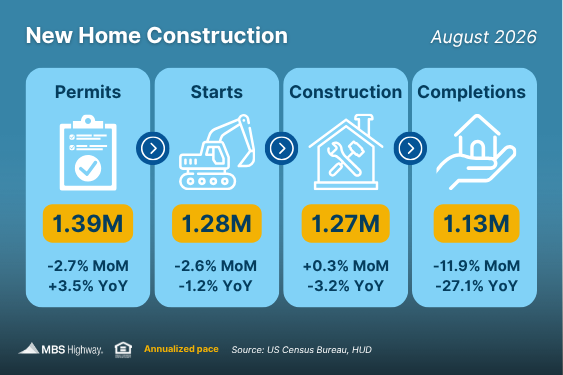
Bottom line: Housing demand remains relatively strong compared with the pace of new construction. Household formations, a measure of how many new households are being created, were running at an annual pace of about 1.4 million as of June 30. That pace may have eased somewhat as mortgage rates rose, but it still suggests demand is roughly in line with, or slightly above, the current pace of new housing supply.
The catch? New homes take time to reach the market. Builders have to navigate permitting, construction, and completion before buyers can move in. If mortgage rates decline and housing demand picks up, the limited supply of new homes could continue to support home prices in the months ahead.
Pending Home Sales Tick Higher
Pending home sales, which measure signed contracts for existing homes, edged up 0.3% from July to August. However, sales were still down 4.7% from a year ago, with all four U.S. regions posting year-over-year declines.
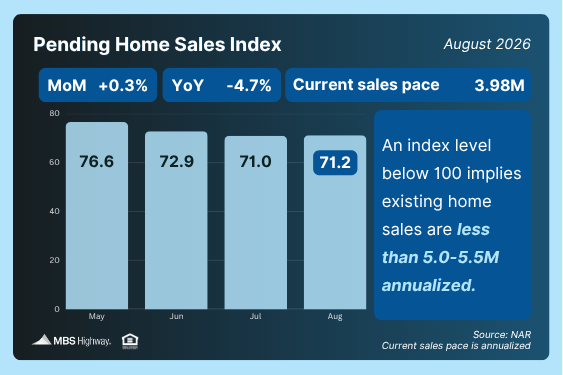
Bottom line: Higher mortgage rates are weighing on housing activity, but they haven't brought the market to a standstill. Buyers still "steadily entered into contracts" last month, according to NAR Chief Economist Lawrence Yun, even as overall sales remained below last year's pace.
Quick Look: Spending and Unemployment
Retail sales rose 1.2% in August, beating expectations. Higher gas prices helped drive stronger sales at gas stations, lifting the overall result. But the gains were broad-based: 12 of 13 retail categories saw sales increase, with back-to-school shopping likely providing an additional boost.
Unemployment claims have told a similar story in recent weeks. Initial claims remain relatively low, at around 196,000, but they may not capture the full extent of job losses if some workers turn to freelance or gig work instead of filing for benefits. At the same time, continuing claims remain elevated at 1.73 million, suggesting some job seekers are taking longer to find new employment.
Family Hack of the Week
Try these Chocolate Chip Pecan Cookies, perfect for fall and National Pecan Cookie Day on September 21. This recipe yields about 2 dozen cookies.
Line 2 baking sheets with parchment paper. In a large bowl, beat 1 stick room-temperature unsalted butter, 1/3 cup packed light brown sugar, and 1/3 cup granulated sugar with an electric mixer until fluffy. Add 1 teaspoon vanilla and 1 egg, and beat until combined.
In a medium bowl, whisk together 1 1/4 cups all-purpose flour, 1/2 teaspoon baking soda, and 1/2 teaspoon salt. Add the flour mixture to the butter mixture and beat until just combined. Stir in 1 cup milk chocolate chips and 1/2 cup roughly chopped pecans. Scoop slightly rounded tablespoons of dough, roll into balls, and place 2 inches apart on the prepared baking sheets. Refrigerate for 30 minutes. Position oven racks in the top and bottom thirds of the oven and preheat to 350 degrees Fahrenheit. Bake for 12 to 15 minutes, until the cookies are set and golden on the bottoms. Let cool on the baking sheets for 10 minutes, then transfer to racks to cool completely.
What to Watch Ahead
It's a quieter week for economic data, with New Home Sales and weekly jobless claims due Thursday.
Author: Abdel Khawatmi with PRMG Got Mortgages | 201-679-0422