
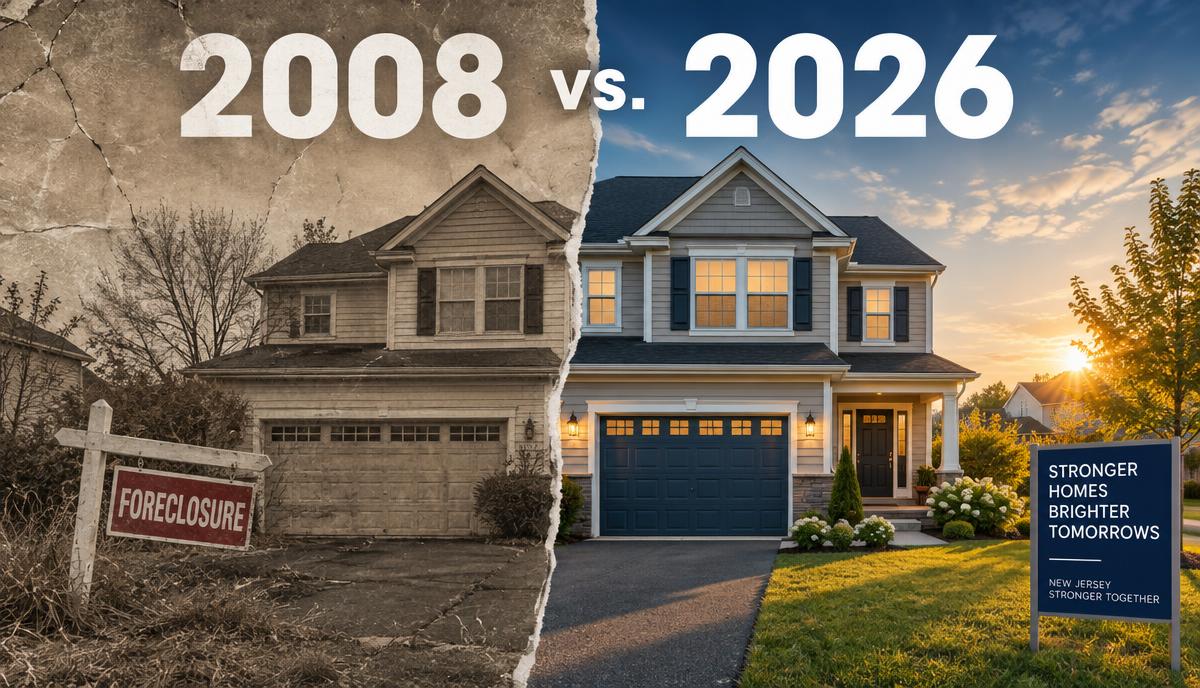
Quick answer
No. Today’s market is uncomfortable, but it is not a repeat of 2008. The 2008 crash was a mortgage and credit crisis driven by risky subprime lending, rising delinquencies and a wave of foreclosures. The 2026 market is mainly an affordability challenge: elevated mortgage rates are slowing sales and letting inventory build, while distressed sales remain only about 2% of national transactions.
Last Updated: September 25, 2026
Every time the housing market gets uncomfortable, I hear the same question: “Are we heading toward another 2008?” Higher mortgage rates, slower home sales, more inventory and buyers becoming more cautious all make the comparison feel natural, and I understand why people make it.
But uncomfortable does not automatically mean unhealthy, and the housing market we’re navigating today is fundamentally different from the market that led into the 2008 housing crisis. The biggest difference comes down to what is actually causing the slowdown.
What happened in 2008?
The housing crisis wasn’t simply caused by home prices getting too high. There were major problems inside the mortgage system itself. Risky subprime lending had expanded dramatically, and borrowers were frequently placed into adjustable-rate and other mortgage products that became difficult to sustain. As delinquencies increased and home prices weakened, foreclosures accelerated.
According to the Federal Reserve, by May 2008 approximately one-quarter of subprime adjustable-rate mortgages were 90 days or more delinquent or already in foreclosure. Foreclosure proceedings had also been initiated on approximately 1.5 million U.S. homes during 2007 alone.
That created a vicious cycle. Borrowers couldn’t make payments, so foreclosures increased. Distressed properties flooded the market, home values declined, and more homeowners found themselves underwater. Credit tightened, and the problem kept feeding itself. That was a mortgage and credit crisis, not simply a period of high mortgage rates.
What is happening in 2026?
Today’s market has a different problem: affordability. Mortgage rates remain elevated, and Freddie Mac reported the average 30-year fixed mortgage at 7.03% as of September 24, 2026. That absolutely affects purchasing power. (For the story behind this week’s rate move, read Why Mortgage Rates Hit 7.26%.)
But higher rates are also causing some buyers to stay on the sidelines, which is slowing transaction volume and allowing inventory to build. According to the National Association of REALTORS®, August 2026 ended with approximately 1.62 million existing homes available for sale, representing 4.9 months of supply — the highest months-of-supply level in more than a decade.
Here’s another important distinction. The national median existing-home sales price was $429,100 in August, still 1.6% higher than one year earlier, and distressed sales — foreclosures and short sales — represented only 2% of transactions. That doesn’t mean every housing market is appreciating or that prices can’t decline in individual markets. Real estate is local, and New Jersey towns can move differently from the national numbers. But nationally, these figures describe a very different environment from the foreclosure-driven crisis surrounding 2008.
2008 vs. 2026: what’s actually different?
| 2008 Housing Crisis | 2026 Housing Market |
|---|---|
| Major subprime mortgage problems | Affordability is a primary challenge |
| Rapidly increasing mortgage delinquencies | Distressed sales remain a small share of transactions |
| Large wave of foreclosures | No comparable national foreclosure wave |
| Falling prices amplified borrower distress | National median existing-home price remains above year-ago levels |
| Mortgage-credit crisis | Higher-rate and affordability challenge |
| Distressed inventory pressured sellers | Increasing inventory can give buyers additional negotiating leverage |
National statistics do not represent every local housing market. Conditions can vary significantly by state, county, municipality and property type.
The part buyers shouldn’t miss
Here’s where today’s market gets interesting. The same mortgage rates making buyers uncomfortable may also be creating opportunities for the buyers who remain active. When rates are lower and affordability improves, more buyers can qualify and more people tend to enter the market — and more buyers can mean more competition. Today, higher borrowing costs have removed some of that competition, and NAR has specifically noted that increased housing supply is giving buyers better opportunities to negotiate.
In practice, that can potentially mean fewer competing offers, more negotiating room on purchase price, seller concessions toward closing costs, seller-paid temporary or permanent rate buydowns when permitted, more time to perform proper due diligence, and a better chance of getting an offer accepted. For several years buyers were asking, “How much over asking do I need to offer?” Today, in some markets, the better question may be, “What can we negotiate?” That’s a very different housing environment.
For real estate professionals, this is the conversation to have with cautious clients: the headline rate is only one part of the deal, and structure — concessions, buydowns and terms — is where today’s leverage shows up. Our partner resources can help you model those scenarios with your buyers.
Don’t look only at the interest rate
This is where buyers need to look at the entire transaction instead of one number. Yes, mortgage rates matter. But so do the purchase price, seller concessions, property taxes, insurance, the monthly payment, closing costs, your future plans and how much competition exists for the property. In New Jersey especially, property taxes can change the monthly picture as much as the rate — our guide to closing costs in New Jersey and how much house you can afford in NJ walk through the full cost.
A buyer shouldn’t purchase a home simply because someone tells them they can refinance later. Nobody can guarantee where mortgage rates will go. But if the home fits your budget and long-term plans today, a higher-rate environment can sometimes provide negotiating opportunities that disappear when competition increases. Don’t only look at the interest rate — look at the opportunity the interest-rate environment may be creating.
You can potentially change the financing. You can’t change what you paid.
One phrase I use frequently with buyers is this: you may have the ability to refinance your mortgage later if market conditions and your financial situation make it worthwhile, but you cannot refinance the purchase price. And there’s another part people forget — you can’t go back six months later and buy the house somebody else already purchased.
That doesn’t mean buyers should rush. It means buyers should understand the difference between waiting because the numbers don’t work and waiting simply because they’re hoping for a perfect market. Perfect markets rarely exist. Different markets simply create different opportunities.
So, is this 2008 again?
The data today doesn’t describe the same housing and mortgage environment that existed during the 2008 crisis. In 2008, mortgage delinquencies, risky lending and foreclosures were central problems. In 2026, affordability and elevated mortgage rates are major obstacles, while inventory has been improving and distressed transactions remain a relatively small portion of the national market.
That distinction matters, because today’s market isn’t necessarily about waiting for everything to become easier. It may be about understanding where the current environment creates leverage. For some buyers, the opportunity right now may not be getting the lowest interest rate — it may be getting the house, negotiating better terms and getting the offer accepted. For more context on how Fed policy is shaping the market, see The Housing Market After the Fed in our Mortgage Intel library.
Let’s run the numbers before you make the decision
Every buyer, property and local market is different. Before deciding whether to buy now or wait, we can model the actual numbers: purchase price, down payment, monthly payment, seller concessions, potential buydowns and cash needed at closing. The goal isn’t to convince you to buy. The goal is to give you enough information to make an educated decision. Build your mortgage plan or call or text 201-679-0422, and visit GotMortgages.com.
Frequently Asked Questions
Is the 2026 housing market like 2008?
There are important differences. The 2008 housing crisis involved widespread mortgage distress, subprime lending problems and a major foreclosure wave. The 2026 market is being constrained primarily by affordability and elevated mortgage rates, while distressed transactions remain a small percentage of national existing-home sales.
Are home prices falling in 2026?
Housing conditions vary considerably by location. Nationally, the median existing-home sales price in August 2026 was $429,100, approximately 1.6% higher than August 2025, according to NAR.
Do buyers have more negotiating power right now?
In some markets, yes. National housing inventory increased to 4.9 months of supply in August 2026, and NAR has said the increased supply is providing buyers with better opportunities to negotiate. Local conditions can be significantly different.
Should I wait until mortgage rates fall before buying?
There is no single answer. Lower rates can improve affordability but may also bring additional buyers into the market. Buyers should compare today’s payment, purchase price, available concessions, competition and long-term plans rather than basing the decision solely on a prediction about future rates.
Sources
- Freddie Mac Primary Mortgage Market Survey — September 24, 2026
- National Association of REALTORS® Existing-Home Sales — August 2026
- Federal Reserve — Mortgage Delinquencies and Foreclosures, Ben Bernanke, May 5, 2008
Author: Abdel Khawatmi with PRMG Got Mortgages | 201-679-0422